Principles of Accounting is a study guide for O-Level Accounting. It was shared by a member of the books.co.zw community and is free to download with a free account.
File: PDF document, 42 KB, 7 pages. Preview the first page above before you download, and sign in with a free account to get the file.
Topics and key words
Words that appear again and again in this document, which is a quick way to see what it is about: credit, cash, sales, bank, account, capital, profit, accounting, debit, current, balance, purchases, cost and assets.
Text taken from the document
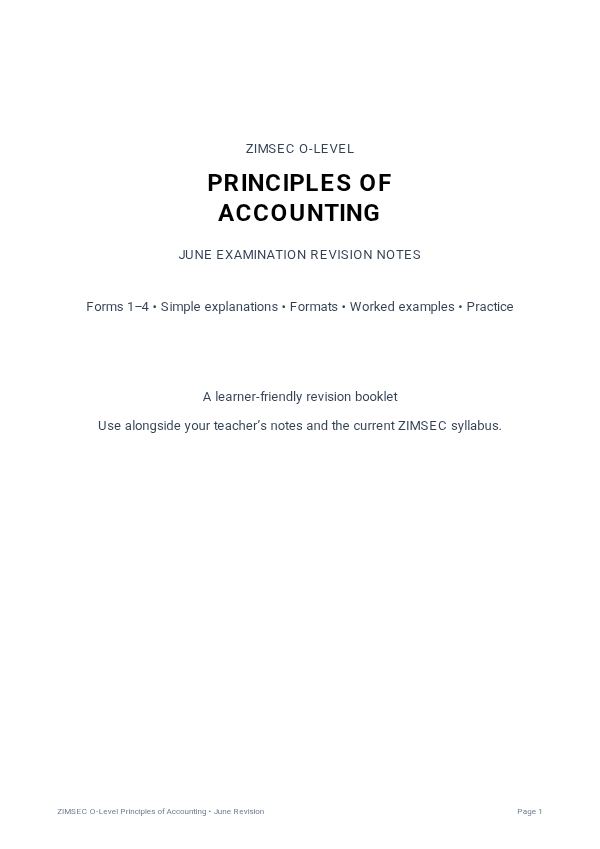
ZIMSEC O-LEVEL
PRINCIPLES OF
ACCOUNTING
JUNE EXAMINATION REVISION NOTES
Forms 1–4 • Simple explanations • Formats • Worked examples • Practice
A learner-friendly revision booklet
Use alongside your teacher’s notes and the current ZIMSEC syllabus.
ZIMSEC O-Level Principles of Accounting • June Revision Page 1
How to use this booklet
Revise one topic at a time. Practise writing accounts and statements in the correct format. Always show workings,
label figures clearly and check that totals agree.
June revision routine: 30–45 minutes per day: revise a concept, copy one format from memory, then answer a
short question. At weekends, attempt a timed past-paper question.
Contents
• 1. Accounting basics and accounting equation
• 2. Source documents and books of original entry
• 3. Double entry and ledger accounts
• 4. Trial balance and errors
• 5. Cash book and petty cash
• 6. Final accounts of a sole trader
• 7. Year-end adjustments
• 8. Bank reconciliation
• 9. Control accounts and incomplete records
• 10. Ratios and non-trading concerns
• 11. Exam practice and answers
1. Accounting basics and accounting equation
What is accounting?
Accounting is the process of identifying, recording, classifying, summarising and communicating financial
information to help people make decisions.
Important terms
Term Meaning
Assets Things/resources owned or controlled by the business (cash,
stock, equipment, debtors).
Liabilities Amounts the business owes (loans, creditors).
Capital Owner’s investment in the business. It increases with extra
capital and profit; decreases with drawings and loss.
Drawings Cash or goods taken by the owner for personal use.
Revenue Income earned from selling goods or providing services.
Expenses Costs incurred to earn revenue.
Debtor A customer who owes the business.
Creditor A supplier the business owes.
Accounting equation: Assets = Capital + Liabilities. Rearranged: Capital = Assets − Liabilities.
Example: Assets $8,000; liabilities $2,500. Capital = $8,000 − $2,500 = $5,500.
2. Source documents and books of original entry
ZIMSEC O-Level Principles of Accounting • June Revision Page 2
What Accounting at O-Level usually covers
Accounting at O-Level typically covers recording transactions, preparing financial statements, cost and management accounting, and analysing results. Not every study guide tests every topic, so check the contents and the text on this page to see what this one includes, and your teacher’s syllabus to see what is expected.
Exam tip: Check that totals balance before you move on.
How to use this study guide
Skim the whole document first to see how it is organised.
Read one section at a time and close the file to write what you remember.
Turn each heading into a question and answer it from memory.
Mark the parts you could not explain and go back to your class notes for them.
Finish by trying questions on the same topic from past papers in Accounting.
Questions people ask
What is Principles of Accounting?
It is a study guide in Accounting for O-Level, shared by a member of the community.
Is the download free?
Yes. You need a free books.co.zw account to download, and you can read this page and see the first-page picture without one.
Which file type is it?
It is a PDF file of 42 KB. Phones and computers can open it with the usual document viewer.
Is the file safe?
Every upload is checked automatically for hidden programs, macros and viruses before and after it is published, and readers can report a problem with any file.