books.co.zw
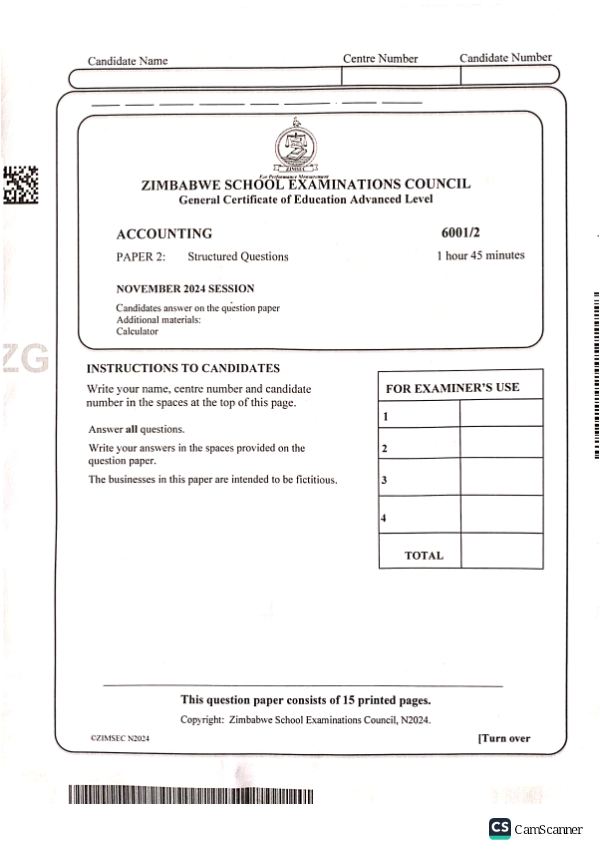
First page of A-Level Accounting 2024 Marking Scheme

A-Level Accounting 2024 Marking Scheme

A-Level · Accounting · Marking Scheme · 2024. Shared by a member of the books.co.zw community.

A free account is needed to download. Sign in or create one

Subject
Accounting
Level
A-Level
Document
Marking Scheme
Year
2024
Pages
15
Language
English
File
PDF, 2.9 MB
Added
2026-11-20
Shared by
the books.co.zw community

About this marking scheme

This is an A-Level Accounting marking scheme from the 2024 exams. Working through a real paper under exam conditions is one of the quickest ways to find out which topics still need revision.

A marking scheme shows what an examiner expects to see for each mark. Compare your own working with it line by line, and notice where marks are given for method rather than for the final answer.

File: PDF document, 2.9 MB, 15 pages. Preview the first page above before you download, and sign in with a free account to get the file.

Topics and key words

Words that appear again and again in this document, which is a quick way to see what it is about: sales, account, balance, cash, control, credit, receivables, entry, trade, correctly, customers, debts, ledger and omitted.

Text taken from the document

Candidate Name
Centre Number Candidate Number
a ZIMBABWE SCHOOL EXAMINATIONS COUNCIL
General Certificate of Education Advanced Level
ACCOUNTING
PAPER 2: Structured Questions
NOVEMBER 2024 SESSION
Candidates answer on the question paper
Additional materials:
Calculator
1 hour 45 minutes
INSTRUCTIONS TO CANDIDATES
Write your name, centre number and candidate
number in the spaces at the top of this page.
Answer all questions.
Write your answers in the spaces provided on the
question paper.
The businesses in this paper are intended to be fictitious.
FOR EXAMINER’S USE
TOTAL
LS ©ZIMSEC N2024
This question paper consists of 15 printed pages.
Copyright: Zimbabwe School Examinations Council, N2024.
[Turn over
CamScanner
Give a reason why a sales ledger account might have a credit balance.
The control account of Shenny, a sole trader was prepared by an
inexperienced bookkeeper as follows:
Trade receivables control account
January 1 Balance b/d
December 31 Sales returns
Bad debts written off
Credit customers’
cheques dishonoured
Set off
Provision for doubtful
debts
Balance c/d
Credit sales 164 816
Discount allowed 4819
Cash and cheques
received from credit
customers 63 221
Cash refund to credit
customers 612
Cash sales 10 000
January 1 Balance b/d 186 817
Prepare a corrected trade receivables control account.
A sales ledger schedule containing the individual receivables accounts had a
balance of $107 589.
Subsequently, the following errors were discovered:
(i) Debts amounting to $501 which were previously written off were
recovered. The figure was correctly recorded in the cash book but no
other entry was made.
(ii) | Accredit note of $1 750 sent to a customer had been entered in the sales
day book.
(iii) A sales invoice of $9 852 had been completely omitted from the books.
(iv) A contra entry of $650 had been omitted in the control account.
(v) The total cash received included $1 000 which was received from
disposal of an old motor vehicle.
(vi) An entry in the sales day book of $351 was missing from the sales total
but was recorded correctly in the sales ledger.
(vii) A receipt of $915 was correctly debited to the bank but posted as $951
: to the trade receivables account.
(viii) A personal account balance of $417 had been omitted from the list of
balances.
(ix) Discount allowed had been overstated by $320,
(x) Acustomer owing $250 was declared bankrupt. The debt was written
off in the control account but no entry had been made in the trade
receivables account. …

What Accounting at A-Level usually covers

Accounting at A-Level typically covers recording transactions, preparing financial statements, cost and management accounting, and analysing results. Not every marking scheme tests every topic, so check the contents and the text on this page to see what this one includes, and your teacher’s syllabus to see what is expected.

Exam tip: Check that totals balance before you move on.

How to use this marking scheme

  1. Print the paper or open it on a large screen, and keep a pencil and a calculator nearby.
  2. Set a timer for the time allowed on the first page, and do not look at notes.
  3. Answer every question you can, and leave a mark next to the ones you guessed.
  4. Mark your own attempt with this scheme, giving marks only where the scheme gives them.
  5. Write down the topics where you lost marks and revise those first.
  6. Repeat with another year of the same paper a few days later, and compare your scores.

A seven-day plan using this marking scheme

  1. Day 1: read through it and sort the questions into those you can do, those you half know and those you cannot start.
  2. Day 2 and 3: revise the topics behind the questions you could not start, using your notes and textbook.
  3. Day 4: do the whole paper again under exam conditions with a timer.
  4. Day 5: mark it carefully and list every mark you lost and why: knowledge, method, careless error or time.
  5. Day 6: fix those mistakes by rewriting the answers you got wrong in full.
  6. Day 7: rest, then try a paper from another year to check that the improvement is real.

Questions people ask

What is A-Level Accounting 2024 Marking Scheme?

It is an A-Level Accounting marking scheme from 2024, shared by a member of the community.

Is this the real exam paper?

It is a copy shared by a member of the community. Check the first page picture above and compare it with the paper your teacher gave you.

Is the download free?

Yes. You need a free books.co.zw account to download, and you can read this page and see the first-page picture without one.

Which file type is it?

It is a PDF file of 2.9 MB. Phones and computers can open it with the usual document viewer.

Is the file safe?

Every upload is checked automatically for hidden programs, macros and viruses before and after it is published, and readers can report a problem with any file.
More Accounting from the community