ExamineAI
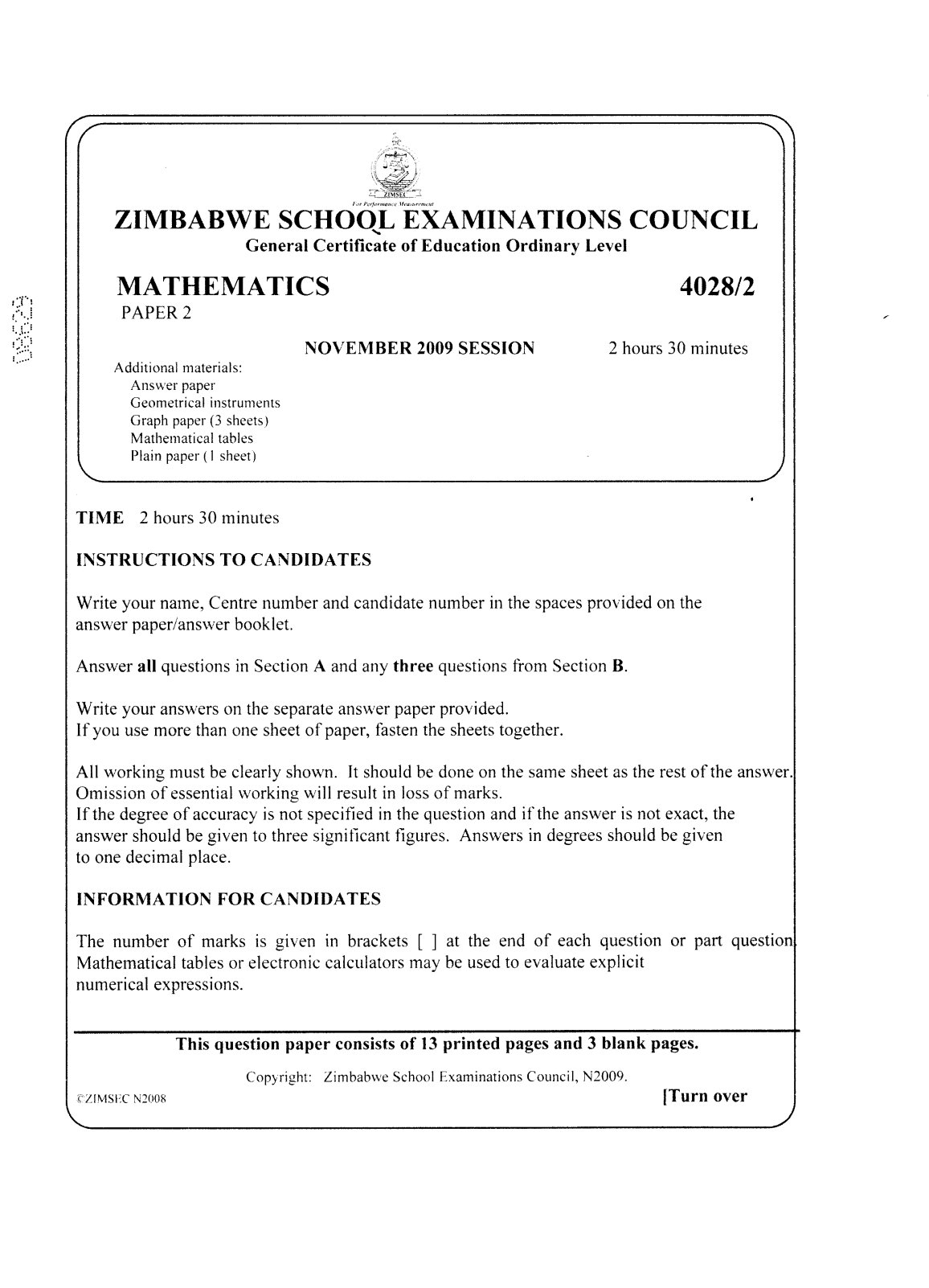
First page of ZIMSEC O-Level Mathematics Paper 2 November 2009 Question Paper

ZIMSEC O-Level Mathematics Paper 2 November 2009 Question Paper

Download and practise with this ZIMSEC O-Level Mathematics Paper 2 November 2009 question paper. Useful for exam revision, past paper practice, and preparation in Zimbabwe.

A free account is needed to download. Sign in or create one

Exam board
ZIMSEC
Subject
Mathematics
Level
O-Level
Document
Question Paper
Paper
Paper 2
Paper code
4028/2
Time allowed
2 hours 30 minutes
Session
November
Year
2009
File
PDF, 379 KB

About this question paper

This is the ZIMSEC O-Level Mathematics question paper for Paper 2 from November 2009. Use it for exam practice under timed conditions. The paper code is 4028/2. Time allowed: 2 hours 30 minutes.

More Mathematics O-Level 2009 papers

Other years: Mathematics O-Level

Extracted text

# ZIMBABWE SCHOOL EXAMINATIONS COUNCIL

**General Certificate of Education Ordinary Level MATHEMATICS**

**4028/2**

## PAPER 2

**NOVEMBER 2009 SESSION**

**2 hours 30 minutes**

**Additional materials:**
Answer paper
Geometrical instruments
Graph paper (3 sheets)
Mathematical tables
Plain paper (1 sheet)

TIME 2 hours 30 minutes

### INSTRUCTIONS TO CANDIDATES

Write your name, Centre number and candidate number in the spaces provided on the answer paper/answer booklet.

Answer all questions in Section **A** and any three questions from Section **B**.

Write your answers on the separate answer paper provided.
If you use more than one sheet of paper, fasten the sheets together.
All working must be clearly shown. It should be done on the same sheet as the rest of the answer.
Omission of essential working will result in loss of marks.
If the degree of accuracy is not specified in the question and if the answer is not exact, the answer should be given to three significant figures. Answers in degrees should be given to one decimal place.

### INFORMATION FOR CANDIDATES

The number of marks is given in brackets [ ] at the end of each question or part question. Mathematical tables or electronic calculators may be used to evaluate explicit numerical expressions.

**This question paper consists of 13 printed pages and 3 blank pages.**

Copyright: Zimbabwe School Examinations Council, N2009.

**Section A [64 marks]**

Answer all the questions in this section.

## Question 1
### (a)

Simplify \(8-24 \div 6+3 \times 4\).

### (b)

Expand \((1-2 x)(x+3)\).

### (c)

#### (i)

Find the L.C.M. of

$$
15 y^{2}, 25 x y^{3} \text { and }\left(x^{3}-x^{2}\right) .
$$

#### (ii)

Evaluate \(\left(\log _{9} 81\right) \times\left(2 \log _{4} 8\right)\).

## Question 2
### (a)

Solve the equations

#### (i)

\(7(h+3)-2(h-4)=4\),

#### (ii)

\(3^{(m+4)}=9^{(m-1)}\).

### (b)

Write down, in set notation, the set represented by the shaded region in the Venn diagram.

![](https://ocr.unopasa.com/p/ocr_assets/f1340ca2b26a12f18e70d940bc9225df2188d0ca8305173b1e2948673f137570.jpg)

### (c)

It is given that

$$
\begin{aligned}  |  \xi=\{x: 2 \leq x \leq 20, x \text { is an integer }\},   |  \mathrm{P}=\{x: x \text { is a prime number }\} \text { and }   |  \mathrm{Q}=\{x: 4 \leq x<17\} .
\end{aligned}
$$

#### (i)

List the elements of P.

#### (ii)

Find \(n\left(Q^{1} \cap P\right)\).

## Question 3
### (a)

Simplify \(\frac{n-3}{6} \div \frac{n^{2}-9}{4}\).

### (b)

Given that \(\mathbf{A}=\left(\begin{array}{ll}2  |  3\end{array}\right)\) and \(\mathbf{B}=\left(\begin{array}{cc}4  |  -1  5  |  6\end{array}\right)\), find

#### (i)

AB ,

#### (ii)

\(\mathrm{B}^{-1}\).

### (c)

If \(\left(\begin{array}{cc}-2  |  p  p+3  |  -4 p\end{array}\right)\) is singular, find the two possible values of \(p\).

### (d)

A company invested money in a bank at \(270 \%\) simple interest per annum. Given that after 8 months, the total value of its investment was \($ 840\) million, calculate the amount invested.

## Question 4
### (a)

![](https://ocr.unopasa.com/p/ocr_assets/80b862f23902f9ff24ceb5509f178e100ce9fca2dc159c897cd257357f1e94b4.jpg)

The diagram shows two squares ABCD and PQRS . Given that \(\mathrm{AB}=12 \mathrm{~cm}\), calculate

#### (i)

the perimeter of PQRS ,

#### (ii)

the area of \(\triangle Q R S\).

### (b)

Sibongile's weekly wage W (in thousands of dollars), is partly constant and partly varies as the number of hours N of overtime she works per week.

#### (i)

Express W in terms of N and constants \(h\) and \(k\).

#### (ii)

Given that when \(\mathrm{W}=80, \mathrm{~N}=10\) and when \(\mathrm{W}=60, \mathrm{~N}=6\), find the value of \(h\) and the value of \(k\).

#### (iii)

Sibongile's normal working time is 44 hours in a week.

Find the total number of hours worked in a week in which she was paid $90 thousand.

## Question 5
### (a)

The volume, \(V\), of material needed to make a cylindrical tube of internal radius \(r\), external radius \(R\) and length \(h\) is given by the formula

$$
\mathrm{V}=\pi\left(\mathrm{R}^{2}-r^{2}\right) h
$$

#### (i)

Taking \(\pi\) to be \(\frac{22}{7}\), find the value of V when \(\mathrm{R}=4 \mathrm{~cm}, r=3 \mathrm{~cm}\) and \(h=150 \mathrm{~cm}\).

#### (ii)

Make R the subject of the formula.

### (b)

A solid cuboid of density \(0,7 \mathrm{~g} / \mathrm{cm}^{3}\) measures 8 cm by 7 cm by \(x \mathrm{~cm}\) and has a total surface area of \(442 \mathrm{~cm}^{2}\).

Calculate

#### (i)

the value of \(x\),

#### (ii)

the mass of the solid.

## Question 6
### (a)

Factorise completely \(3 \mathrm{p}^{2}+7 \mathrm{p}-6\).

### (b)

![](https://ocr.unopasa.com/p/ocr_assets/b9cec3564e0ad9ad981cc2f9a399eaeb2b0a551ae6eae3e73936e99eca9933df.jpg)

#### (i)

Using the graph, write down three inequalities other than \(3 y+x \leq 21\) which satisfy the region \(\boldsymbol{R}\).

#### (ii)

Find the maximum value of 5y-x for integer values of \(x\) and \(y\) in \(\boldsymbol{R}\).

**Section B [36 marks]**

Answer any three questions in this section.

**Each question carries 12 marks.**

## Question 7
### (a)

![](https://ocr.unopasa.com/p/ocr_assets/58814eb19b7d2442ea6db586acc0578fddc4a31f48f0120fa2ba83de7672e640.jpg)

In the hexagon \(\mathbf{P Q R S T U}\), the lines \(\mathbf{P Q}\) and \(\mathbf{U T}\) are parallel. \(\mathbf{U} \hat{\mathbf{P Q}}=y^{\circ} \hat{\mathrm{PQR}}=130^{\circ}, \hat{\mathrm{RS}}=5 y^{\circ}, \hat{\mathrm{RST}}=155^{\circ}\) and \(\hat{\mathrm{STU}}=(180-2 y)^{\circ}\).

#### (i)

Write down an expression, in terms of \(y\), for PUTT.

#### (ii)

Using the sum of interior angles of the hexagon, form an equation in terms of \(y\) and solve it.

#### (iii)

Hence, write down the numerical value of QRS .

### (b)

#### (i)

Show that the equation

$$
\frac{1}{2 x-5}+\frac{2}{3}=\frac{1}{x+3}
$$

reduces to \(4 x^{2}-x-6=0\).

#### (ii)

Hence solve the equation \(4 x^{2}-x-6=0\). giving your answers correct to two decimal places.

## …