ExamineAI
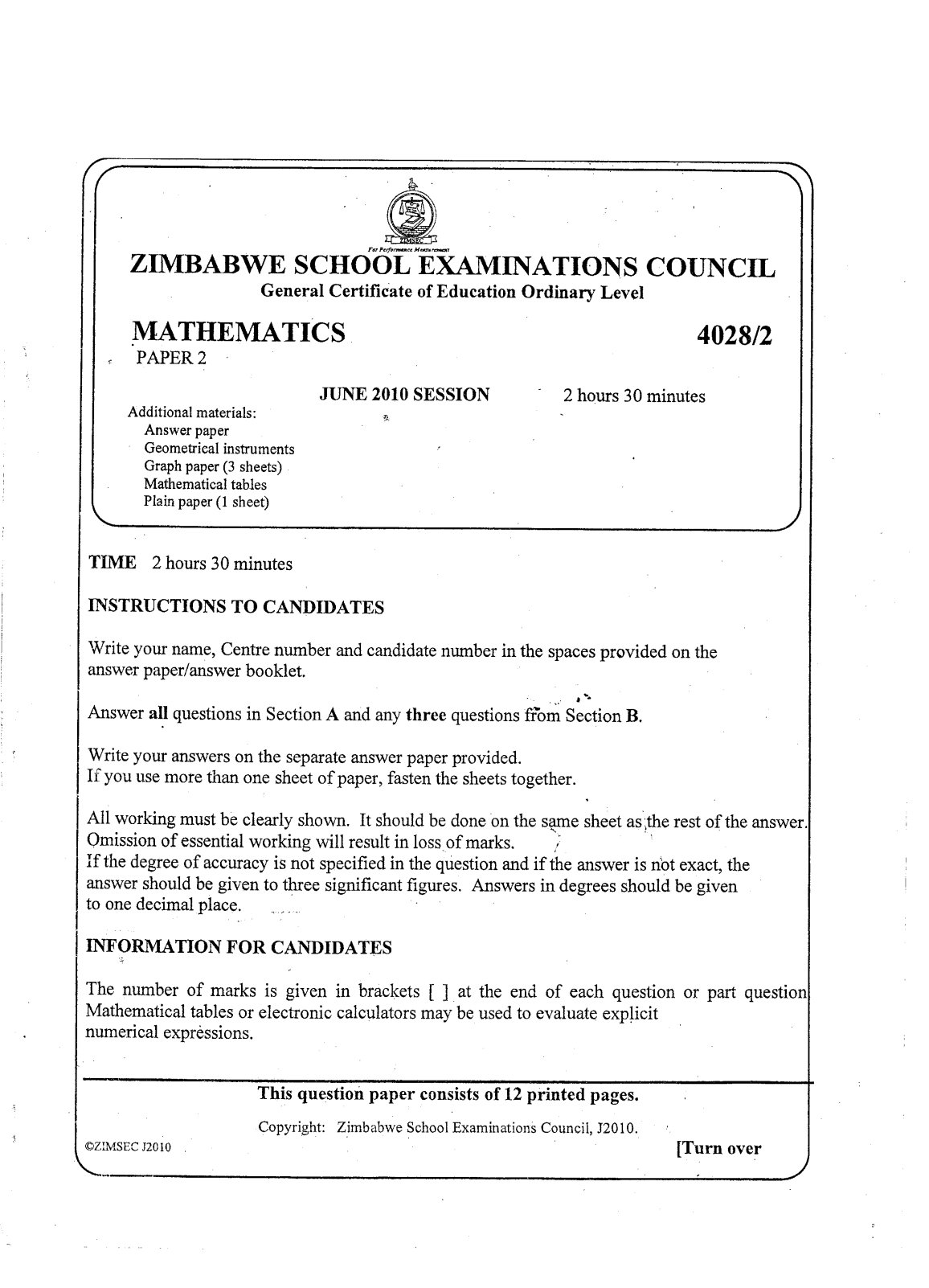
First page of ZIMSEC O-Level Mathematics Paper 2 June 2010 Question Paper

ZIMSEC O-Level Mathematics Paper 2 June 2010 Question Paper

Download and practise with this ZIMSEC O-Level Mathematics Paper 2 June 2010 question paper. Useful for exam revision, past paper practice, and preparation in Zimbabwe.

A free account is needed to download. Sign in or create one

Exam board
ZIMSEC
Subject
Mathematics
Level
O-Level
Document
Question Paper
Paper
Paper 2
Paper code
4028/2
Time allowed
2 hours 30 minutes
Session
June
Year
2010
File
PDF, 272 KB

About this question paper

This is the ZIMSEC O-Level Mathematics question paper for Paper 2 from June 2010. Use it for exam practice under timed conditions. The paper code is 4028/2. Time allowed: 2 hours 30 minutes.

More Mathematics O-Level 2010 papers

Other years: Mathematics O-Level

Extracted text

# ZIMBABWE SCHOOL EXAMINATIONS COUNCIL

General Certificate of Education Ordinary Level
MATHEMATICS
4028/2

## PAPER 2

JUNE 2010 SESSION
Additional materials:
2 hours 30 minutes
Answer paper
Geometrical instruments
Graph paper (3 sheets)
Mathematical tables
Plain paper (1 sheet)

TIME 2 hours 30 minutes

### INSTRUCTIONS TO CANDIDATES

Write your name, Centre number and candidate number in the spaces provided on the answer paper/answer booklet.

Answer all questions in Section A and any three questions from Section B.
Write your answers on the separate answer paper provided.
If you use more than one sheet of paper, fasten the sheets together.
All working must be clearly shown. It should be done on the same sheet as the rest of the answer.
Omission of essential working will result in loss of marks.
If the degree of accuracy is not specified in the question and if the answer is not exact, the answer should be given to three significant figures. Answers in degrees should be given to one decimal place.

### INFORMATION FOR CANDIDATES

The number of marks is given in brackets [ ] at the end of each question or part question Mathematical tables or electronic calculators may be used to evaluate explicit numerical expressions.

## This question paper consists of 12 printed pages.

Copyright: Zimbabwe School Examinations Council, J2010.

**Section A [64 marks]**

Answer all the questions in this section.

## Question 1
### (a)

Remove brackets and simplify the expression \(3(5-x)-2 x(x+3)\).

### (b)

Integers \(x, y\) and \(z\) are such that
\(x \leq 6, y \geq-2\) and \(-6 \leq z \leq 4\).

Find (i) the least possible value of \(y z^{2}\)

(ii) the greatest possible value of \(x-y\),

### (c)

Factorise completely \(125 p^{3}-5 p\).

[Total :9]

## Question 2
### (a)

Express 252 as a product of its prime factors.

### (b)

120 kg of a certain metal has a volume of \(0,4 \mathrm{~m}^{3}\). Find the density of the metal, giving your answer in \(\mathrm{g} / \mathrm{cm}^{3}\).

### (c)

It is given that \(\xi=\{1 ; 2 ; 3 ; 5 ; 7 ; 8 ; 9 ;\}\),
\(A=\{3 ; 5\}\),
\(\mathrm{B}=\{1 ; 3 ; 7 ; 9\}\) and \(\mathrm{C}=\{1 ; 7 ; 9\}\)

(i) Draw a fully labelled Venn diagram to show all the elements in each subset.

(ii) Write down the elements of the following subsets

(a) \(\quad A \cap B \cap C^{\prime}\),

(b) \((A \cup B)^{1} U C\).

## Question 3
### (a)

![](https://ocr.unopasa.com/p/ocr_assets/276231e9e5c5556afeee9093bd547b6ef8f1fe31eb9ae7eab19d31c6a9b0bd6e.jpg)

In the diagram, \(A C E\) and \(A B D\) are straight lines, \(A B=B C=C D\) and \(B \hat{A} C=x^{0}\).

(i) Express in terms of \(x\)

(a) \(\quad C \hat{B} D\),

(b) \(\quad D \hat{C} E\),

(c) \(B \hat{C} D\).

(ii) If \(\mathrm{AC}=\mathrm{AD}\), find the numerical value of \(x\).

### (b)

Given that \(\mathbf{M}=\left(\begin{array}{ll}a  |  b  c  |  d\end{array}\right), \mathbf{N}=\left(\begin{array}{cc}4  |  -2  3  |  0\end{array}\right)\) and \(3 \mathbf{M}+\mathbf{N}=\mathbf{M}\), find

(i) the matrix \(M\),

(ii) \(\quad \mathrm{N}^{2}\).

## Question 4
Two variables R and V are connected by the equation \(\mathrm{R}=\mathrm{kV}+\mathrm{c}\), where k and c are constants.

### (a)

Write down the type of variation between R and V .

### (b)

If the graph of \(\mathrm{R}=\mathrm{kV}+\mathrm{c}\) is drawn with R on the vertical axis, write down, in terms of k and/or c the coordinates of the point where the graph crosses

(i) the vertical axis,

(ii) the horizontal axis.

### (c)

Make V the subject of the equation \(\mathrm{R}=\mathrm{kV}+\mathrm{c}\).

### (d)

Given that \(\mathrm{R}=14\) when \(\mathrm{V}=6\) and that \(\mathrm{R}=8\) when \(\mathrm{V}=2\),

(i) form a pair of simultaneous equations in k and c ,

(ii) hence find the numerical value of k and the numerical value of c .

## Question 5
### (a)

In a school with 1050 pupils, \(\frac{4}{7}\) of the pupils were boys. One quarter of the boys were suspended for misbehaviour.

(i) Find the number of boys suspended.

(ii) Express the number of girls as a fraction of the remaining pupils.

(iii) If two pupils were chosen at random from the remaining pupils to testify, find the probability that the two pupils were of the same sex.

### (b)

![](https://ocr.unopasa.com/p/ocr_assets/1237b94cd6ee62b16ec2c85d5d2129d269244850efa283cfaf022bc0659dbc61.jpg)

In the diagram, \(\mathrm{P}, \mathrm{Q}, \mathrm{R}\) and S are points on the circumference of the circle with centre O . OS is parallel to QR and \(P \hat{R} Q=54^{\circ}\). POR is a straight line.

Calculate

(i) \(R O \hat{S}\),

(ii) \(R \hat{P} S\),

(iii) \(P \hat{Q} S\).

## Question 6
Answer the whole of this question on a sheet of plain paper.

Use ruler and compasses only for all constructions and show all construction lines and arcs.

### (a)

Construct on a single diagram

(i) quadrilateral ABCD in which \(\mathrm{AB}=8 \mathrm{~cm}, A \hat{B} C=90^{\circ}\); \(B \hat{C} D=120^{\circ}, \mathrm{BC}=10 \mathrm{~cm}\) and \(\mathrm{CD}=5 \mathrm{~cm}\),

(ii) the locus of points equidistant from B and C ,

(iii) the locus of points equidistant from DC and DA .

### (b)

(i) Mark and label the point P which is equidistant from B and C and equidistant from DC and DA.

(ii) Draw a circle with centre P and radius PC .

(iii) Measure and write down the length of PC.

**Section B [36 marks]**

Answer any three questions in this section.

## Question 7
![](https://ocr.unopasa.com/p/ocr_assets/2c0ca106dbc6d6120954ec9c69ce65ef4d9aba90dfcb3000279d8b3b161bb48a.jpg)

In the diagram, PQ is parallel to \(\mathrm{OR}, P M=\frac{1}{3} P R, \overrightarrow{O P}=2 \mathbf{a}\) and \(\overrightarrow{O R}=3 \mathbf{b}\).

### (a)

Express in terms of \(\mathbf{a}\) and/or \(\mathbf{b}\)

(i) \(\overrightarrow{P R}\),

(ii) \(\overrightarrow{P M}\),

(iii) \(\overrightarrow{O M}\).

### (b)

(i) Given that \(\mathrm{PQ}=\mathrm{hOR}\), write down in terms of \(\mathrm{h}, \mathbf{a}\) and/or \(\mathbf{b}\) an expression for

(a) …