ExamineAI
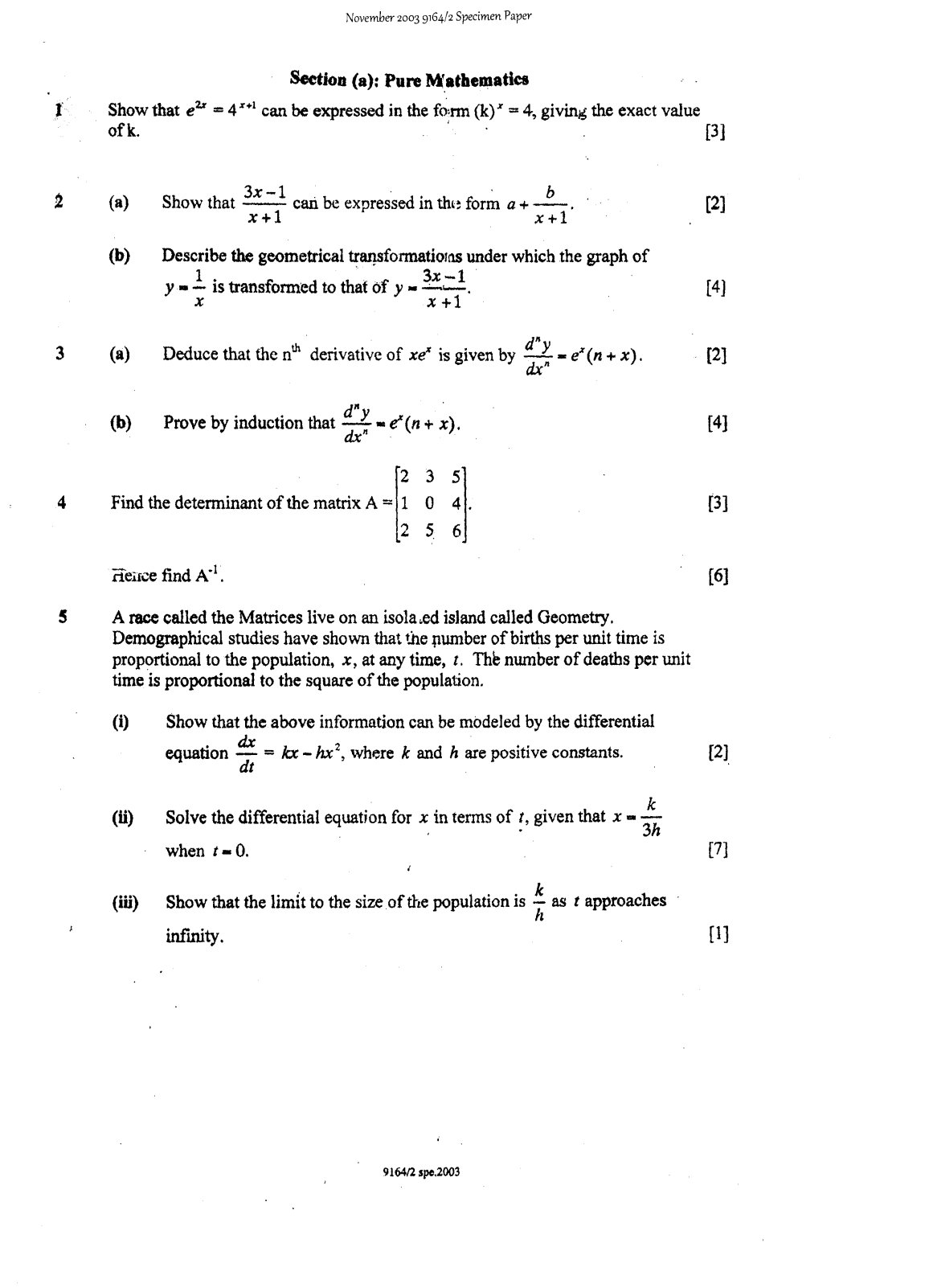
First page of ZIMSEC A-Level Pure Mathematics Paper 2 November 2003 Question Paper

ZIMSEC A-Level Pure Mathematics Paper 2 November 2003 Question Paper

Download and practise with this ZIMSEC A-Level Pure Mathematics Paper 2 November 2003 question paper. Useful for exam revision, past paper practice, and preparation in Zimbabwe.

A free account is needed to download. Sign in or create one

Exam board
ZIMSEC
Subject
Pure Mathematics
Level
A-Level
Document
Question Paper
Paper
Paper 2
Paper code
9164/2
Session
November
Year
2003
File
PDF, 152 KB

About this question paper

This is the ZIMSEC A-Level Pure Mathematics question paper for Paper 2 from November 2003. Use it for exam practice under timed conditions. The paper code is 9164/2.

Other years: Pure Mathematics A-Level

Text from the first page

November 2003 9164/2 Specimen Paper

Section (a): Pure Mathematics
1 Show that $e^{2 x}=4^{x+1}$ can be expressed in the form $(\mathrm{k})^{x}=4$, giving the exact value of $k$.

[3]

2 (a) Show that $\frac{3 x-1}{x+1}$ can be expressed in the form $a+\frac{b}{x+1}$.

[2]
(b) Describe the geometrical transformations under which the graph of $y=\frac{1}{x}$ is transformed to that of $y=\frac{3 x-1}{x+1}$.

[4]
3
(a) Deduce that the $\mathrm{n}^{\text {th }}$ derivative of $x e^{x}$ is given by $\frac{d^{n} y}{d x^{n}}=e^{x}(n+x)$.

[2]
(b) Prove by induction that $\frac{d^{n} y}{d x^{n}}=e^{x}(n+x)$.

[4]

4 Find the determinant of the matrix $A=\left[\begin{array}{lll}2  |  3  |  5  1  |  0  |  4  2  |  5  |  6\end{array}\right]$.

[3]

Fince find $\mathrm{A}^{-1}$.

[6]

5 A race called the Matrices live on an isola ed island called Geometry. Demographical studies have shown that the number of births per unit time is proportional to the population, $x$, at any time, $t$. The number of deaths per unit time is proportional to the square of the population.
(i) Show that the above information can be modeled by the differential equation $\frac{d x}{d t}=k x-h x^{2}$, where $k$ and $h$ are positive constants.

[2]
(ii) Solve the differential equation for $x$ in terms of $t$, given that $x=\frac{k}{3 h}$ when $t=0$.

[7]
(iii) Show that the limit to the size of the population is $\frac{k}{h}$ as $t$ approaches infinity.

[1]
9164/2 spe. 2003