ExamineAI
First page of ZIMSEC A-Level Pure Mathematics Paper 1 June 2019 Question Paper

ZIMSEC A-Level Pure Mathematics Paper 1 June 2019 Question Paper

Download and practise with this ZIMSEC A-Level Pure Mathematics Paper 1 June 2019 question paper. Useful for exam revision, past paper practice, and preparation in Zimbabwe.

A free account is needed to download. Sign in or create one

Exam board
ZIMSEC
Subject
Pure Mathematics
Level
A-Level
Document
Question Paper
Paper
Paper 1
Paper code
6042/1
Session
June
Year
2019
File
PDF, 3.3 MB

About this question paper

This is the ZIMSEC A-Level Pure Mathematics question paper for Paper 1 from June 2019. Use it for exam practice under timed conditions. The paper code is 6042/1.

More Pure Mathematics A-Level 2019 papers

Other years: Pure Mathematics A-Level

Extracted text

# ZIMBABWE SCHOOL EXAMINATIONS COUNCIL <br> General Certificate of Education Advanced Level

**PURE MATHEMATICS**

PAPER 1
JUNE 2019 SESSION
3 hours

Additional materials:
Answer paper
Graph paper
List of Formulae MF 7
Scientific calculator

TIME 3 hours

### INSTRUCTIONS TO CANDIDATES

Write your Name, Centre number and Candidate number in the spaces provided on the answer paper/answer booklet.

Answer all questions.
If a numerical answer cannot be given exactly and the accuracy required is not specified in the question then in the case of an angle it should be given to the nearest degree and in other cases it should be given correct to 2 significant figures.

### INFORMATION FOR CANDIDATES

The number of marks is given in brackets [ ] at the end of each question or part question.
The total number of marks for this paper is 120.
The use of a scientific calculator is expected, where appropriate.
You are reminded of the need for clear presentation in your answers.

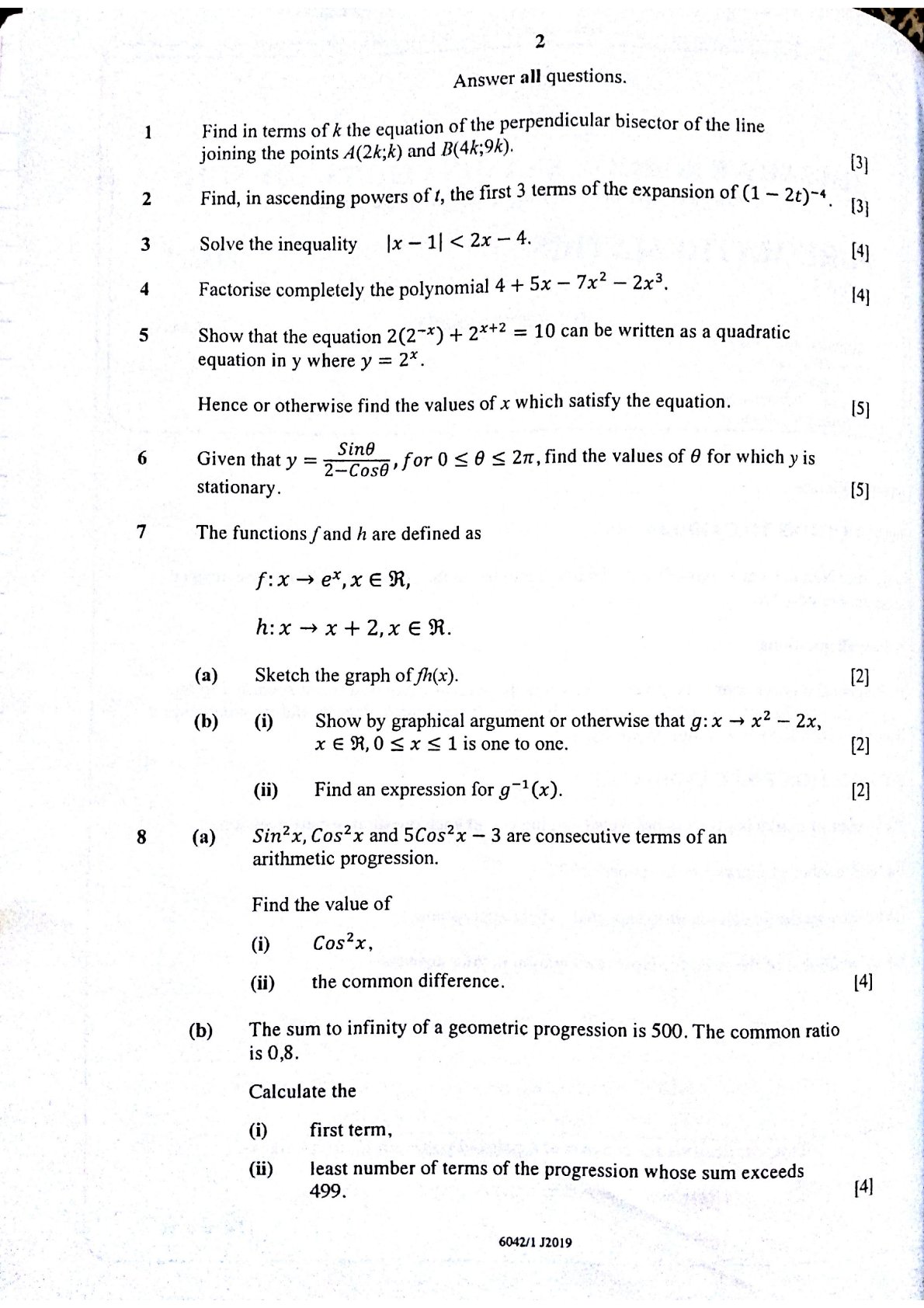
## Question 1
Find in terms of \(k\) the equation of the perpendicular bisector of the line joining the points \(A(2 k ; k)\) and \(B(4 k ; 9 k)\).

## Question 2
Find, in ascending powers of \(t\), the first 3 terms of the expansion of \((1-2 t)^{-4}\).

## Question 3
Solve the inequality \(|x-1|<2 x-4\).

## Question 4
Factorise completely the polynomial \(4+5 x-7 x^{2}-2 x^{3}\).

## Question 5
Show that the equation \(2\left(2^{-x}\right)+2^{x+2}=10\) can be written as a quadratic equation in \(y\) where \(y=2^{x}\).

Hence or otherwise find the values of \(x\) which satisfy the equation.

## Question 6
Given that \(y=\frac{\operatorname{Sin} \theta}{2-\operatorname{Cos} \theta}\), for \(0 \leq \theta \leq 2 \pi\), find the values of \(\theta\) for which \(y\) is stationary.

## Question 7
The functions \(f\) and \(h\) are defined as

$$
\begin{aligned}  |  f: x \rightarrow e^{x}, x \in \Re,   |  h: x \rightarrow x+2, x \in \Re .
\end{aligned}
$$

### (a)

Sketch the graph of \(f h(x)\).

### (b)

#### (i)

Show by graphical argument or otherwise that \(g: x \rightarrow x^{2}-2 x\), \(x \in \Re, 0 \leq x \leq 1\) is one to one.

#### (ii)

Find an expression for \(g^{-1}(x)\).

## Question 8
### (a)

\(\operatorname{Sin}^{2} x, \operatorname{Cos}^{2} x\) and \(5 \operatorname{Cos}^{2} x-3\) are consecutive terms of an arithmetic progression.

Find the value of

#### (i)

\(\operatorname{Cos}^{2} x\),

#### (ii)

the common difference.

### (b)

The sum to infinity of a geometric progression is 500. The common ratio is 0,8.

Calculate the

#### (i)

first term,

#### (ii)

least number of terms of the progression whose sum exceeds 499.

## Question 9
### (a)

Evaluate \(\int_{1}^{4} x \ln x d x\).

### (b)

#### (i)

Use the trapezium rule with 4 ordinates to approximate the value of \(\int_{1}^{4} x \ln x d x\)

#### (ii)

Hence find the relative error when the trapezium rule is used to approximate the integral, \(\int_{1}^{4} x \ln x d x\).

## Question 10
The function \(f(x)=\frac{x^{3}-x-2}{(x-1)\left(x^{2}+1\right)}\).

### (a)

Express \(f(x)\) in the form \(\mathrm{A}+\frac{\mathrm{B}}{x-1}+\frac{C x+\mathrm{D}}{x^{2}+1}\) where \(\mathrm{A}, \mathrm{B}, \mathrm{C}\) and D are constants.

### (b)

Hence evaluate \(\int_{2}^{3} f(x) d x\).

## Question 11
### (a)

By sketching suitable graphs, show that the equation \(\operatorname{Sec} x=3-x^{2}\) has exactly one root in the interval \(0<x<\frac{1}{2} \pi\).

### (b)

Show that if a sequence of values given by the iterative formula

$$
x_{n+1}=\operatorname{Cos}^{-1}\left(\frac{1}{3-x_{n}^{2}}\right)
$$

converges, then it converges to a root of the equation given in part (a).

### (c)

Use the iterative formula in (b), with the value \(x_{0}=1,024627\) to determine the root of the equation in (a) in the interval \(0<x<\frac{1}{2} \pi\) correct to 2 decimal places, showing the result of each iteration.

## Question 12
The rate at which a quantity \(x\) is decreasing is proportional to the product of \(x\) and \(1-x\).

### (i)

Form a differential equation which models this situation.

### (ii)

Initially \(x=0,2\) and the rate of decrease is 1,6 units per unit time. Solve the differential equation.

## Question 13
### (a)

#### (i)

Express \(2 \operatorname{Sin} x-4 \operatorname{Cos} x\) in the form \(R \operatorname{Sin}(x-\alpha)\) where \(\mathrm{R}>0\) and \(\alpha\) is acute.

#### (ii)

Hence solve the equation \(2 \operatorname{Sin} x-4 \operatorname{Cos} x=\sqrt{5}\), for \(0^{\circ} \leq x \leq 360^{\circ}\).

### (b)

#### (i)

Obtain, in terms of the constant \(a\), an expression for the first 3 simplified terms of the series expansion for \(y=e^{a-x}\).

#### (ii)

If the coefficient of \(x\) in the series expansion in (i) is -4 , find the exact value of \(a\).

## Question 14
### (a)

A curve has parametric equations

$$
\begin{aligned}  |  x=\operatorname{Cos}^{2} \theta   |  y=1-2 \operatorname{Sin}^{2} \theta \text { for } 0^{0} \leq \theta \leq 2 \pi
\end{aligned}
$$

#### (i)

Find \(\frac{d y}{d x}\).

#### (ii)

By writing \(\operatorname{Cos} 3 \theta\) as \(\operatorname{Cos}(2 \theta+\theta)\) or otherwise, prove the identity

$$
2 \operatorname{Sin}^{2} \theta \operatorname{Cos} \theta \equiv \frac{1}{2}(\operatorname{Cos} \theta-\operatorname{Cos} 3 \theta) .
$$

### (b)

A dust pan is in the form of a sector ABCO of a circle of radius \(r\) (see diagram).

![](https://ocr.unopasa.com/p/ocr_assets/c8cb1cd6532b072f102000942e3f2a6f22627ff5be830254286d16a41f2de8b5.jpg)

#### (i)

If the length of \(\operatorname{arc} \mathrm{AB}\) is \(\frac{1}{2} r\), find angle AOB in degrees.

#### (ii)

The segment ACB is cut off along straight line AC.

Find the percentage of the area cut off to the area of the remaining area of sector AOC.

## Question 15
![](https://ocr.unopasa.com/p/ocr_assets/bbee691ca5531884428645a9b19e4d261d8a0d1a21d52616c6bb5be6d56e10ba.jpg)

In the diagram, \(P\) is the point of intersection of the curves \(y=e^{2 x}\) and …