ExamineAI
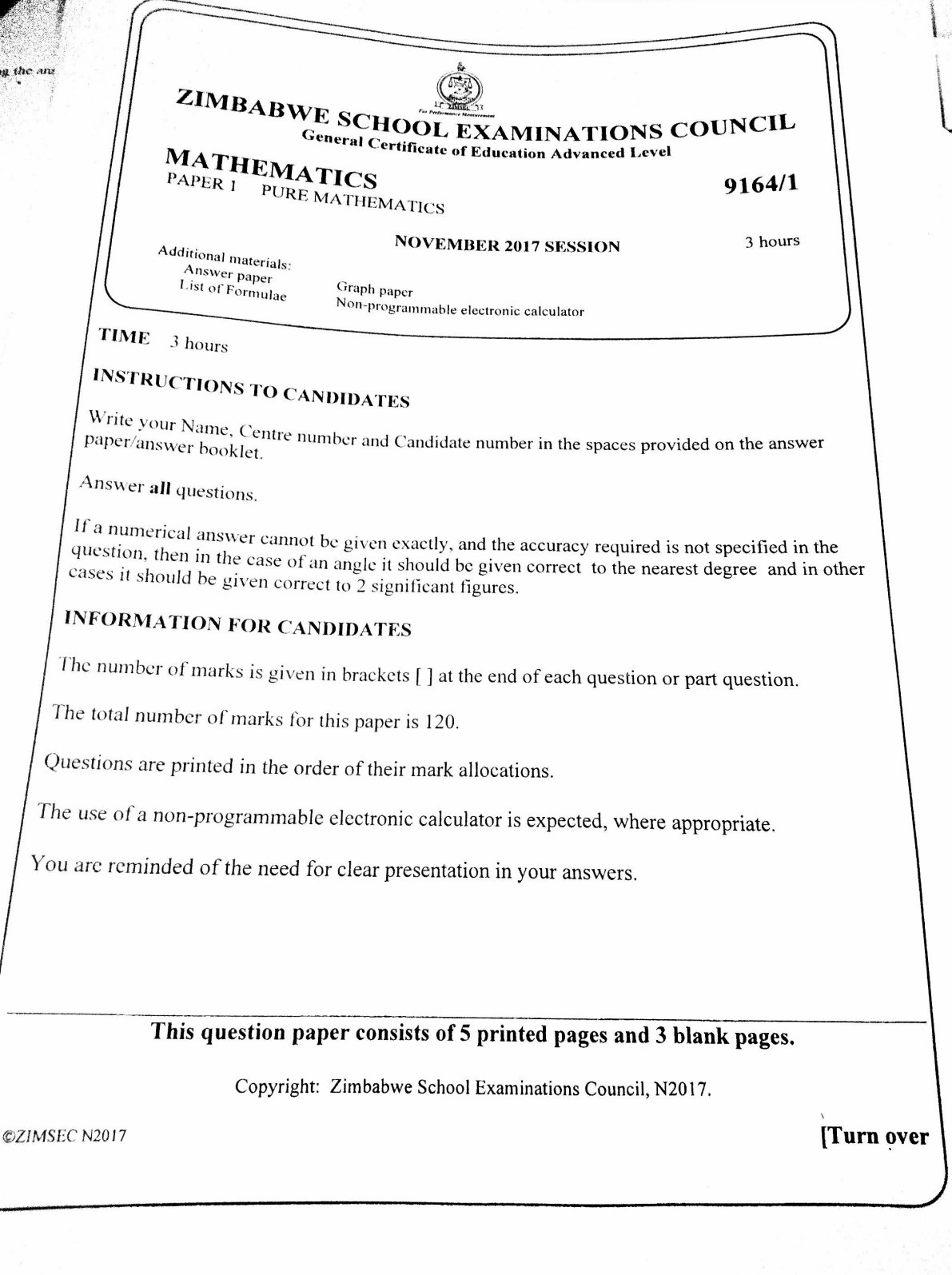
First page of ZIMSEC A-Level Pure Mathematics Paper 1 November 2017 Question Paper

ZIMSEC A-Level Pure Mathematics Paper 1 November 2017 Question Paper

Download and practise with this ZIMSEC A-Level Pure Mathematics Paper 1 November 2017 question paper. Useful for exam revision, past paper practice, and preparation in Zimbabwe.

A free account is needed to download. Sign in or create one

Answers: ZIMSEC A-Level Pure Mathematics Paper 1 November 2017 Marking Scheme

Exam board
ZIMSEC
Subject
Pure Mathematics
Level
A-Level
Document
Question Paper
Paper
Paper 1
Paper code
9164/1
Time allowed
3 hours
Session
November
Year
2017
File
PDF, 2.4 MB

About this question paper

This is the ZIMSEC A-Level Pure Mathematics question paper for Paper 1 from November 2017. Use it for exam practice under timed conditions, then check your work against the marking scheme. The paper code is 9164/1. Time allowed: 3 hours. See the marking scheme.

More Pure Mathematics A-Level 2017 papers

Other years: Pure Mathematics A-Level

Extracted text

# ZIMBABWE SCHOOL EXAMINATIONS COUNCIL

**MATHEMATICS**
**PAPER 1 PURE MATHEMATICS**

General Certificate of Education Advanced Level

NOVEMBER 2017 SESSION

Additional materials:
Answer paper
List of Formulae
Graph paper
Non-programmable electronic calculator

TIME 3 hours

### INSTRUCTIONS TO CANDIDATES

Write your Name, Centre number and Candidate number in the spaces provided on the answer paper/answer booklet.

Answer all questions.
If a numerical answer cannot be given exactly, and the accuracy required is not specified in the question, then in the case of an angle it should be given correct to the nearest degree and in other cases it should be given correct to 2 significant figures.

### INFORMATION FOR CANDIDATES

The number of marks is given in brackets [ ] at the end of each question or part question.
The total number of marks for this paper is 120.
Questions are printed in the order of their mark allocations.
The use of a non-programmable electronic calculator is expected, where appropriate.
You are reminded of the need for clear presentation in your answers.

**This question paper consists of 5 printed pages and 3 blank pages.**

Copyright: Zimbabwe School Examinations Council, N2017.

## Question 1
Given the complex numbers \(w=1+2 i\) and \(u=3-i\), find

### (a)

in the form \(a+i b\), where \(a\) and \(b\) are real numbers

#### (i)

\(u+w\)

#### (ii)

\(u w\)

### (b)

the argument of \(u w\).

## Question 2
Functions \(f\) and \(h\) are defined as

$$
\begin{aligned}  |  f(x)=3 x-1, x \in \mathrm{R},   |  h(x)=2 x+5, x \in \mathrm{R} .
\end{aligned}
$$

Find the value of \(x\) for which \(f h(x)=2 h f(x)\).

## Question 3
### (i)

Express \(2 x^{2}-3 x+7\) in the form \(p(x+q)^{2}+r\), where \(p, q\) and \(r\) are constants.

### (ii)

Hence, or otherwise write down the coordinates of the turning point of \(y=2 x^{2}-3 x+7\).

## Question 4
Quantities \(y\) and \(x\) are related by the equation \(y^{2} x^{3}=c\) where c is a constant.
Find the percentage decrease in \(y\) if \(x\) increases by \(0.5 \%\).

## Question 5
In a geometric progression the first term is \(a\) and the common ratio is \(r\) where \(0<r<1\).

If the sum of the first four terms is half the sum to infinity, find

### (i)

the exact value of \(r\),

### (ii)

the \(9^{\text {th }}\) term when \(a=2\).

## Question 6
Find the equation of the normal to the curve \(y=3 e^{-2 x}+x+3\) at the point where \(x=0\).

## Question 7
### (i)

Show that the equation \(e^{-x}-2 x+3=0\) has only one real root, by sketching the graphs of \(y=e^{-x}\) and \(y=2 x-3\) on the same axes.

### (ii)

Taking \(x_{1}=1\) as your first approximation to the root of equation \(e^{x}-2 x+3=0\), use the Newton-Raphson method twice to find the root correct to 3 decimal places.

## Question 8
The position vectors of points \(\mathrm{A}, \mathrm{B}\) and C relative to the origin O are \(i+2 j-3 k\), \(3 i-2 j+5 k\) and \(p i-p j+(p-1) k\), respectively.

Find

### (i)

a unit vector in the direction \(\overrightarrow{\mathrm{AB}}\),

### (ii)

the angle between \(\overrightarrow{\mathrm{OA}}\) and \(\overrightarrow{\mathrm{OB}}\),

### (iii)

the value of \(p\) for which \(\overrightarrow{\mathrm{OB}}\) is perpendicular to \(\overrightarrow{\mathrm{OC}}\).

## Question 9
A rectangular wooden block has base length \(3 x\) metres, width \(2 x\) metres, height \(h\) metres, total surface area of \(A \mathrm{~m}^{2}\) and volume \(144 \mathrm{~m}^{3}\).

### (a)

Express in terms of \(x\) the

#### (i)

height, \(h\),

#### (ii)

total surface area, \(A\).

### (b)

Given that \(x\) can vary, find the stationary value of the total surface area A and determine its nature.

## Question 10
It is given that \(g(x)=3 x^{4}+b x^{3}+c x^{2}-7 x-4\) has factors \((x+1)\) and \((x-1)\).

### (i)

Find the value of \(b\) and the value of \(c\).

### (ii)

Factorise \(g(x)\) completely.

## Question 11
### (i)

Prove the identity \(\cot 2 \theta \equiv \cot \theta-\operatorname{cosec} 2 \theta\).

### (ii)

Hence, or otherwise solve the equation \(\cot \theta-\operatorname{cosec} 2 \theta=\frac{\sqrt{3}}{2}\) for \(0^{\circ} \leq \theta \leq 360^{\circ}\).

## Question 12
The diagram shows the shaded region \(\mathbf{S}\) bounded by the curve \(y=\sqrt{x+1}\), line \(y=x-1\) and the \(x\)-axis.

![](https://ocr.unopasa.com/p/ocr_assets/b768cf93e0be5114f253c9a22fef8ff1ce6c11a5ef269b92d1c564b5ee1e9a45.jpg)

Find the exact value of the

### (i)

area of \(\mathbf{S}\),

### (ii)

volume generated when \(\mathbf{S}\) is rotated completely about the \(x\)-axis.

## Question 13
### (a)

Solve the equation \(2^{1+2 x}-9\left(2^{x}\right)=-4\).

### (b)

#### (i)

On the same axes, sketch the graphs of \(y=x^{2}\) and \(y=|2 x-3|\).

#### (ii)

Hence, or otherwise, solve the inequality \(|2 x-3|<x^{2}\).

## Question 14
### (i)

Find the exact value of \(\int_{0}^{1} 2 x^{2} e^{x} d x\).

### (ii)

Use the trapezium rule with 6 ordinates to evaluate \(\int_{0}^{1} 2 x^{2} e^{x} d x\), correct to 4 decimal places.

### (iii)

Hence, find correct to 3 decimal places, the percentage error in using the trapezium rule as an approximation to the integral.

## Question 15
### (a)

#### (i)

Given that \(y=e^{2 x} \sin x\) and \(\frac{d y}{d x}=e^{2 x} \cos x+2 e^{2 x} \sin x\), find

1. \(\frac{d^{2} y}{d x^{2}}\),
2. \(\frac{d^{3} y}{d x^{3}}\).

#### (ii)

Hence, or otherwise, obtain the Maclaurin series for \(y=e^{2 x} \sin x\), up to the term in \(x^{3}\).

### (b)

The rate at which the temperature of a hot iron bar, \(\theta^{\circ} \mathrm{C}\), falls is inversely proportional to its temperature at time, \(t\) minutes.

#### (i)

Show that the above situation satisfies the differential equation

$$
\frac{d \theta}{d t}=-\frac{k}{\theta} .
$$

#### (ii)

Solve the differential equation, expressing \(\theta\) in terms of \(t\).

#### (iii)

If the temperature decreases from \(80^{\circ} \mathrm{C}\) to \(70^{\circ} \mathrm{C}\) in 20 minutes, find its …