ExamineAI
First page of ZIMSEC A-Level Mathematics Paper 2 June 2016 Question Paper

ZIMSEC A-Level Mathematics Paper 2 June 2016 Question Paper

Download and practise with this ZIMSEC A-Level Mathematics Paper 2 June 2016 question paper. Useful for exam revision, past paper practice, and preparation in Zimbabwe.

A free account is needed to download. Sign in or create one

Answers: ZIMSEC A-Level Mathematics Paper 2 June 2016 Marking Scheme

Exam board
ZIMSEC
Subject
Mathematics
Level
A-Level
Document
Question Paper
Paper
Paper 2
Paper code
9164/2
Time allowed
3 hours
Session
June
Year
2016
File
PDF, 1.0 MB

About this question paper

This is the ZIMSEC A-Level Mathematics question paper for Paper 2 from June 2016. Use it for exam practice under timed conditions, then check your work against the marking scheme. The paper code is 9164/2. Time allowed: 3 hours. See the marking scheme.

More Mathematics A-Level 2016 papers

Other years: Mathematics A-Level

Extracted text

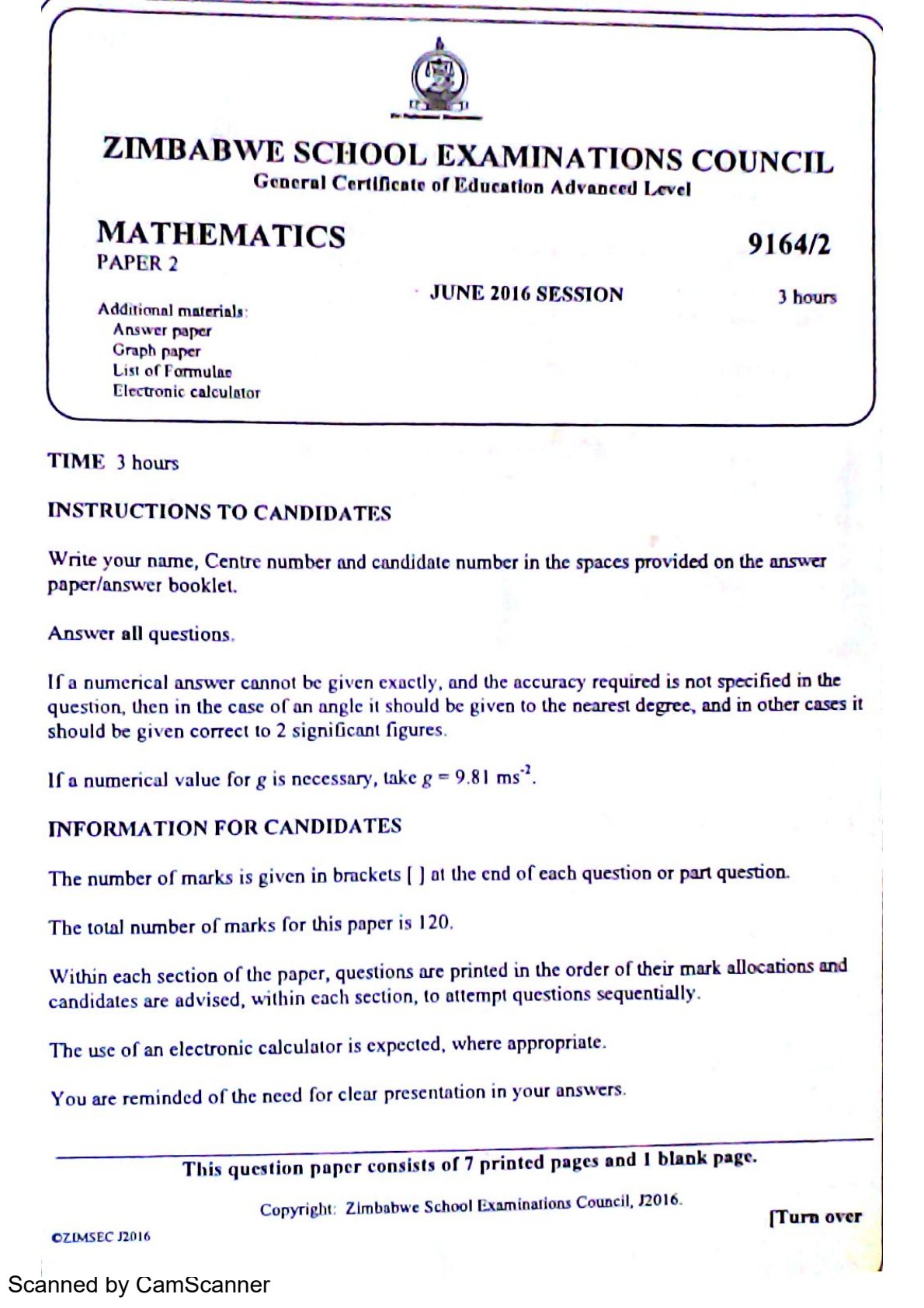
# ZIMBABWE SCHOOL EXAMINATIONS COUNCIL <br> General Certificate of Education Advanced Level

**MATHEMATICS**

PAPER 2

Additional materials:
Answer paper
Graph paper
List of Formulae
Electronic calculator

9164/2

3 hours

JUNE 2016 SESSION

TIME 3 hours

### INSTRUCTIONS TO CANDIDATES

Write your name, Centre number and candidate number in the spaces provided on the answer paper/answer booklet.

Answer all questions.
If a numerical answer cannot be given exactly, and the accuracy required is not specified in the question, then in the case of an angle it should be given to the nearest degree, and in other cases it should be given correct to 2 significant figures.

If a numerical value for \(g\) is necessary, take \(g=9.81 \mathrm{~ms}^{-2}\).

### INFORMATION FOR CANDIDATES

The number of marks is given in brackets [ ] at the end of each question or part question.
The total number of marks for this paper is 120 .
Within each section of the paper, questions are printed in the order of their mark allocations and candidates are advised, within each section, to attempt questions sequentially.

The use of an electronic calculator is expected, where appropriate.
You are reminded of the need for clear presentation in your answers.

This question paper consists of 7 printed pages and 1 blank page.
Copyright: Zimbabwe School Examinations Council, 12016.
[Turn over

**Section (A): Pure Mathematics**

## Question 1
By using the substitution \(u=6x\), show that
\[
\int_{0}^{1/2} \frac{\cos x}{3+\cos^3 x} dx = \frac{1}{4} \ln \frac{1}{3}
\]

## Question 2
The gradient of a curve at a point \((x; y)\) is proportional to the product of \(\sqrt{x}\) and \(y^2\). The curve passes through the points \((0; -2)\) and \((9; 1)\).

### (i)

Show that the equation of the curve is \(y = \frac{18}{x^{1} - 9}\).

### (ii)

Hence write down an equation of its asymptote.

## Question 3
### (a)

Express in the form \(r(\cos \theta + i \sin \theta)\), the roots of the equation \(z^4 - 8 - 8i = 0\).

### (b)

Show \(\operatorname{Arg}(z+1) = \frac{\pi}{3}\) in an Argand diagram.

## Question 4
It is given that \(y = x^2 e^x\).

### (i)

Show that \(\frac{d^3 y}{dx^3} = 4e^x + 2xe^x + \frac{d^2 y}{dx^2}\).

### (ii)

Hence, prove by induction that the statement
\[
\frac{d^n y}{dx^n} = (n-1)(2e^x) + 2xe^x + \frac{d^{n-1} y}{dx^{n-1}}
\]
is true for all positive integers, \(n\), such that \(n \geq 2\).

## Question 5
Given the points \(A(0; 2; 2)\), \(B(4; 1; 0)\) and \(C(-2; 0; 3)\) find the

### (i)

value of \(q\), given that the Cartesian equation of a perpendicular bisector of a line joining the points A and B, passing through point \(D(1; q; 0)\) is \(x-2 = \frac{2y-3}{4} = z-1\).

### (ii)

exact shortest distance of the line in part (i) to the origin,

### (iii)

Cartesian equation of the plane containing points A, B and C.

## Question 6
### (a)

The matrix \(A = \begin{pmatrix} 2  |  k  |  4  3  |  12  |  8  1  |  8  |  k \end{pmatrix}\).

#### (i)

Given that \(A\) is singular find the exact value of \(k\),

#### (ii)

1. Given that \(k=5\), find the inverse of \(A\)

2. Hence or otherwise solve the following simultaneous equations:

\[
\begin{aligned}
2x + 5y + 4z &= 1
3x + 12y + 8z &= 1
x + 8y + 5z &= 1
\end{aligned}
\]

### (b)

The transformation, \(P\), maps a point \(A(1; 2)\) onto \(A_1(3; 2)\) and a point \(B(2; 5)\) onto \(B_1(7; 5)\).

#### (i)

Find the matrix representing the transformation \(P\).

#### (ii)

Describe fully the transformation \(P\).

#### (iii)

Given that C is mapped onto \(C_1\) by transformation \(P\), and that the area of triangle \(ABC\) is \(4 \mathrm{~cm}^2\), find the area of triangle \(A_1 B_1 C_1\).

## Question 7
The trajectory of a projectile's motion is described by the equation \(y = 2x - 0.01x^2\) where \(x\) is the horizontal displacement and \(y\) is the vertical displacement from the point of projection.

Find the

### (i)

angle of projection,

### (ii)

initial velocity of projection.

**Section (B): Mechanics**

## Question 8
![](https://ocr.unopasa.com/p/ocr_assets/35e088b2a4078e09132082e7f91b79b5e2adb43bcfe952960e610eb116c32464.jpg)

The diagram shows three coplanar forces acting at point \(Y\). The 7 N force is horizontal, the 6 N force is inclined to it at \(50^\circ\) and the 5 N force acts at an angle of \(30^\circ\) below the horizontal.

Find the magnitude and direction of the resultant of the three forces.

## Question 9
A particle starts from rest and accelerates at \(2 \mathrm{~ms}^{-2}\) for 3 seconds. It then maintains the attained velocity for 4 seconds and then finally decelerates at \(5 \mathrm{~ms}^{-2}\) for 2 seconds.

### (a)

Sketch a velocity-time graph for the motion of the particle for the 9 seconds.

### (b)

Calculate the

#### (i)

total distance travelled by the particle in the 9 seconds,

#### (ii)

displacement of the particle at the end of the 9 seconds.

## Question 10
Two identical small trays each of mass 0.2 kg, are connected by a light inextensible string which passes over a fixed smooth pulley, as shown in Fig. 10.1. The trays remain balanced.

![](https://ocr.unopasa.com/p/ocr_assets/60b40fb1550afc7270da44d885173a2d289512ad29bd3d52343908675472a2e5.jpg)
Fig. 10.1

![](https://ocr.unopasa.com/p/ocr_assets/8753278b33ccc6b19ae22c987f7e7a0d08f6c892284080dd18eb415551c1309d.jpg)
Fig. 10.2

A mass of 80 grammes is then placed on one of the trays, which begins to move downwards, see Fig 10.2.

Calculate the

### (i)

acceleration of the trays and the tension in the string,

### (ii)

force exerted on the 80 gramme mass by the tray when in motion.

**Section (C): Statistics**

## Question 11
A continuous random variable \(X\) has a probability density function \(f(x)\) given by \(f(x)=0\) for \(x<1\) and for \(x>5\). For \(x\) between 1 and 5, its form is shown on the graph.

![](https://ocr.unopasa.com/p/ocr_assets/cd0d93e4ac09e4547f98f841c24b1dd25e0be5e5c34c87331d4d416e6a1c23da.jpg)

### (a)

Show that \(k = \frac{2}{9}\).

### …