ExamineAI
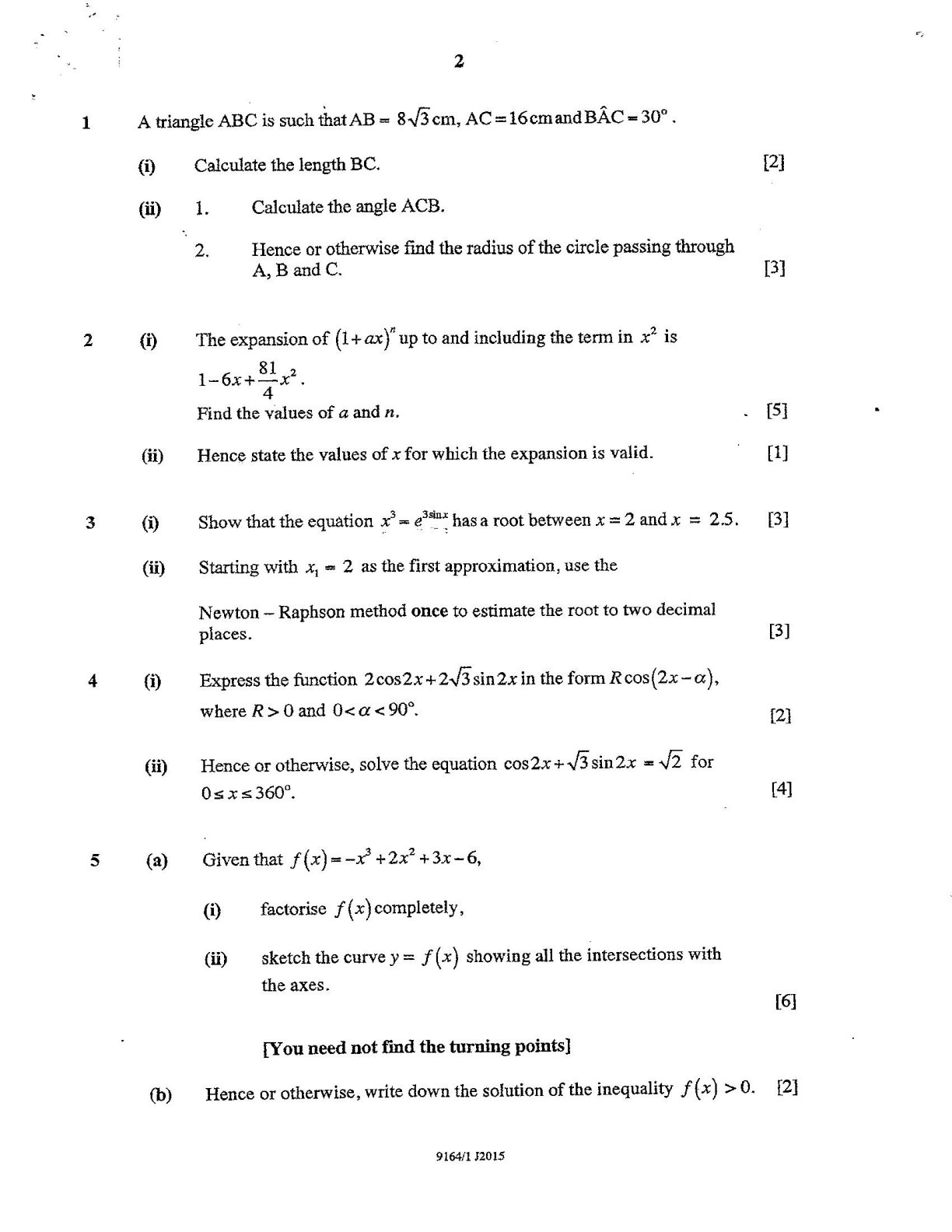
First page of ZIMSEC A-Level Mathematics Paper 1 June 2015 Question Paper

ZIMSEC A-Level Mathematics Paper 1 June 2015 Question Paper

Download and practise with this ZIMSEC A-Level Mathematics Paper 1 June 2015 question paper. Useful for exam revision, past paper practice, and preparation in Zimbabwe.

A free account is needed to download. Sign in or create one

Answers: ZIMSEC A-Level Mathematics Paper 1 June 2015 Marking Scheme

Exam board
ZIMSEC
Subject
Mathematics
Level
A-Level
Document
Question Paper
Paper
Paper 1
Paper code
9164/1
Session
June
Year
2015
File
PDF, 1.1 MB

About this question paper

This is the ZIMSEC A-Level Mathematics question paper for Paper 1 from June 2015. Use it for exam practice under timed conditions, then check your work against the marking scheme. The paper code is 9164/1. See the marking scheme.

More Mathematics A-Level 2015 papers

Other years: Mathematics A-Level

Text from the first page

2

1 A triangle ABC is such that $\mathrm{AB}=8 \sqrt{3} \mathrm{~cm}, \mathrm{AC}=16 \mathrm{~cm}$ and $\mathrm{B} \widehat{\mathrm{A}} \mathrm{C}=30^{\circ}$.
(i) Calculate the length BC .

[2]
(ii) 1. Calculate the angle ACB .
2. Hence or otherwise find the radius of the circle passing through $\mathrm{A}, \mathrm{B}$ and C .

[3]

2 (i) The expansion of $(1+a x)^{n}$ up to and including the term in $x^{2}$ is $1-6 x+\frac{81}{4} x^{2}$.
Find the values of $a$ and $n$.

[5]
(ii) Hence state the values of $x$ for which the expansion is valid.

[1]

3 (i) Show that the equation $x^{3}=e^{3 \sin x}$ has a root between $x=2$ and $x=2.5$.

[3]
(ii) Starting with $x_{1}=2$ as the first approximation, use the

Newton - Raphson method once to estimate the root to two decimal places.

[3]

4 (i) Express the function $2 \cos 2 x+2 \sqrt{3} \sin 2 x$ in the form $R \cos (2 x-\alpha)$, where $R>0$ and $0<\alpha<90^{\circ}$.

[2]
(ii) Hence or otherwise, solve the equation $\cos 2 x+\sqrt{3} \sin 2 x=\sqrt{2}$ for $0 \leq x \leq 360^{\circ}$.

[4]

5 (a) Given that $f(x)=-x^{3}+2 x^{2}+3 x-6$,
(i) factorise $f(x)$ completely,
(ii) sketch the curve $y=f(x)$ showing all the intersections with the axes.

[6]

[You need not find the turning points]
(b) Hence or otherwise, write down the solution of the inequality $f(x)>0$.

9164/1 J2015