ExamineAI
First page of Secondary Economics Inflation Notes Zimbabwe

Secondary Economics Inflation Notes Zimbabwe

Study Economics notes on Inflation for Secondary. Useful for revision, homework, and exam preparation in Zimbabwe.

A free account is needed to download. Sign in or create one

Subject
Economics
Document
Notes
File
PDF, 452 KB

About this notes

This is the Economics notes. It is a free notes for revision.

More Economics papers

Other years: Economics

Text from the first page

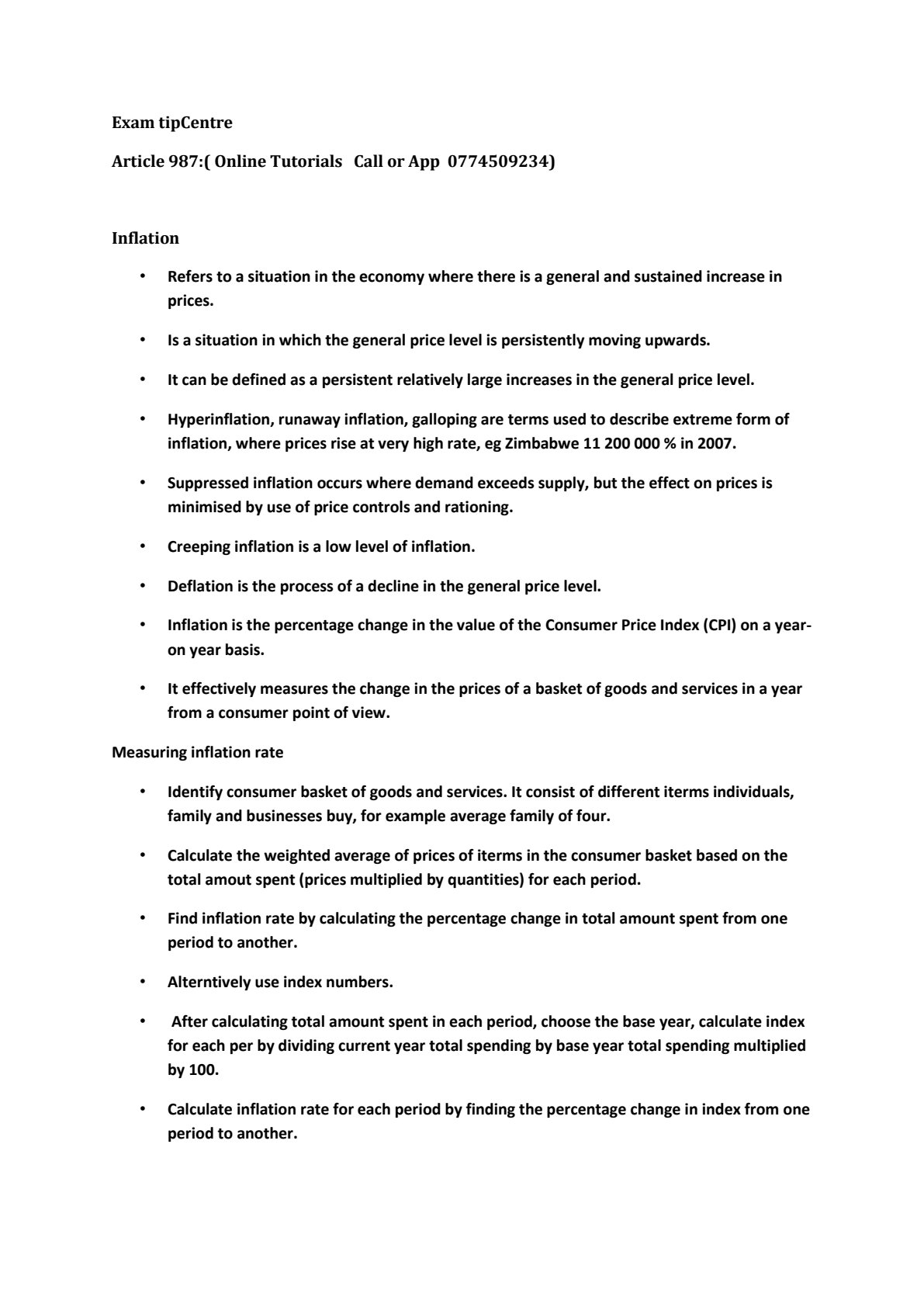
Exam tipCentre
Article 987:( Online Tutorials Call or App 0774509234)

Inflation
- Refers to a situation in the economy where there is a general and sustained increase in prices.
- Is a situation in which the general price level is persistently moving upwards.
- It can be defined as a persistent relatively large increases in the general price level.
- Hyperinflation, runaway inflation, galloping are terms used to describe extreme form of inflation, where prices rise at very high rate, eg Zimbabwe 11200000 \% in 2007.
- Suppressed inflation occurs where demand exceeds supply, but the effect on prices is minimised by use of price controls and rationing.
- Creeping inflation is a low level of inflation.
- Deflation is the process of a decline in the general price level.
- Inflation is the percentage change in the value of the Consumer Price Index (CPI) on a yearon year basis.
- It effectively measures the change in the prices of a basket of goods and services in a year from a consumer point of view.

Measuring inflation rate
- Identify consumer basket of goods and services. It consist of different iterms individuals, family and businesses buy, for example average family of four.
- Calculate the weighted average of prices of iterms in the consumer basket based on the total amout spent (prices multiplied by quantities) for each period.
- Find inflation rate by calculating the percentage change in total amount spent from one period to another.
- Alterntively use index numbers.
- After calculating total amount spent in each period, choose the base year, calculate index for each per by dividing current year total spending by base year total spending multiplied by 100 .
- Calculate inflation rate for each period by finding the percentage change in index from one period to another.