Economic Efficiency Economics
Access this Economics textbook. Useful for learning, classroom study, and revision in Zimbabwe.
A free account is needed to download. Sign in or create one
- Subject
- Economics
- Document
- Textbook
- File
- PDF, 158 KB
Access this Economics textbook. Useful for learning, classroom study, and revision in Zimbabwe.
A free account is needed to download. Sign in or create one
This is the Economics textbook. It is a free textbook for revision.
Chapter 6: Economic Efficiency

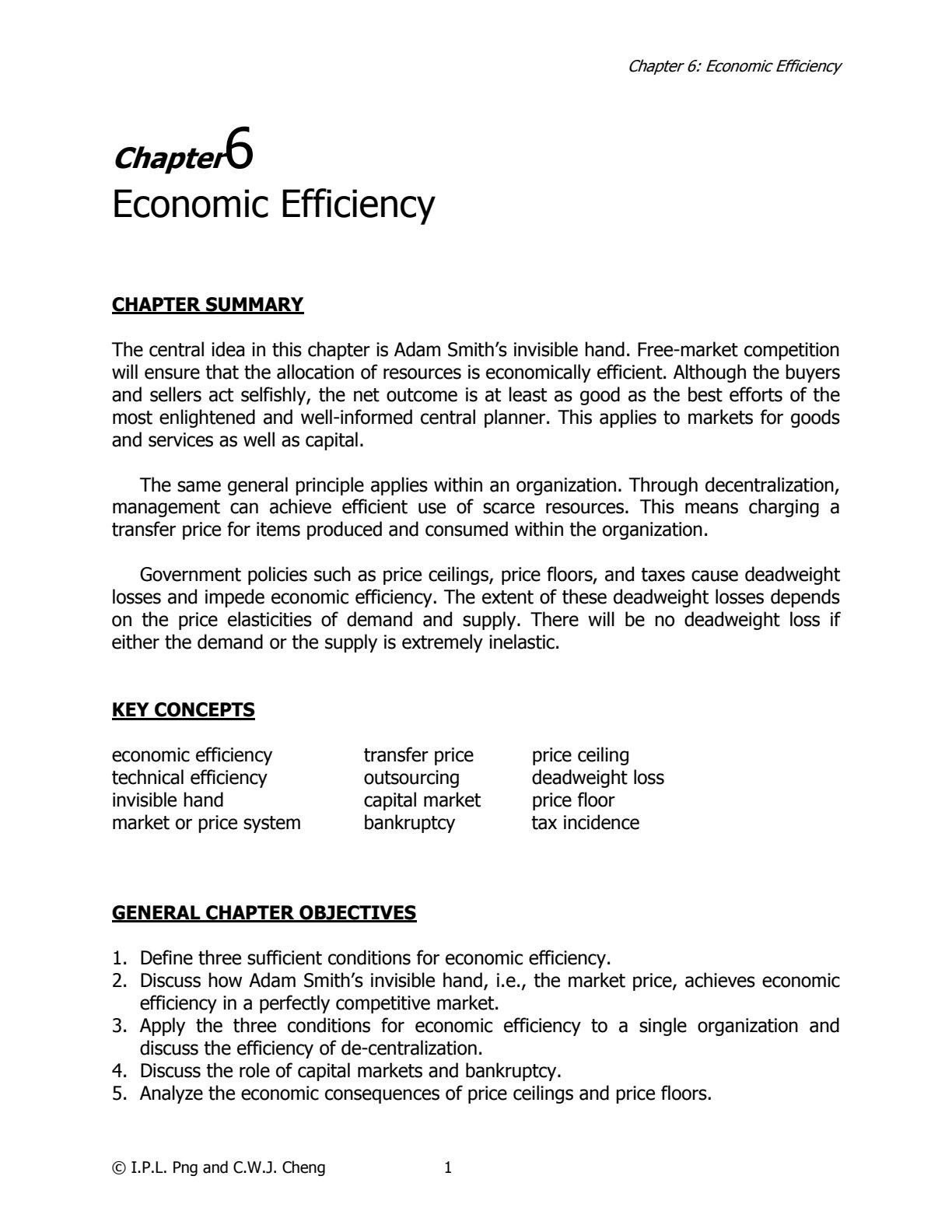
Chapter 6
Economic Efficiency

CHAPTER SUMMARY
The central idea in this chapter is Adam Smith's invisible hand. Free-market competition will ensure that the allocation of resources is economically efficient. Although the buyers and sellers act selfishly, the net outcome is at least as good as the best efforts of the most enlightened and well-informed central planner. This applies to markets for goods and services as well as capital.

The same general principle applies within an organization. Through decentralization, management can achieve efficient use of scarce resources. This means charging a transfer price for items produced and consumed within the organization.

Government policies such as price ceilings, price floors, and taxes cause deadweight losses and impede economic efficiency. The extent of these deadweight losses depends on the price elasticities of demand and supply. There will be no deadweight loss if either the demand or the supply is extremely inelastic.

KEY CONCEPTS
economic efficiency
transfer price
price ceiling
technical efficiency
outsourcing
deadweight loss
invisible hand
capital market
price floor
market or price system
bankruptcy
tax incidence

GENERAL CHAPTER OBJECTIVES
1. Define three sufficient conditions for economic efficiency.
2. Discuss how Adam Smith's invisible hand, i.e., the market price, achieves economic efficiency in a perfectly competitive market.
3. Apply the three conditions for economic efficiency to a single organization and discuss the efficiency of de-centralization.
4. Discuss the role of capital markets and bankruptcy.
5. Analyze the economic consequences of price ceilings and price floors.

© I.P.L. Png and C.W.J. Cheng
1