ExamineAI
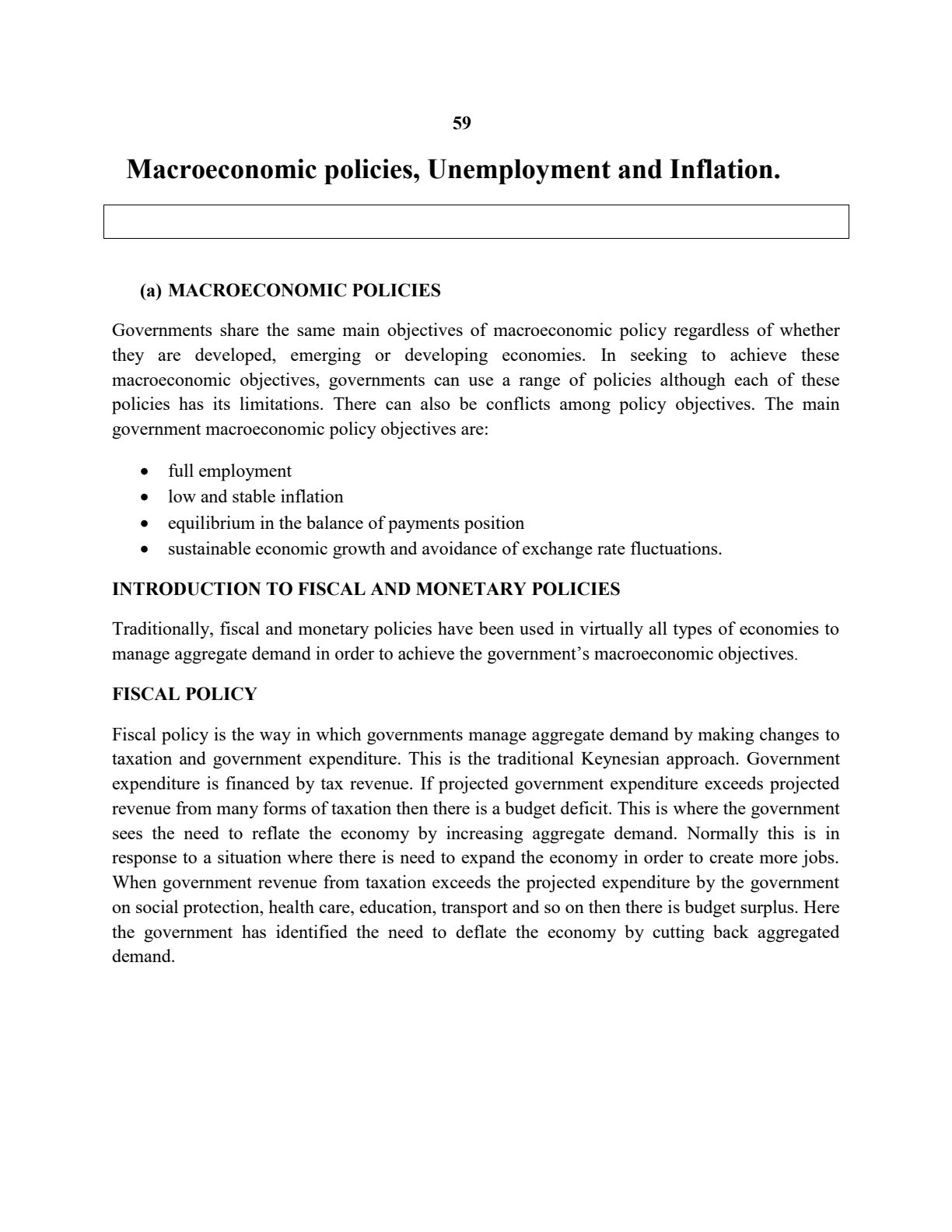
First page of Economics Macroeconomic policies, Unemployment and Inflation Notes Zimbabwe

Economics Macroeconomic policies, Unemployment and Inflation Notes Zimbabwe

Study Economics notes on Macroeconomic policies, Unemployment and Inflation. Useful for revision, homework, and exam preparation in Zimbabwe.

A free account is needed to download. Sign in or create one

Subject
Economics
Document
Notes
File
PDF, 605 KB

About this notes

This is the Economics notes. It is a free notes for revision.

More Economics papers

Other years: Economics

Text from the first page

59

Macroeconomic policies, Unemployment and Inflation.
(a) MACROECONOMIC POLICIES

Governments share the same main objectives of macroeconomic policy regardless of whether they are developed, emerging or developing economies. In seeking to achieve these macroeconomic objectives, governments can use a range of policies although each of these policies has its limitations. There can also be conflicts among policy objectives. The main government macroeconomic policy objectives are:
- full employment
- low and stable inflation
- equilibrium in the balance of payments position
- sustainable economic growth and avoidance of exchange rate fluctuations.

INTRODUCTION TO FISCAL AND MONETARY POLICIES
Traditionally, fiscal and monetary policies have been used in virtually all types of economies to manage aggregate demand in order to achieve the government's macroeconomic objectives.

FISCAL POLICY
Fiscal policy is the way in which governments manage aggregate demand by making changes to taxation and government expenditure. This is the traditional Keynesian approach. Government expenditure is financed by tax revenue. If projected government expenditure exceeds projected revenue from many forms of taxation then there is a budget deficit. This is where the government sees the need to reflate the economy by increasing aggregate demand. Normally this is in response to a situation where there is need to expand the economy in order to create more jobs. When government revenue from taxation exceeds the projected expenditure by the government on social protection, health care, education, transport and so on then there is budget surplus. Here the government has identified the need to deflate the economy by cutting back aggregated demand.