ExamineAI
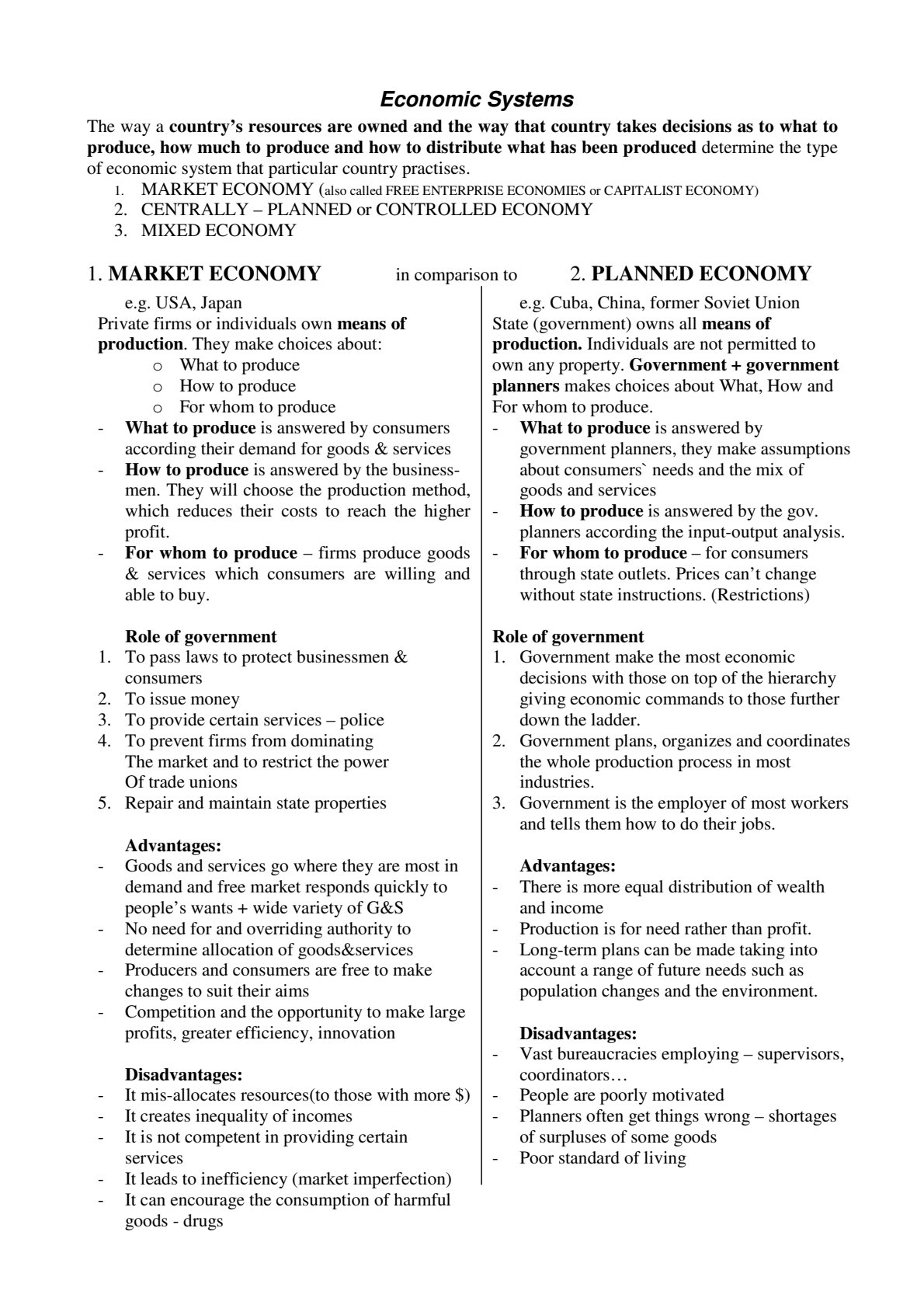
First page of Secondary Economics Economic Systems Notes Zimbabwe

Secondary Economics Economic Systems Notes Zimbabwe

Study Economics notes on Economic Systems for Secondary. Useful for revision, homework, and exam preparation in Zimbabwe.

A free account is needed to download. Sign in or create one

Subject
Economics
Document
Notes
File
PDF, 58 KB

About this notes

This is the Economics notes. It is a free notes for revision.

More Economics papers

Other years: Economics

Text from the first page

Economic Systems
The way a country's resources are owned and the way that country takes decisions as to what to produce, how much to produce and how to distribute what has been produced determine the type of economic system that particular country practises.
1. MARKET ECONOMY (also called FREE ENTERPRISE ECONOMIES or CAPITALIST ECONOMY)
2. CENTRALLY - PLANNED or CONTROLLED ECONOMY
3. MIXED ECONOMY
1. MARKET ECONOMY
e.g. USA, Japan
Private firms or individuals own means of production. They make choices about:
- What to produce
- How to produce
- For whom to produce
- What to produce is answered by consumers according their demand for goods \& services
- How to produce is answered by the businessmen. They will choose the production method, which reduces their costs to reach the higher profit.
- For whom to produce - firms produce goods \& services which consumers are willing and able to buy.

Role of government
1. To pass laws to protect businessmen \& consumers
2. To issue money
3. To provide certain services - police
4. To prevent firms from dominating The market and to restrict the power Of trade unions
5. Repair and maintain state properties

Advantages:
- Goods and services go where they are most in demand and free market responds quickly to people's wants + wide variety of G\&S
- No need for and overriding authority to determine allocation of goods\&services
- Producers and consumers are free to make changes to suit their aims
- Competition and the opportunity to make large profits, greater efficiency, innovation

Disadvantages:
- It mis-allocates resources(to those with more $)
- It creates inequality of incomes
- It is not competent in providing certain services
- It leads to inefficiency (market imperfection)
- It can encourage the consumption of harmful goods - drugs
in comparison to
2. PLANNED ECONOMY
e.g. Cuba, China, former Soviet Union State (government) owns all means of production. Individuals are not permitted to own any property. Government + government planners makes choices about What, How and For whom to produce.
- What to produce is answered by government planners, they make assumptions about consumersˋ needs and the mix of goods and services
- How to produce is answered by the gov. planners according the input-output analysis.
- For whom to produce - for consumers through state outlets. Prices can't change without state instructions. (Restrictions)

Role of government
1. Government make the most economic decisions with those on top of …