ExamineAI
First page of Secondary Biology Photosynthesis and Leaf Adaptations Notes Zimbabwe

Secondary Biology Photosynthesis and Leaf Adaptations Notes Zimbabwe

Study Biology notes on Photosynthesis and Leaf Adaptations for Secondary. Useful for revision, homework, and exam preparation in Zimbabwe.

A free account is needed to download. Sign in or create one

Subject
Biology
Document
Notes
File
PDF, 258 KB

About this notes

This is the Biology notes. It is a free notes for revision.

More Biology papers

Text from the first page

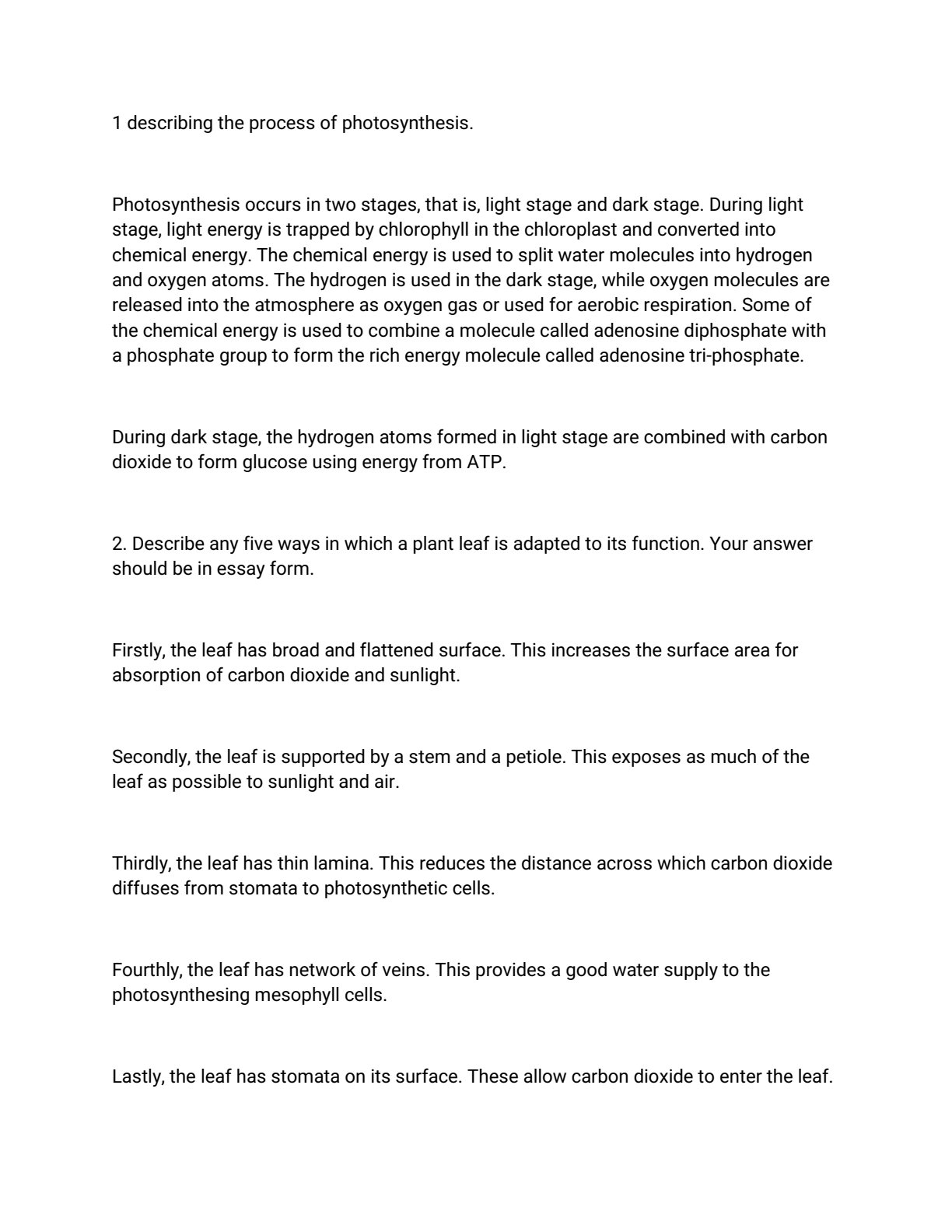
1 describing the process of photosynthesis.

Photosynthesis occurs in two stages, that is, light stage and dark stage. During light stage, light energy is trapped by chlorophyll in the chloroplast and converted into chemical energy. The chemical energy is used to split water molecules into hydrogen and oxygen atoms. The hydrogen is used in the dark stage, while oxygen molecules are released into the atmosphere as oxygen gas or used for aerobic respiration. Some of the chemical energy is used to combine a molecule called adenosine diphosphate with a phosphate group to form the rich energy molecule called adenosine tri-phosphate.

During dark stage, the hydrogen atoms formed in light stage are combined with carbon dioxide to form glucose using energy from ATP.
2. Describe any five ways in which a plant leaf is adapted to its function. Your answer should be in essay form.

Firstly, the leaf has broad and flattened surface. This increases the surface area for absorption of carbon dioxide and sunlight.

Secondly, the leaf is supported by a stem and a petiole. This exposes as much of the leaf as possible to sunlight and air.

Thirdly, the leaf has thin lamina. This reduces the distance across which carbon dioxide diffuses from stomata to photosynthetic cells.

Fourthly, the leaf has network of veins. This provides a good water supply to the photosynthesing mesophyll cells.

Lastly, the leaf has stomata on its surface. These allow carbon dioxide to enter the leaf.