ExamineAI
First page of Secondary Biology Ecosystems and Biogeochemical Cycles Notes Zimbabwe

Secondary Biology Ecosystems and Biogeochemical Cycles Notes Zimbabwe

Study Biology notes on Ecosystems and Biogeochemical Cycles for Secondary. Useful for revision, homework, and exam preparation in Zimbabwe.

A free account is needed to download. Sign in or create one

Subject
Biology
Document
Notes
File
PDF, 492 KB

About this notes

This is the Biology notes. It is a free notes for revision.

More Biology papers

Text from the first page

Ecosystems
An ecosystem is made up of living organisms that depend on each other and on their environment.
Biogeochemical cycles
-Energy enters the ecosystem from the sun
-plants convert this energy into chemical energy which is consumed and used by animals
These nutrient and chemical elements move through the ecosystem in biogeochemical cycles.
Nutrient cycles
The process can be summarized as follows:
\[
\text { photosynthesis ⟶ feeding } \text { ⟶ decomposition }
\]
-plants are the producers.
-all animals depend on plants directly (herbivores) or indirectly (carnivores and omnivores)
-when animals eat plants or other animals they take in the nutrients from those organisms and use them for life processes.
-when plants and animals die they return the nutrients to the environment.
-bacteria and fungi break down dead vegetation and animals through decay and decomposition -earth worms and other small animals mix mineral and organic matter distributing it through the soil for plant roots to access.

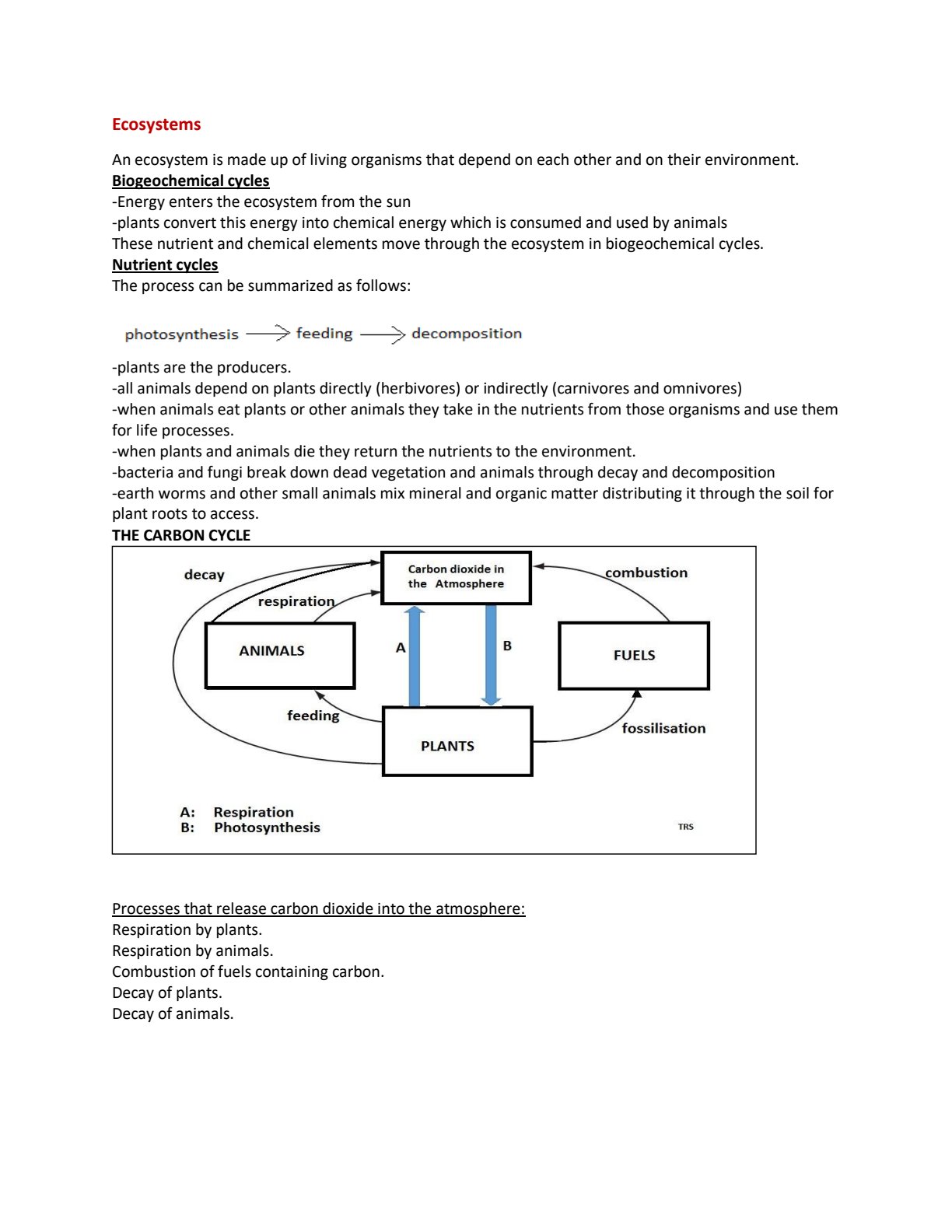
THE CARBON CYCLE

Processes that release carbon dioxide into the atmosphere:
Respiration by plants.
Respiration by animals.
Combustion of fuels containing carbon.
Decay of plants.
Decay of animals.