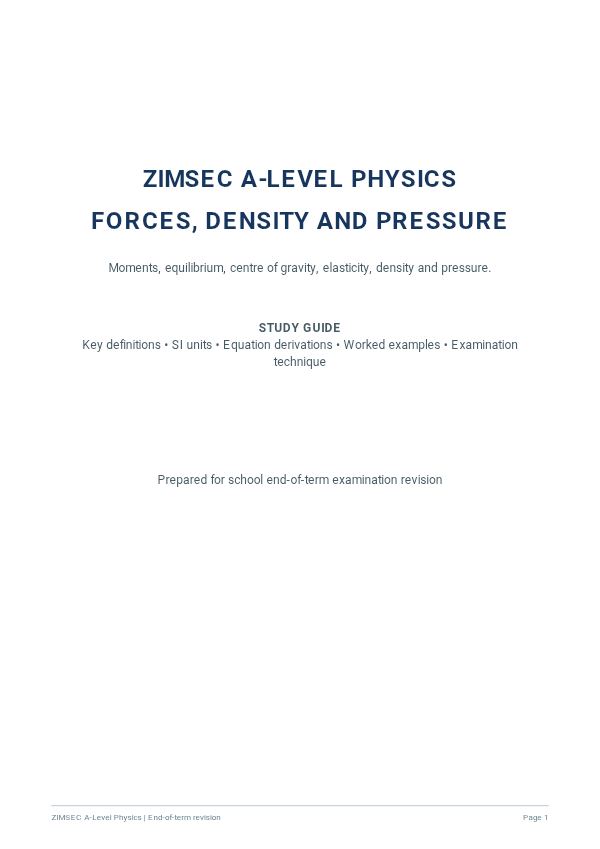
Zimsec a-Level Physics Forces, Density and Pressure is a study guide for AS Level Physics (2026). Other students and teachers can use it for revision, lesson preparation or extra practice.
Study guide
File: PDF document, 31 KB, 3 pages. Preview the first page above before you download, and sign in with a free account to get the file.
Topics and key words
Words that appear again and again in this document, which is a quick way to see what it is about: force, pressure, density, area, extension, gravity, moment, moments, equilibrium, a-level, elastic, end-of-term, modulus and perpendicular.
Text taken from the document
ZIMSEC A-LEVEL PHYSICS
FORCES, DENSITY AND PRESSURE
Moments, equilibrium, centre of gravity, elasticity, density and pressure.
STUDY GUIDE
Key definitions • SI units • Equation derivations • Worked examples • Examination
technique
Prepared for school end-of-term examination revision
ZIMSEC A-Level Physics | End-of-term revision Page 1
Forces, Density and Pressure
Moments, equilibrium, centre of gravity, elasticity, density and pressure.
1. Moments and equilibrium
The moment of a force about a point is the turning effect of the force. Moment = perpendicular distance from pivot to
line of action × force. Unit N m.
For equilibrium: resultant force is zero and resultant moment about any point is zero. In a coplanar problem, Σ Fx = 0,
Σ Fy = 0 and clockwise moments = anticlockwise moments.
Choose a pivot that removes unknown forces from the moment equation. Use perpendicular distance, not necessarily
the length of the object.
Example: a 10 N force acts perpendicular to a spanner 0.25 m from the pivot. Moment = 10 × 0.25 = 2.5 N m.
2. Centre of gravity
The centre of gravity is the point through which the resultant weight of a body may be considered to act. For a uniform
symmetrical object, it is at the geometrical centre.
An object is in stable equilibrium if a small displacement raises its centre of gravity and it tends to return; unstable if it
moves farther away; neutral if its height remains unchanged.
A wider base and lower centre of gravity generally improve stability.
3. Density and pressure
Density ρ = mass/volume. SI unit kg m n ³. Relative density = density of substance / density of water (for solids and
liquids); it has no unit.
Pressure p = force/area. SI unit Pa = N m n ² = kg m n ¹ s n ².
Pressure in a liquid at depth h: p = ρ gh (gauge pressure). Absolute pressure = atmospheric pressure + ρ gh. This
assumes a fluid of uniform density and hydrostatic conditions.
Derivation of p = ρ gh: consider a liquid column of area A and height h. Its volume is Ah; mass is ρ Ah; weight is ρ Ahg.
Pressure = force/area = ρ Ahg/A = ρ gh.
4. Hooke's law and elastic energy
For a spring within its limit of proportionality, extension x is directly proportional to applied force F: F = kx. k is the
spring constant, unit N m n ¹.
The limit of proportionality is where force is no longer proportional to extension. The elastic limit is the greatest
deformation for which the material returns to its original shape when the load is removed; these limits need not be
identical. …
What Physics at AS Level usually covers
Physics at AS Level typically covers forces and motion, energy and power, thermal physics, waves, light and sound, electricity, magnetism and atomic physics. Not every study guide tests every topic, so check the contents and the text on this page to see what this one includes, and your teacher’s syllabus to see what is expected.
Exam tip: Write the formula first, substitute with units, and give the final answer with its unit.
How to use this study guide
Skim the whole document first to see how it is organised.
Read one section at a time and close the file to write what you remember.
Turn each heading into a question and answer it from memory.
Mark the parts you could not explain and go back to your class notes for them.
Finish by trying questions on the same topic from past papers in Physics.
Questions people ask
What is Zimsec a-Level Physics Forces, Density and Pressure?
It is a study guide in Physics for AS Level, shared by a member of the community.
Is the download free?
Yes. You need a free books.co.zw account to download, and you can read this page and see the first-page picture without one.
Which file type is it?
It is a PDF file of 31 KB. Phones and computers can open it with the usual document viewer.
Is the file safe?
Every upload is checked automatically for hidden programs, macros and viruses before and after it is published, and readers can report a problem with any file.