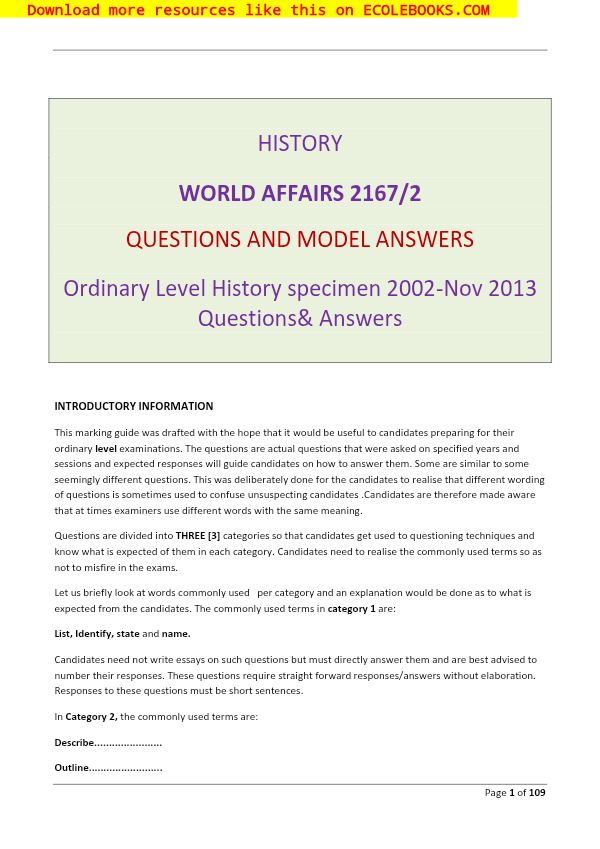
O-Level History November 2002 is an O-Level History question paper from the November 2002 exams. Students use papers like this to see how questions are really asked, how marks are shared out and how much time each section deserves.
The questions follow the format used at O-Level. Attempt it without notes first, mark it honestly, and keep a list of the questions you missed.
File: PDF document, 1.4 MB, 109 pages. Preview the first page above before you download, and sign in with a free account to get the file.
Topics and key words
Words that appear again and again in this document, which is a quick way to see what it is about: germany, france, britain, first, europe, russia, balkan, world, british, allied, austria, like, allies and download.
Text taken from the document
Download more resources like this on ECOLEBOOKS.COM
HISTORY
WORLD AFFAIRS 2167/2
QUESTIONS AND MODEL ANSWERS
Ordinary Leve l History specimen 2002 - Nov 2013
Question s & Answers
INTRODUCTORY INFORMATION
This marking guide was drafted with the hope that it would be useful to candidates preparing for their
ordinary level examinations. The questions are actual questions that were asked on specified years and
sessions and expected responses will guide candidates on how to answer them. Some are similar to some
seemingly different questions. This was deliberately done for the candidates to realise that different wording
of questions is sometimes used to confuse unsuspecting candidates .Candidates are therefore made aware
that at times examiners use different words with the same meaning.
Questions are divided into THREE [3] categories so that candidates get used to questioning techniques and
know what is expected of them in each category. Candidates need to realise the commonly used terms so as
not to misfire in the exams.
Let us briefly look at words commonly used per category and an explanation would be done as to what is
expected from the candidates. The commonly used terms in category 1 are:
List, Identify, state and name.
Candidates need not write essays on such questions but must directly answer them and are best advised to
number their responses. These questions require straight forward responses/answers without elaboration.
Responses to these questions must be short sentences.
In Category 2, the commonly used terms are:
Describe.......................
Outline.........................
Page 1 of 109
Download more resources like this on ECOLEBOOKS.COM
Show how.....................
Candidates are required to show their full understanding of what is demanded by the question. They need to
fully explain points to get maximum points. Candidates are required to explain the 12 points as per mark
allocation. Mere identification without elaboration might result in candidates unnecessarily losing valuable
marks. Writing in point form will result in candidates getting half marks. Candidates should also note that at
times these questions may be divided into TWO PARTS. In this scenario candidates are to explain six points
for the first part and another six points for second part.
CATEGORY 3. questions at this level are analytical/ analysis. Commonly used terms/Phrases are:
To what.......................
How far.........................
There are THREE levels to …
What History at O-Level usually covers
History at O-Level typically covers the main events, causes and consequences of the period studied, key people, and how to use and judge sources. Not every question paper tests every topic, so check the contents and the text on this page to see what this one includes, and your teacher’s syllabus to see what is expected.
Exam tip: Structure longer answers as point, evidence and explanation, and always link back to the question.
How to use this question paper
Print the paper or open it on a large screen, and keep a pencil and a calculator nearby.
Set a timer for the time allowed on the first page, and do not look at notes.
Answer every question you can, and leave a mark next to the ones you guessed.
Mark your answers with the marking scheme for the same paper and session if the library has it.
Write down the topics where you lost marks and revise those first.
Repeat with another year of the same paper a few days later, and compare your scores.
A seven-day plan using this question paper
Day 1: read through it and sort the questions into those you can do, those you half know and those you cannot start.
Day 2 and 3: revise the topics behind the questions you could not start, using your notes and textbook.
Day 4: do the whole paper again under exam conditions with a timer.
Day 5: mark it carefully and list every mark you lost and why: knowledge, method, careless error or time.
Day 6: fix those mistakes by rewriting the answers you got wrong in full.
Day 7: rest, then try a paper from another year to check that the improvement is real.
Questions people ask
What is O-Level History November 2002?
It is an O-Level History question paper from November 2002, shared by a member of the community.
Where can I find the answers?
Look for the marking scheme for the same subject, paper and session in the library. If it is not there yet, you can upload it so other students can use it too.
Is this the real exam paper?
It is a copy shared by a member of the community. Check the first page picture above and compare it with the paper your teacher gave you.
Is the download free?
Yes. You need a free books.co.zw account to download, and you can read this page and see the first-page picture without one.
Which file type is it?
It is a PDF file of 1.4 MB. Phones and computers can open it with the usual document viewer.
Is the file safe?
Every upload is checked automatically for hidden programs, macros and viruses before and after it is published, and readers can report a problem with any file.