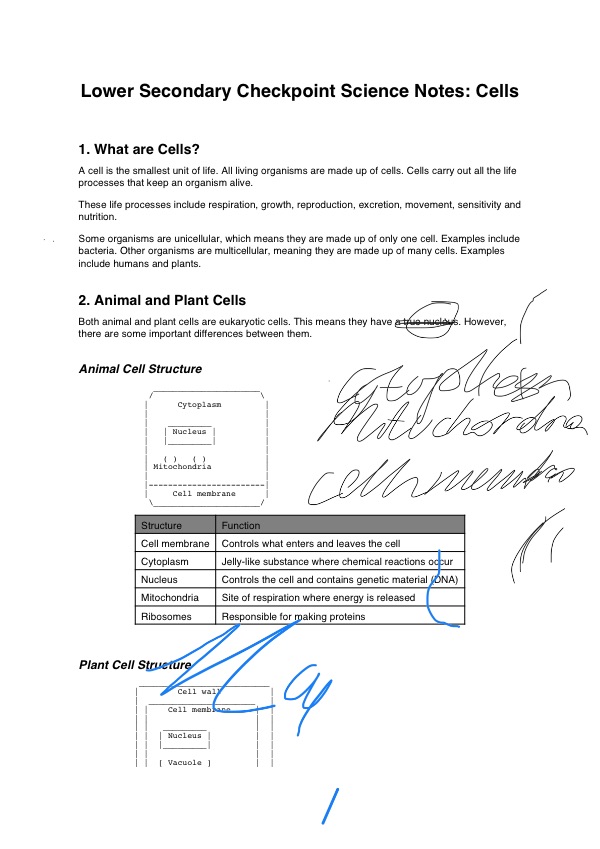
(anonymous) is a worksheet for O-Level Science. Other students and teachers can use it for revision, lesson preparation or extra practice.
A cell is the smallest unit of life. All living organisms are made up of cells. Cells carry out all the life These life processes include respiration, growth, reproduction, excretion, movement, sensitivity and Some organisms are unicellular, which means they are made up of only one cell.…
File: PDF document, 1.3 MB, 2 pages. Preview the first page above before you download, and sign in with a free account to get the file.
Topics and key words
Words that appear again and again in this document, which is a quick way to see what it is about: cell, cells, animal, nucleus, plant, controls, membrane, structure, vacuole, absent, chloroplasts, cytoplasm, include and life.
Text taken from the document
Lower Secondary Checkpoint Science Notes: Cells
1. What are Cells?
A cell is the smallest unit of life. All living organisms are made up of cells. Cells carry out all the life
processes that keep an organism alive.
These life processes include respiration, growth, reproduction, excretion, movement, sensitivity and
nutrition.
Some organisms are unicellular, which means they are made up of only one cell. Examples include
bacteria. Other organisms are multicellular, meaning they are made up of many cells. Examples
include humans and plants.
2. Animal and Plant Cells
Both animal and plant cells are eukaryotic cells. This means they have a true nucleus. However,
there are some important differences between them.
Animal Cell Structure
______________________
/ \
| Cytoplasm |
| |
| _________ |
| | Nucleus | |
| |_________| |
| |
| ( ) ( ) |
| Mitochondria |
| |
|------------------------|
| Cell membrane |
\______________________/
Structure Function
Cell membrane Controls what enters and leaves the cell
Cytoplasm Jelly-like substance where chemical reactions occur
Nucleus Controls the cell and contains genetic material (DNA)
Mitochondria Site of respiration where energy is released
Ribosomes Responsible for making proteins
Plant Cell Structure
___________________________
| Cell wall |
| ______________________ |
| | Cell membrane | |
| | | |
| | _________ | |
| | | Nucleus | | |
| | |_________| | |
| | | |
| | [ Vacuole ] | |
| | | |
| | o o o | |
| | Chloroplasts | |
| |______________________| |
|__________________________|
Structure Function
Cell wall Provides support and protection to the cell
Cell membrane Controls movement of substances in and out of the cell
Cytoplasm Where chemical reactions take place
Nucleus Controls activities of the cell
Mitochondria Releases energy through respiration
Chloroplasts Contain chlorophyll for photosynthesis
Vacuole Contains cell sap and helps keep the cell firm
Differences Between Animal and Plant Cells
Feature Animal Cell Plant Cell
Cell wall Absent Present
Chloroplasts Absent Present
Vacuole Small or absent Large central vacuole
Shape Irregular Regular (rectangular)
How to use this worksheet
Skim the whole document first to see how it is organised.
Read one section at a time and close the file to write what you remember.
Turn each heading into a question and answer it from memory.
Mark the parts you could not explain and go back to your class notes for them.
Finish by trying questions on the same topic from past papers in Science.
Questions people ask
What is (anonymous)?
It is a worksheet in Science for O-Level, shared by a member of the community.
Is the download free?
Yes. You need a free books.co.zw account to download, and you can read this page and see the first-page picture without one.
Which file type is it?
It is a PDF file of 1.3 MB. Phones and computers can open it with the usual document viewer.
Is the file safe?
Every upload is checked automatically for hidden programs, macros and viruses before and after it is published, and readers can report a problem with any file.