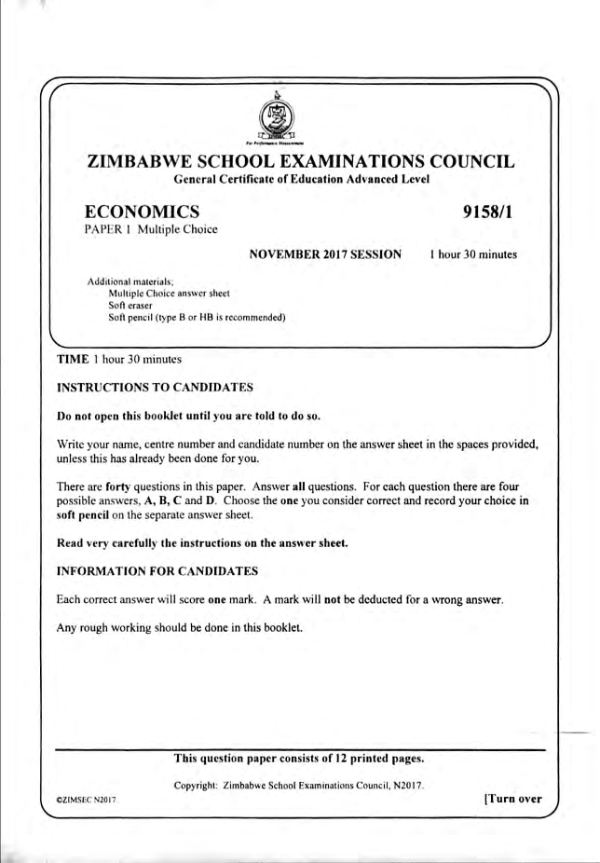
A Levels Economics 2017 is an A-Level Economics question paper, Paper 1,2,3 from the November 2017 exams. It was shared by a member of the books.co.zw community so that other candidates can practise with it for free.
The questions follow the format used at A-Level. Attempt it without notes first, mark it honestly, and keep a list of the questions you missed.
There are 2017 questions all of them paper 1-paper 3
File: PDF document, 1.2 MB, 15 pages. Preview the first page above before you download, and sign in with a free account to get the file.
Topics and key words
Words that appear again and again in this document, which is a quick way to see what it is about: fall, maize, period, apple, distribution, income, price, soap, consumption, economy, equitable, sheet, sugarbeans and wealth.
Economics at A-Level typically covers basic economic problems, demand and supply, production, markets, money and banking, government policy, and international trade. Not every question paper tests every topic, so check the contents and the text on this page to see what this one includes, and your teacher’s syllabus to see what is expected.
Exam tip: Draw and label supply and demand diagrams neatly; examiners reward them.
How to use this question paper
Print the paper or open it on a large screen, and keep a pencil and a calculator nearby.
Set a timer for the time allowed on the first page of Paper 1,2,3, and do not look at notes.
Answer every question you can, and leave a mark next to the ones you guessed.
Mark your answers with the marking scheme for the same paper and session if the library has it.
Write down the topics where you lost marks and revise those first.
Repeat with another year of the same paper a few days later, and compare your scores.
A seven-day plan using this question paper
Day 1: read through it and sort the questions into those you can do, those you half know and those you cannot start.
Day 2 and 3: revise the topics behind the questions you could not start, using your notes and textbook.
Day 4: do the whole paper again under exam conditions with a timer.
Day 5: mark it carefully and list every mark you lost and why: knowledge, method, careless error or time.
Day 6: fix those mistakes by rewriting the answers you got wrong in full.
Day 7: rest, then try a paper from another year to check that the improvement is real.
Questions people ask
What is A Levels Economics 2017?
It is an A-Level Economics question paper (Paper 1,2,3) from November 2017, shared by a member of the community.
Where can I find the answers?
Look for the marking scheme for the same subject, paper and session in the library. If it is not there yet, you can upload it so other students can use it too.
Is this the real exam paper?
It is a copy shared by a member of the community. Check the first page picture above and compare it with the paper your teacher gave you.
Is the download free?
Yes. You need a free books.co.zw account to download, and you can read this page and see the first-page picture without one.
Which file type is it?
It is a PDF file of 1.2 MB. Phones and computers can open it with the usual document viewer.
Is the file safe?
Every upload is checked automatically for hidden programs, macros and viruses before and after it is published, and readers can report a problem with any file.