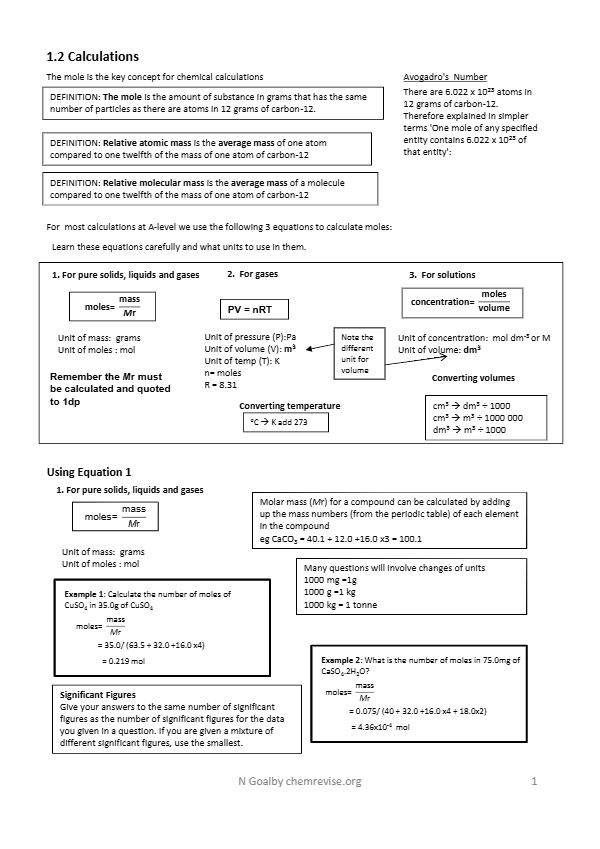
1.2 Calculations is a set of notes for A-Level Chemistry. Other students and teachers can use it for revision, lesson preparation or extra practice.
The mole is the key concept for chemical calculations Avogadro's Number DEFINITION: The mole is the amount of substance in grams that has the same number of particles as there are atoms in 12 grams of carbon - 12. DEFINITION: Relative atomic mass is the average mass of one atom
File: PDF document, 223 KB, 14 pages. Preview the first page above before you download, and sign in with a free account to get the file.
Topics and key words
Words that appear again and again in this document, which is a quick way to see what it is about: mass, moles, volume, concentration, solution, water, example, ions, formula, chloride, atoms, empirical, mole and molecular.
Text taken from the document
1.2 Calculations
The mole is the key concept for chemical calculations Avogadro's Number
23
There are 6.022 x 10 atoms in
DEFINITION: The mole is the amount of substance in grams that has the same
12 grams of carbon - 12.
number of particles as there are atoms in 12 grams of carbon - 12.
Therefore explained in simpler
terms 'One mole of any specified
23
entity contains 6.022 x 10 of
DEFINITION: Relative atomic mass is the average mass of one atom
that entity':
compared to one twelfth of the mass of one atom of carbon - 12
DEFINITION: Relative molecular mass is the average mass of a molecule
compared to one twelfth of the mass of one atom of carbon - 12
For most calculations at A - level we use the following 3 equations to calculate moles:
Learn these equations carefully and what units to use in them.
1. For pure solids, liquids and gases 2. For gases 3. For solutions
moles
mass
concentration=
moles= volume
PV = nRT
M r
- 3
Unit of mass : grams Unit of pressure (P):Pa Unit of concentration: mol dm or M Note the
3 3 different
Unit of moles : mol Unit of volume (V): m Unit of volume : dm
unit for
Unit of temp (T): K
volume
n= moles
Converting volumes Remember the M r must
R = 8.31
be calculated and quoted
to 1dp
3 3
cm dm ÷ 1000 Converting temperature
3 3
cm m ÷ 1000 000 o
C K add 273
3 3
dm m ÷ 1000
Using Equation 1
1. For pure solids, liquids and gases
Molar mass ( M r) for a compound can be calculated by adding
mass
up the mass numbers (from the periodic table) of each element
moles=
in the compound M r
eg CaCO = 40.1 + 12.0 +16.0 x3 = 100.1
3
Unit of mass : grams
Unit of moles : mol
Many questions will involve changes of units
1000 mg =1g
1000 g =1 kg
Example 1 : Calculate the number of moles of
CuSO in 35.0g of CuSO 1000 kg = 1 tonne
4 4
mass
moles=
M r
= 35.0/ (63.5 + 32.0 + 16.0 x4)
= 0.219 mol Example 2 : What is the number of moles in 75.0mg of
CaSO .2H O?
4 2
mass
moles=
Significant Figures
M r
Give your answers to the same number of significant
= 0.075/ (40 + 32.0 +16.0 x4 + 18.0x2)
figures as the number of significant figures for the data
- 4
= 4.36x10 mol
you given in a question. If you are given a mixture of
different significant figures, use the smallest.
1 N Goalby chemrevise.org
Avogadro's Constant
Avogadro's Constant (L) The mole is the amount of substance in
23
There are 6.022 x 10 atoms in 12 grams of carbon - 12. Therefore grams that has the same number of particles
explained in simpler terms 'One mole of any specified entity …
What Chemistry at A-Level usually covers
Chemistry at A-Level typically covers the particulate nature of matter, atomic structure and bonding, acids, bases and salts, rates of reaction, metals and the reactivity series, electrolysis, organic chemistry and the mole concept. Not every notes tests every topic, so check the contents and the text on this page to see what this one includes, and your teacher’s syllabus to see what is expected.
Exam tip: Balance every equation and learn the tests for gases and ions, which are common short questions.
How to use these notes
Skim the whole document first to see how it is organised.
Read one section at a time and close the file to write what you remember.
Turn each heading into a question and answer it from memory.
Mark the parts you could not explain and go back to your class notes for them.
Finish by trying questions on the same topic from past papers in Chemistry.
Questions people ask
What is 1.2 Calculations?
It is a set of notes in Chemistry for A-Level, shared by a member of the community.
Is the download free?
Yes. You need a free books.co.zw account to download, and you can read this page and see the first-page picture without one.
Which file type is it?
It is a PDF file of 223 KB. Phones and computers can open it with the usual document viewer.
Is the file safe?
Every upload is checked automatically for hidden programs, macros and viruses before and after it is published, and readers can report a problem with any file.