ExamineAI
First page of A-Level History 2017 Study Guide

A-Level History 2017 Study Guide

Access this A-Level History 2017 study guide for revision, practice, and exam preparation in Zimbabwe.

A free account is needed to download. Sign in or create one

Subject
History
Level
A-Level
Document
Study Guide
Year
2017
File
PDF, 1.1 MB

About this study guide

This is the A-Level History study guide from 2017. It is a free study guide for revision.

More History A-Level 2017 papers

Other years: History A-Level

Text from the first page

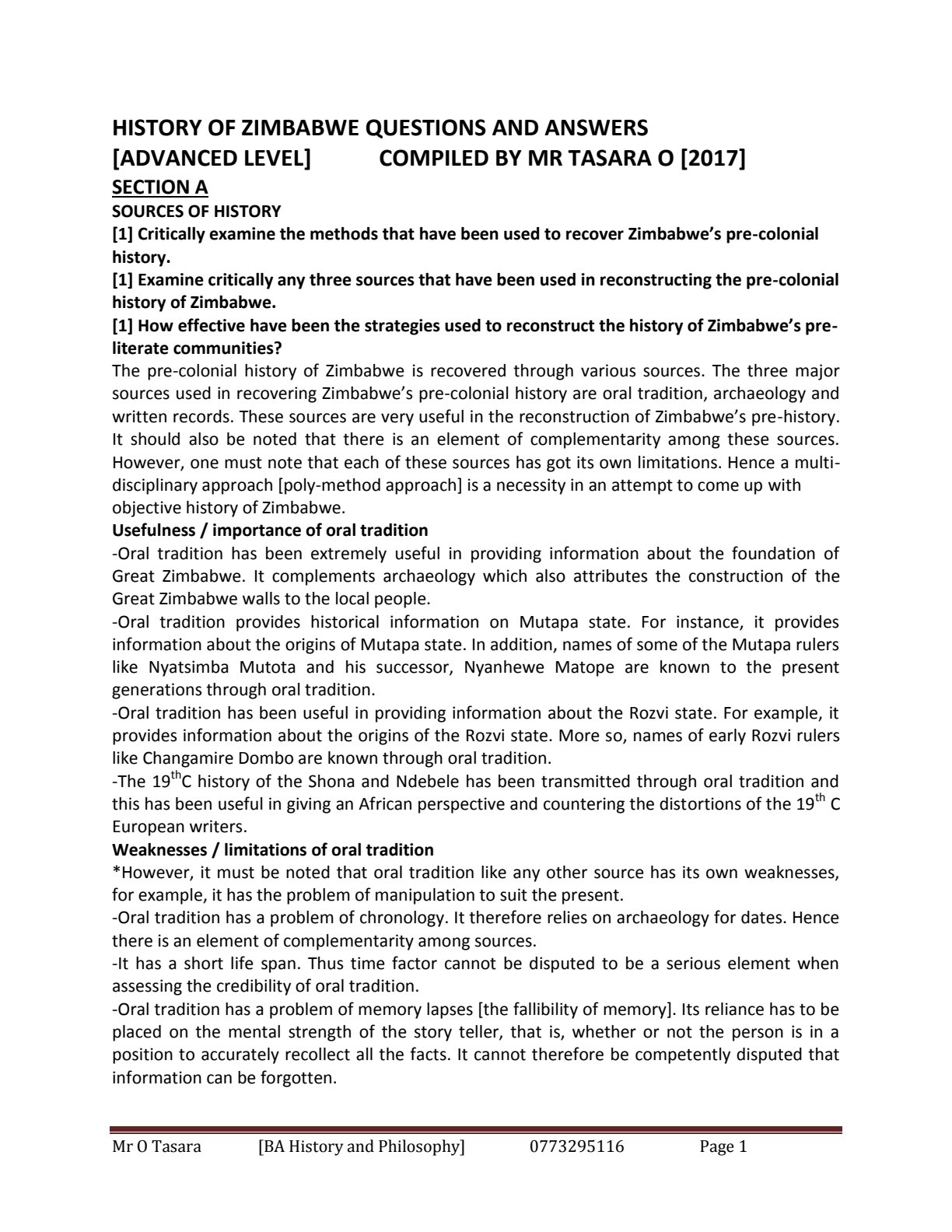
HISTORY OF ZIMBABWE QUESTIONS AND ANSWERS [ADVANCED LEVEL] COMPILED BY MR TASARA O [2017]
SECTION A
SOURCES OF HISTORY
[1] Critically examine the methods that have been used to recover Zimbabwe's pre-colonial history.
[1] Examine critically any three sources that have been used in reconstructing the pre-colonial history of Zimbabwe.
[1] How effective have been the strategies used to reconstruct the history of Zimbabwe's preliterate communities?
The pre-colonial history of Zimbabwe is recovered through various sources. The three major sources used in recovering Zimbabwe's pre-colonial history are oral tradition, archaeology and written records. These sources are very useful in the reconstruction of Zimbabwe's pre-history. It should also be noted that there is an element of complementarity among these sources. However, one must note that each of these sources has got its own limitations. Hence a multidisciplinary approach [poly-method approach] is a necessity in an attempt to come up with objective history of Zimbabwe.
Usefulness / importance of oral tradition
-Oral tradition has been extremely useful in providing information about the foundation of Great Zimbabwe. It complements archaeology which also attributes the construction of the Great Zimbabwe walls to the local people.
-Oral tradition provides historical information on Mutapa state. For instance, it provides information about the origins of Mutapa state. In addition, names of some of the Mutapa rulers like Nyatsimba Mutota and his successor, Nyanhewe Matope are known to the present generations through oral tradition.
-Oral tradition has been useful in providing information about the Rozvi state. For example, it provides information about the origins of the Rozvi state. More so, names of early Rozvi rulers like Changamire Dombo are known through oral tradition.
-The $19{ }^{\text {th }} \mathrm{C}$ history of the Shona and Ndebele has been transmitted through oral tradition and this has been useful in giving an African perspective and countering the distortions of the $19{ }^{\text {th }} \mathrm{C}$ European writers.
Weaknesses / limitations of oral tradition
*However, it must be noted that oral tradition like any other source has its own weaknesses, for example, it has the problem of manipulation to suit the present.
-Oral tradition has a problem of chronology. It therefore relies on archaeology for dates. Hence there is an element of complementarity among sources.
-It has a short life span. Thus …