ExamineAI
First page of A-Level History Sources of History Used in Recovering Zimbabwe's Pre-Colonial History Notes Zimbabwe

A-Level History Sources of History Used in Recovering Zimbabwe's Pre-Colonial History Notes Zimbabwe

Study History notes on Sources of History Used in Recovering Zimbabwe's Pre-Colonial History for A-Level. Useful for revision, homework, and exam preparation in Zimbabwe.

A free account is needed to download. Sign in or create one

Exam board
ZIMSEC
Subject
History
Level
A-Level
Document
Notes
Paper code
9155/5
Year
2017
File
PDF, 1.7 MB

About this notes

This is the ZIMSEC A-Level History notes from 2017. It is a free notes for revision. The paper code is 9155/5.

More History A-Level 2017 papers

Other years: History A-Level

Text from the first page

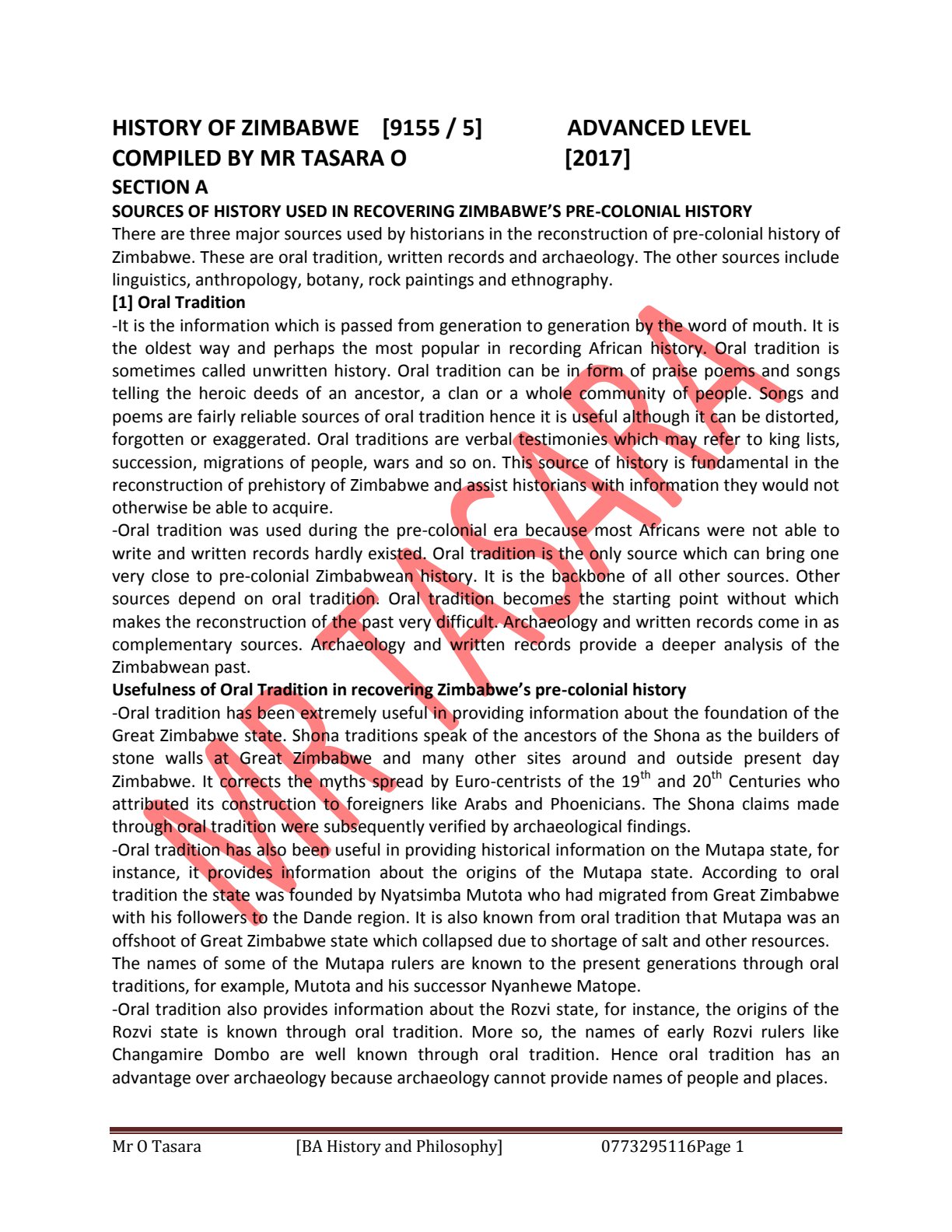
HISTORY OF ZIMBABWE [9155 / 5] COMPILED BY MR TASARA O
SECTION A

ADVANCED LEVEL
[2017]

SOURCES OF HISTORY USED IN RECOVERING ZIMBABWE'S PRE-COLONIAL HISTORY
There are three major sources used by historians in the reconstruction of pre-colonial history of Zimbabwe. These are oral tradition, written records and archaeology. The other sources include linguistics, anthropology, botany, rock paintings and ethnography.
[1] Oral Tradition
-It is the information which is passed from generation to generation by the word of mouth. It is the oldest way and perhaps the most popular in recording African history. Oral tradition is sometimes called unwritten history. Oral tradition can be in form of praise poems and songs telling the heroic deeds of an ancestor, a clan or a whole community of people. Songs and poems are fairly reliable sources of oral tradition hence it is useful although it can be distorted, forgotten or exaggerated. Oral traditions are verbal testimonies which may refer to king lists, succession, migrations of people, wars and so on. This source of history is fundamental in the reconstruction of prehistory of Zimbabwe and assist historians with information they would not otherwise be able to acquire.
-Oral tradition was used during the pre-colonial era because most Africans were not able to write and written records hardly existed. Oral tradition is the only source which can bring one very close to pre-colonial Zimbabwean history. It is the backbone of all other sources. Other sources depend on oral tradition. Oral tradition becomes the starting point without which makes the reconstruction of the past very difficult. Archaeology and written records come in as complementary sources. Archaeology and written records provide a deeper analysis of the Zimbabwean past.
Usefulness of Oral Tradition in recovering Zimbabwe's pre-colonial history
-Oral tradition has been extremely useful in providing information about the foundation of the Great Zimbabwe state. Shona traditions speak of the ancestors of the Shona as the builders of stone walls at Great Zimbabwe and many other sites around and outside present day Zimbabwe. It corrects the myths spread by Euro-centrists of the $19{ }^{\text {th }}$ and $20^{\text {th }}$ Centuries who attributed its construction to foreigners like Arabs and Phoenicians. The Shona claims made through oral tradition were subsequently verified by archaeological findings.
-Oral tradition has also been useful in providing historical …