ExamineAI
First page of Secondary History The Rise of Dictatorship in Europe Notes Zimbabwe

Secondary History The Rise of Dictatorship in Europe Notes Zimbabwe

Study History notes on The Rise of Dictatorship in Europe for Secondary. Useful for revision, homework, and exam preparation in Zimbabwe.

A free account is needed to download. Sign in or create one

Subject
History
Document
Notes
File
PDF, 431 KB

About this notes

This is the History notes. It is a free notes for revision.

More History papers

Other years: History

Text from the first page

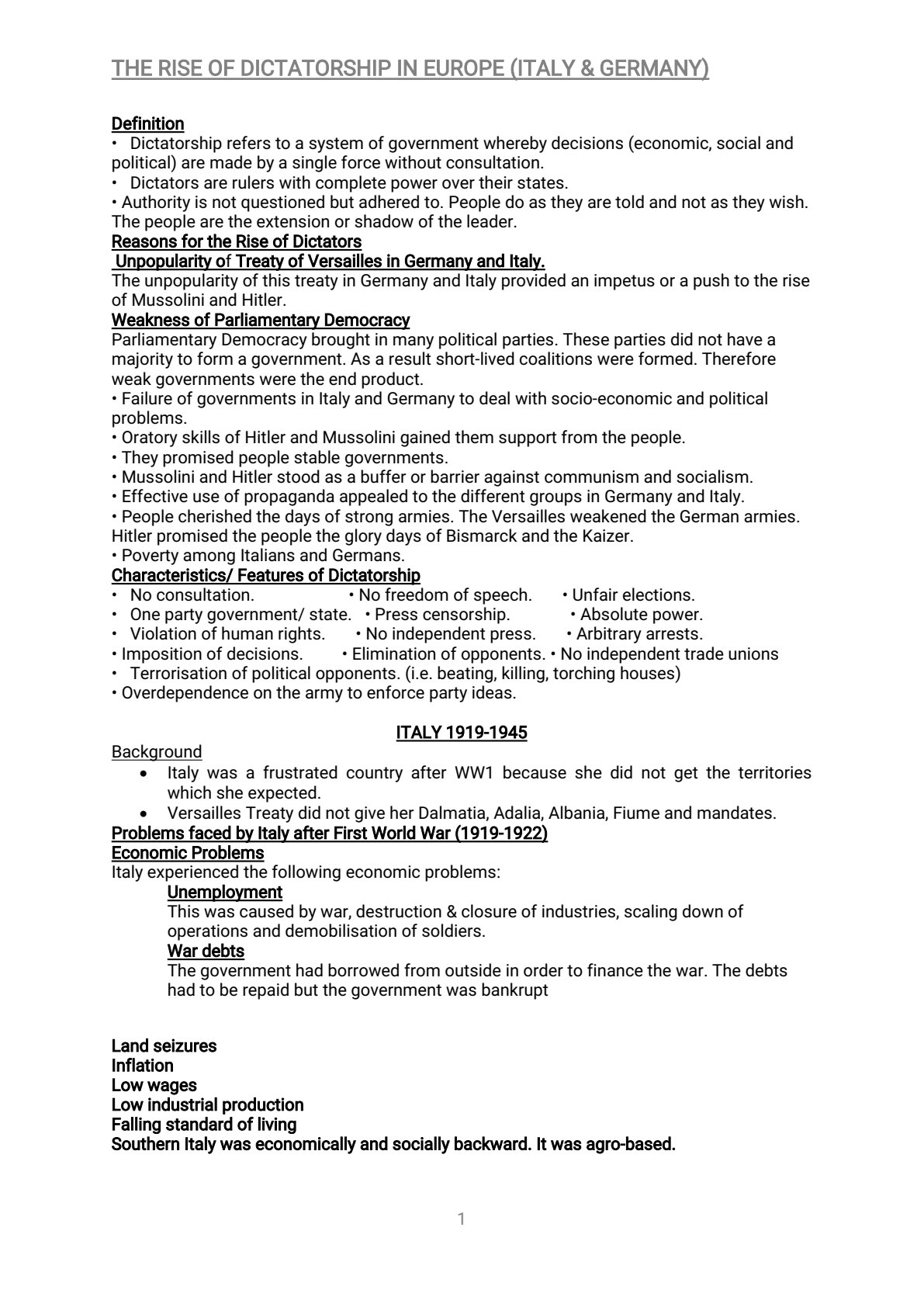
THE RISE OF DICTATORSHIP IN EUROPE (ITALY \& GERMANY)

Definition
- Dictatorship refers to a system of government whereby decisions (economic, social and political) are made by a single force without consultation.
- Dictators are rulers with complete power over their states.
- Authority is not questioned but adhered to. People do as they are told and not as they wish. The people are the extension or shadow of the leader.
Reasons for the Rise of Dictators
Unpopularity of Treaty of Versailles in Germany and Italy.
The unpopularity of this treaty in Germany and Italy provided an impetus or a push to the rise of Mussolini and Hitler.
Weakness of Parliamentary Democracy
Parliamentary Democracy brought in many political parties. These parties did not have a majority to form a government. As a result short-lived coalitions were formed. Therefore weak governments were the end product.
- Failure of governments in Italy and Germany to deal with socio-economic and political problems.
- Oratory skills of Hitler and Mussolini gained them support from the people.
- They promised people stable governments.
- Mussolini and Hitler stood as a buffer or barrier against communism and socialism.
- Effective use of propaganda appealed to the different groups in Germany and Italy.
- People cherished the days of strong armies. The Versailles weakened the German armies. Hitler promised the people the glory days of Bismarck and the Kaizer.
- Poverty among Italians and Germans.

Characteristics/ Features of Dictatorship
- No consultation.
- One party government/ state.
- Violation of human rights.
- Imposition of decisions. - Elimination of opponents. - No independent trade unions
- Terrorisation of political opponents. (i.e. beating, killing, torching houses)
- Overdependence on the army to enforce party ideas.
- No freedom of speech.
- Press censorship.
- No independent press.
- Unfair elections.
- Absolute power.
- Arbitrary arrests.

ITALY 1919-1945
Background
- Italy was a frustrated country after WW1 because she did not get the territories which she expected.
- Versailles Treaty did not give her Dalmatia, Adalia, Albania, Fiume and mandates.

Problems faced by Italy after First World War (1919-1922)
Economic Problems
Italy experienced the following economic problems:
Unemployment
This was caused by war, destruction \& closure of industries, scaling down of operations and demobilisation of soldiers.
War debts
The government had borrowed from outside in order to finance the …