ExamineAI
First page of Secondary History Dictatorships in Europe: Mussolini and Hitler Notes Zimbabwe

Secondary History Dictatorships in Europe: Mussolini and Hitler Notes Zimbabwe

Study History notes on Dictatorships in Europe: Mussolini and Hitler for Secondary. Useful for revision, homework, and exam preparation in Zimbabwe.

A free account is needed to download. Sign in or create one

Subject
History
Document
Notes
File
PDF, 499 KB

About this notes

This is the History notes. It is a free notes for revision.

More History papers

Other years: History

Text from the first page

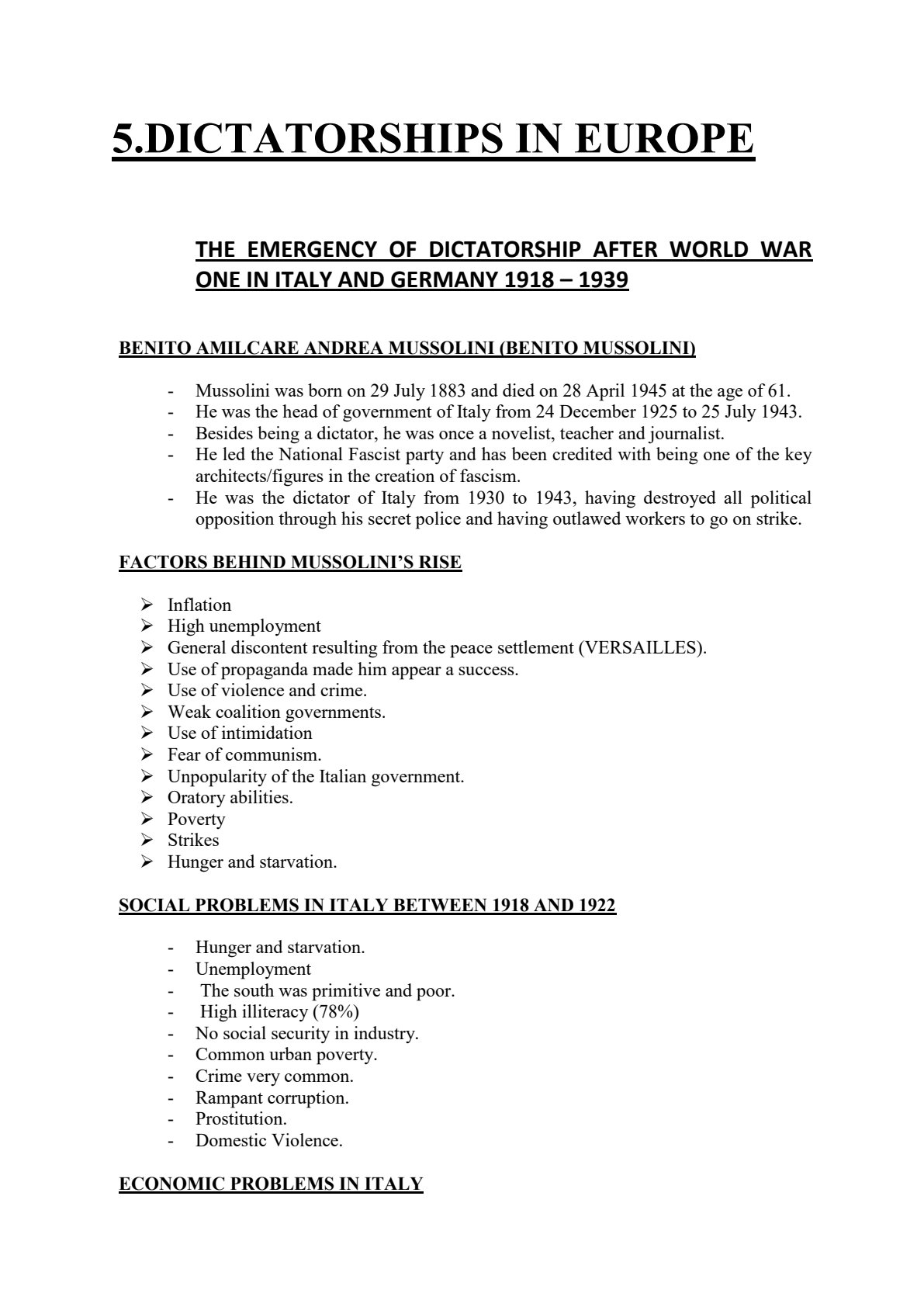
5.DICTATORSHIPS IN EUROPE

THE EMERGENCY OF DICTATORSHIP AFTER WORLD WAR ONE IN ITALY AND GERMANY 1918-1939

BENITO AMILCARE ANDREA MUSSOLINI (BENITO MUSSOLINI)
- Mussolini was born on 29 July 1883 and died on 28 April 1945 at the age of 61.
- He was the head of government of Italy from 24 December 1925 to 25 July 1943.
- Besides being a dictator, he was once a novelist, teacher and journalist.
- He led the National Fascist party and has been credited with being one of the key architects/figures in the creation of fascism.
- He was the dictator of Italy from 1930 to 1943, having destroyed all political opposition through his secret police and having outlawed workers to go on strike.

FACTORS BEHIND MUSSOLINI'S RISE
- Inflation
- High unemployment
- General discontent resulting from the peace settlement (VERSAILLES).
- Use of propaganda made him appear a success.
- Use of violence and crime.
- Weak coalition governments.
- Use of intimidation
- Fear of communism.
- Unpopularity of the Italian government.
- Oratory abilities.
- Poverty
- Strikes
- Hunger and starvation.

SOCIAL PROBLEMS IN ITALY BETWEEN 1918 AND 1922
- Hunger and starvation.
- Unemployment
- The south was primitive and poor.
- High illiteracy (78\%)
- No social security in industry.
- Common urban poverty.
- Crime very common.
- Rampant corruption.
- Prostitution.
- Domestic Violence.

ECONOMIC PROBLEMS IN ITALY