ExamineAI
First page of Secondary History French Revolution Notes Zimbabwe

Secondary History French Revolution Notes Zimbabwe

Study History notes on French Revolution for Secondary. Useful for revision, homework, and exam preparation in Zimbabwe.

A free account is needed to download. Sign in or create one

Subject
History
Document
Notes
File
PDF, 243 KB

About this notes

This is the History notes. It is a free notes for revision.

More History papers

Other years: History

Text from the first page

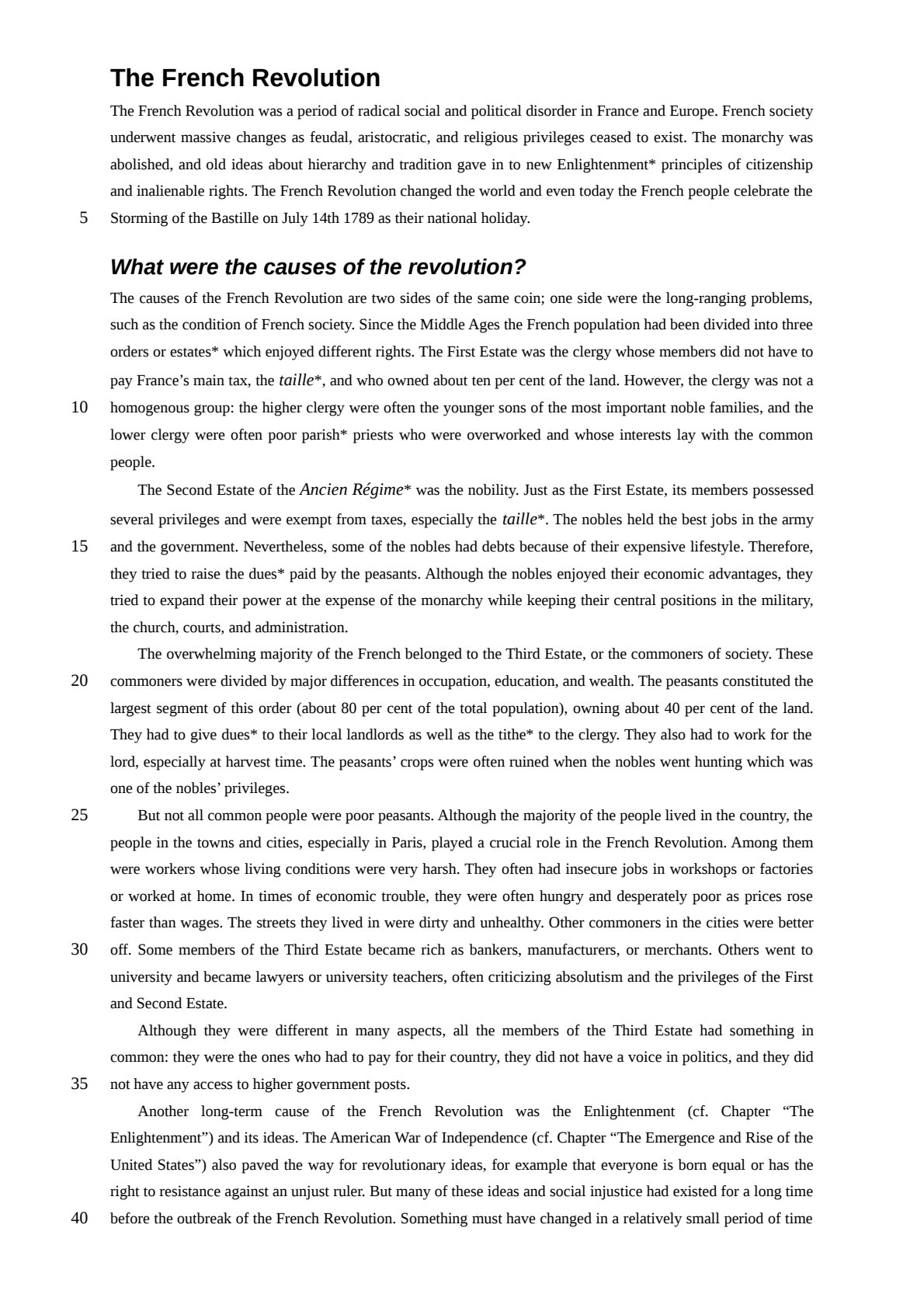
The French Revolution
The French Revolution was a period of radical social and political disorder in France and Europe. French society underwent massive changes as feudal, aristocratic, and religious privileges ceased to exist. The monarchy was abolished, and old ideas about hierarchy and tradition gave in to new Enlightenment* principles of citizenship and inalienable rights. The French Revolution changed the world and even today the French people celebrate the
5
10
15
20
25
30
35
40 Storming of the Bastille on July 14th 1789 as their national holiday.

What were the causes of the revolution?
The causes of the French Revolution are two sides of the same coin; one side were the long-ranging problems, such as the condition of French society. Since the Middle Ages the French population had been divided into three orders or estates* which enjoyed different rights. The First Estate was the clergy whose members did not have to pay France's main tax, the taille*, and who owned about ten per cent of the land. However, the clergy was not a homogenous group: the higher clergy were often the younger sons of the most important noble families, and the lower clergy were often poor parish* priests who were overworked and whose interests lay with the common people.

The Second Estate of the Ancien Régime* was the nobility. Just as the First Estate, its members possessed several privileges and were exempt from taxes, especially the taille*. The nobles held the best jobs in the army and the government. Nevertheless, some of the nobles had debts because of their expensive lifestyle. Therefore, they tried to raise the dues* paid by the peasants. Although the nobles enjoyed their economic advantages, they tried to expand their power at the expense of the monarchy while keeping their central positions in the military, the church, courts, and administration.

The overwhelming majority of the French belonged to the Third Estate, or the commoners of society. These commoners were divided by major differences in occupation, education, and wealth. The peasants constituted the largest segment of this order (about 80 per cent of the total population), owning about 40 per cent of the land. They had to give dues* to their local landlords as well as the tithe* to the clergy. They also had to work for the lord, especially at harvest time. The peasants' crops were often ruined when the nobles went hunting which was one of the nobles' privileges.

But not all common people were poor …