ExamineAI
First page of Secondary Chemistry Redox Equations Notes Zimbabwe

Secondary Chemistry Redox Equations Notes Zimbabwe

Study Chemistry notes on Redox Equations for Secondary. Useful for revision, homework, and exam preparation in Zimbabwe.

A free account is needed to download. Sign in or create one

Subject
Chemistry
Document
Notes
File
PDF, 64 KB

About this notes

This is the Chemistry notes. It is a free notes for revision.

More Chemistry papers

Other years: Chemistry

Text from the first page

Chemguide - answers

REDOX EQUATIONS
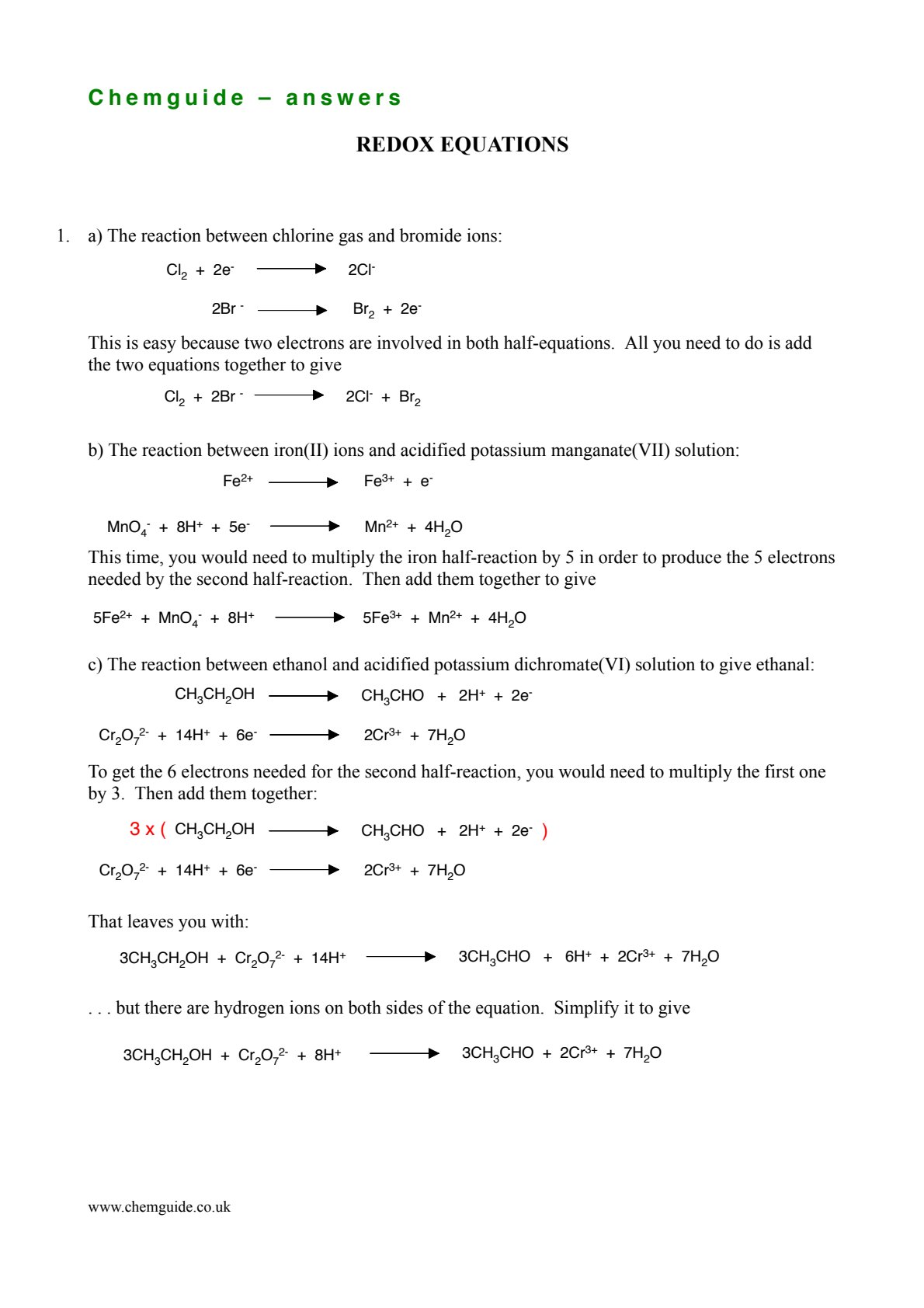
1. a) The reaction between chlorine gas and bromide ions:
\[
\begin{aligned}
\mathrm{Cl}_{2}+2 \mathrm{e}^{-}  |  \longrightarrow 2 \mathrm{Cl}^{-}
2 \mathrm{Br}^{-}  |  \longrightarrow \mathrm{Br}_{2}+2 \mathrm{e}^{-}
\end{aligned}
\]

This is easy because two electrons are involved in both half-equations. All you need to do is add the two equations together to give
\[
\mathrm{Cl}_{2}+2 \mathrm{Br}^{-} \longrightarrow 2 \mathrm{Cl}^{-}+\mathrm{Br}_{2}
\]
b) The reaction between iron(II) ions and acidified potassium manganate(VII) solution:
\[
\begin{aligned}
\mathrm{Fe}^{2+}  |  \longrightarrow \mathrm{Fe}^{3+}+\mathrm{e}^{-}
\mathrm{MnO}_{4}^{-}+8 \mathrm{H}^{+}+5 \mathrm{e}^{-}  |  \longrightarrow \mathrm{Mn}^{2+}+4 \mathrm{H}_{2} \mathrm{O}
\end{aligned}
\]

This time, you would need to multiply the iron half-reaction by 5 in order to produce the 5 electrons needed by the second half-reaction. Then add them together to give
\[
5 \mathrm{Fe}^{2+}+\mathrm{MnO}_{4}^{-}+8 \mathrm{H}^{+} \longrightarrow 5 \mathrm{Fe}^{3+}+\mathrm{Mn}^{2+}+4 \mathrm{H}_{2} \mathrm{O}
\]
c) The reaction between ethanol and acidified potassium dichromate(VI) solution to give ethanal:
\[
\begin{aligned}
\mathrm{CH}_{3} \mathrm{CH}_{2} \mathrm{OH}  |  \longrightarrow \mathrm{CH}_{3} \mathrm{CHO}+2 \mathrm{H}^{+}+2 \mathrm{e}^{-}
\mathrm{Cr}_{2} \mathrm{O}_{7}^{2-}+14 \mathrm{H}^{+}+6 \mathrm{e}^{-}  |  \longrightarrow 2 \mathrm{Cr}^{3+}+7 \mathrm{H}_{2} \mathrm{O}
\end{aligned}
\]

To get the 6 electrons needed for the second half-reaction, you would need to multiply the first one by 3 . Then add them together:
\[
\begin{aligned}
3 \times\left(\mathrm{CH}_{3} \mathrm{CH}_{2} \mathrm{OH}\right.  |  \left.\longrightarrow \mathrm{CH}_{3} \mathrm{CHO}+2 \mathrm{H}^{+}+2 \mathrm{e}^{-}\right)
\mathrm{Cr}_{2} \mathrm{O}_{7}^{2-}+14 \mathrm{H}^{+}+6 \mathrm{e}^{-}  |  \longrightarrow 2 \mathrm{Cr}^{3+}+7 \mathrm{H}_{2} \mathrm{O}
\end{aligned}
\]

That leaves you with:
\[
3 \mathrm{CH}_{3} \mathrm{CH}_{2} \mathrm{OH}+\mathrm{Cr}_{2} \mathrm{O}_{7}^{2-}+14 \mathrm{H}^{+} \longrightarrow 3 \mathrm{CH}_{3} \mathrm{CHO}+6 \mathrm{H}^{+}+2 \mathrm{Cr}^{3+}+7 \mathrm{H}_{2} \mathrm{O}
\]
... but there are hydrogen ions on both sides of the equation. Simplify it to give
\[
3 \mathrm{CH}_{3} \mathrm{CH}_{2} \mathrm{OH}+\mathrm{Cr}_{2} \mathrm{O}_{7}^{2-}+8 \mathrm{H}^{+} \longrightarrow 3 \mathrm{CH}_{3} \mathrm{CHO}+2 \mathrm{Cr}^{3+}+7 \mathrm{H}_{2} …