ExamineAI
First page of Chemistry Organic Chemistry Notes Zimbabwe

Chemistry Organic Chemistry Notes Zimbabwe

Study Chemistry notes on Organic Chemistry. Useful for revision, homework, and exam preparation in Zimbabwe.

A free account is needed to download. Sign in or create one

Subject
Chemistry
Document
Notes
Year
2017
File
PDF, 2.3 MB

About this notes

This is the Chemistry notes from 2017. It is a free notes for revision.

Other years: Chemistry

Text from the first page

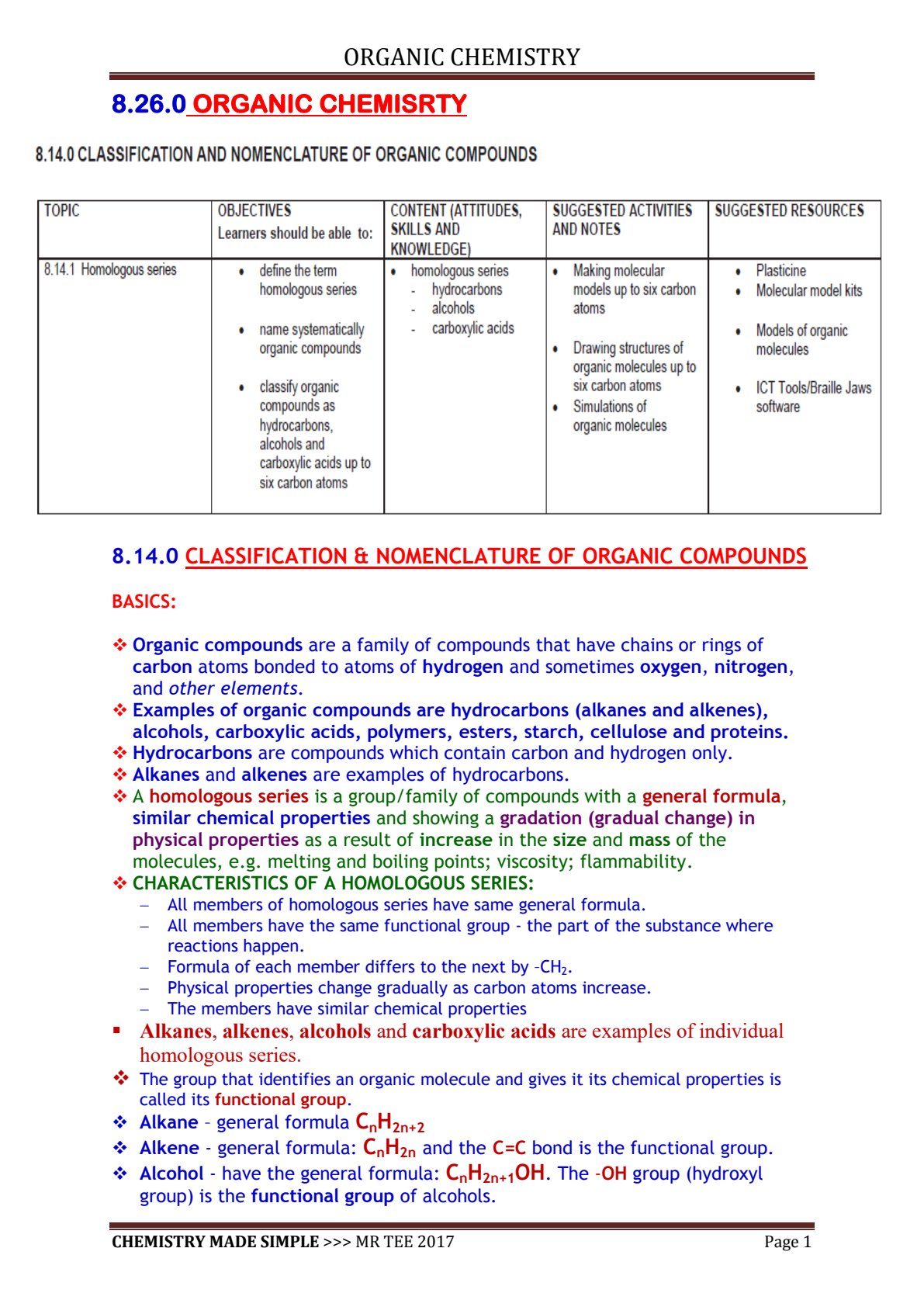
ORGANIC CHEMISTRY
8.26.0 ORGANIC CHEMISRTY

\begin{table}
\captionsetup{labelformat=empty}
\caption{8.14.0 CLASSIFICATION AND NOMENCLATURE OF ORGANIC COMPOUNDS}

 TOPIC  |
OBJECTIVES
Learners should be able to:
  |
CONTENT (ATTITUDES, SKILLS AND
KNOWLEDGE)
  |  SUGGESTED ACTIVITIES AND NOTES  |  SUGGESTED RESOURCES
 8.14.1 Homologous series  |
- define the term homologous series
- name systematically organic compounds
- classify organic compounds as hydrocarbons, alcohols and carboxylic acids up to six carbon atoms
  |
- homologous series
- hydrocarbons
- alcohols
- carboxylic acids
  |
- Making molecular models up to six carbon atoms
- Drawing structures of organic molecules up to six carbon atoms
- Simulations of organic molecules
  |
- Plasticine
- Molecular model kits
- Models of organic molecules
- ICT Tools/Braille Jaws software

\end{table}
8.14.0 CLASSIFICATION \& NOMENCLATURE OF ORGANIC COMPOUNDS

BASICS:
Organic compounds are a family of compounds that have chains or rings of carbon atoms bonded to atoms of hydrogen and sometimes oxygen, nitrogen, and other elements.
Examples of organic compounds are hydrocarbons (alkanes and alkenes), alcohols, carboxylic acids, polymers, esters, starch, cellulose and proteins.
* Hydrocarbons are compounds which contain carbon and hydrogen only.
* Alkanes and alkenes are examples of hydrocarbons.
* A homologous series is a group/family of compounds with a general formula, similar chemical properties and showing a gradation (gradual change) in physical properties as a result of increase in the size and mass of the molecules, e.g. melting and boiling points; viscosity; flammability.
\& CHARACTERISTICS OF A HOMOLOGOUS SERIES:
- All members of homologous series have same general formula.
- All members have the same functional group - the part of the substance where reactions happen.
- Formula of each member differs to the next by $-\mathrm{CH}_{2}$.
- Physical properties change gradually as carbon atoms increase.
- The members have similar chemical properties
- Alkanes, alkenes, alcohols and carboxylic acids are examples of individual homologous series.
* The group that identifies an organic molecule and gives it its chemical properties is called its functional group.
- Alkane - general formula $\mathrm{C}_{\mathrm{n}} \mathrm{H}_{2 \mathrm{n}+2}$
- Alkene - general formula: $\mathrm{C}_{\mathrm{n}} \mathrm{H}_{2 \mathrm{n}}$ and the $\mathrm{C}=\mathrm{C}$ bond is the functional group.
* Alcohol - have the general …