ExamineAI
First page of Secondary Chemistry Color of Transition Metal Complexes Notes Zimbabwe

Secondary Chemistry Color of Transition Metal Complexes Notes Zimbabwe

Study Chemistry notes on Color of Transition Metal Complexes for Secondary. Useful for revision, homework, and exam preparation in Zimbabwe.

A free account is needed to download. Sign in or create one

Subject
Chemistry
Document
Notes
File
PDF, 399 KB

About this notes

This is the Chemistry notes. It is a free notes for revision.

More Chemistry papers

Other years: Chemistry

Text from the first page

Color of Transition Metal Complexes
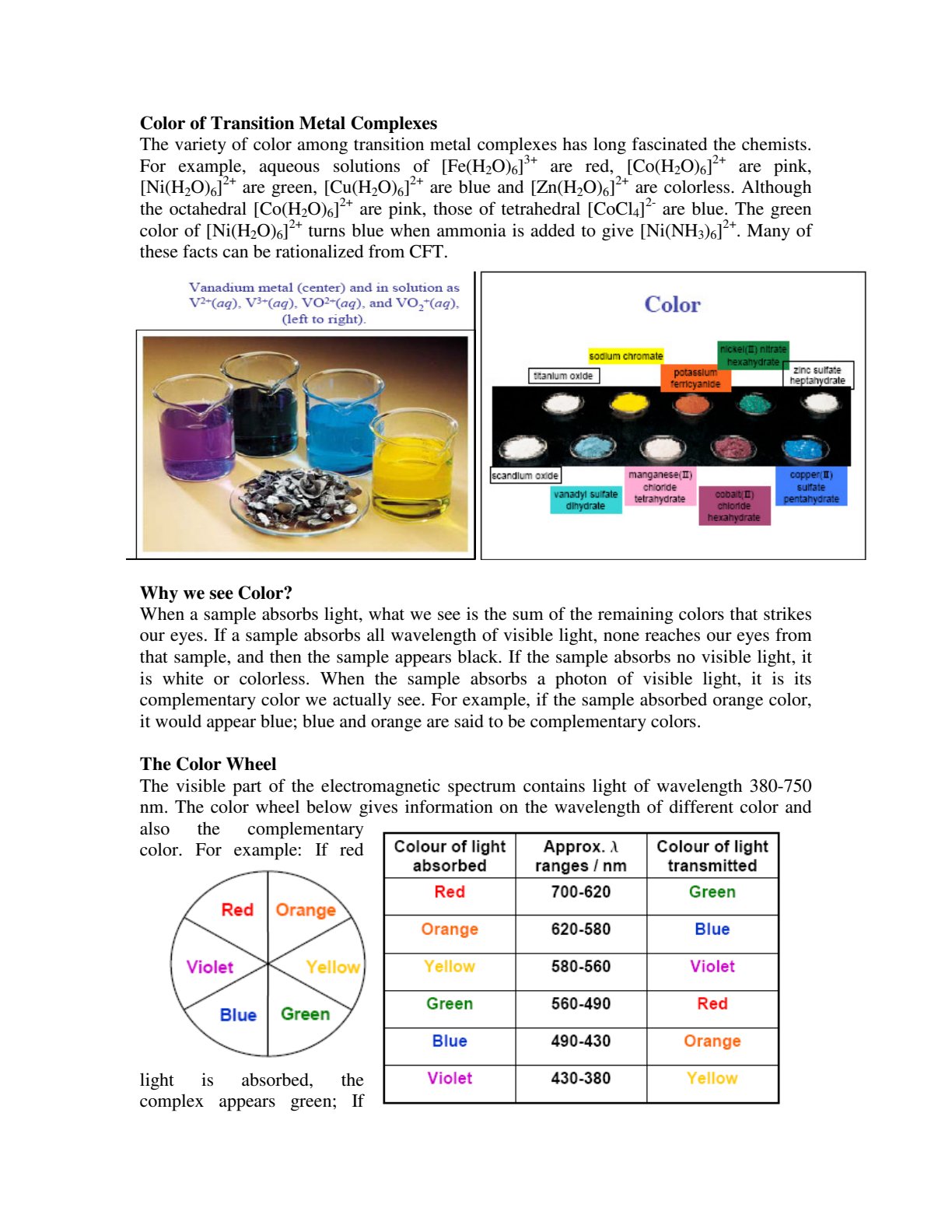
The variety of color among transition metal complexes has long fascinated the chemists. For example, aqueous solutions of $\left[\mathrm{Fe}\left(\mathrm{H}_{2} \mathrm{O}\right)_{6}\right]^{3+}$ are red, $\left[\mathrm{Co}\left(\mathrm{H}_{2} \mathrm{O}\right)_{6}\right]^{2+}$ are pink, $\left[\mathrm{Ni}\left(\mathrm{H}_{2} \mathrm{O}\right)_{6}\right]^{2+}$ are green, $\left[\mathrm{Cu}\left(\mathrm{H}_{2} \mathrm{O}\right)_{6}\right]^{2+}$ are blue and $\left[\mathrm{Zn}\left(\mathrm{H}_{2} \mathrm{O}\right)_{6}\right]^{2+}$ are colorless. Although the octahedral $\left[\mathrm{Co}\left(\mathrm{H}_{2} \mathrm{O}\right)_{6}\right]^{2+}$ are pink, those of tetrahedral $\left[\mathrm{CoCl}_{4}\right]^{2-}$ are blue. The green color of $\left[\mathrm{Ni}\left(\mathrm{H}_{2} \mathrm{O}\right)_{6}\right]^{2+}$ turns blue when ammonia is added to give $\left[\mathrm{Ni}\left(\mathrm{NH}_{3}\right)_{6}\right]^{2+}$. Many of these facts can be rationalized from CFT.

Vanadium metal (center) and in solution as $\mathrm{V}^{2+}(a q), \mathrm{V}^{3+}(a q), \mathrm{VO}^{2+}(a q)$, and $\mathrm{VO}_{2}{ }^{+}(a q)$, (left to right).

Why we see Color?
When a sample absorbs light, what we see is the sum of the remaining colors that strikes our eyes. If a sample absorbs all wavelength of visible light, none reaches our eyes from that sample, and then the sample appears black. If the sample absorbs no visible light, it is white or colorless. When the sample absorbs a photon of visible light, it is its complementary color we actually see. For example, if the sample absorbed orange color, it would appear blue; blue and orange are said to be complementary colors.

The Color Wheel
The visible part of the electromagnetic spectrum contains light of wavelength 380-750 nm . The color wheel below gives information on the wavelength of different color and also the complementary color. For example: If red
light is absorbed, the complex appears green; If

 Colour of light absorbed  |  Approx. $\lambda$ ranges / nm  |  Colour of light transmitted
 Red  |  700-620  |  Green
 Orange  |  620-580  |  Blue
 Yellow  |  580-560  |  Violet
 Green  |  560-490  |  Red
 Blue  |  490-430  |  Orange
 Violet  |  430-380  |  Yellow