ExamineAI
First page of Secondary Chemistry Chemical Periodicity Notes Zimbabwe

Secondary Chemistry Chemical Periodicity Notes Zimbabwe

Study Chemistry notes on Chemical Periodicity for Secondary. Useful for revision, homework, and exam preparation in Zimbabwe.

A free account is needed to download. Sign in or create one

Subject
Chemistry
Document
Notes
File
PDF, 4.3 MB

About this notes

This is the Chemistry notes. It is a free notes for revision.

More Chemistry papers

Other years: Chemistry

Text from the first page

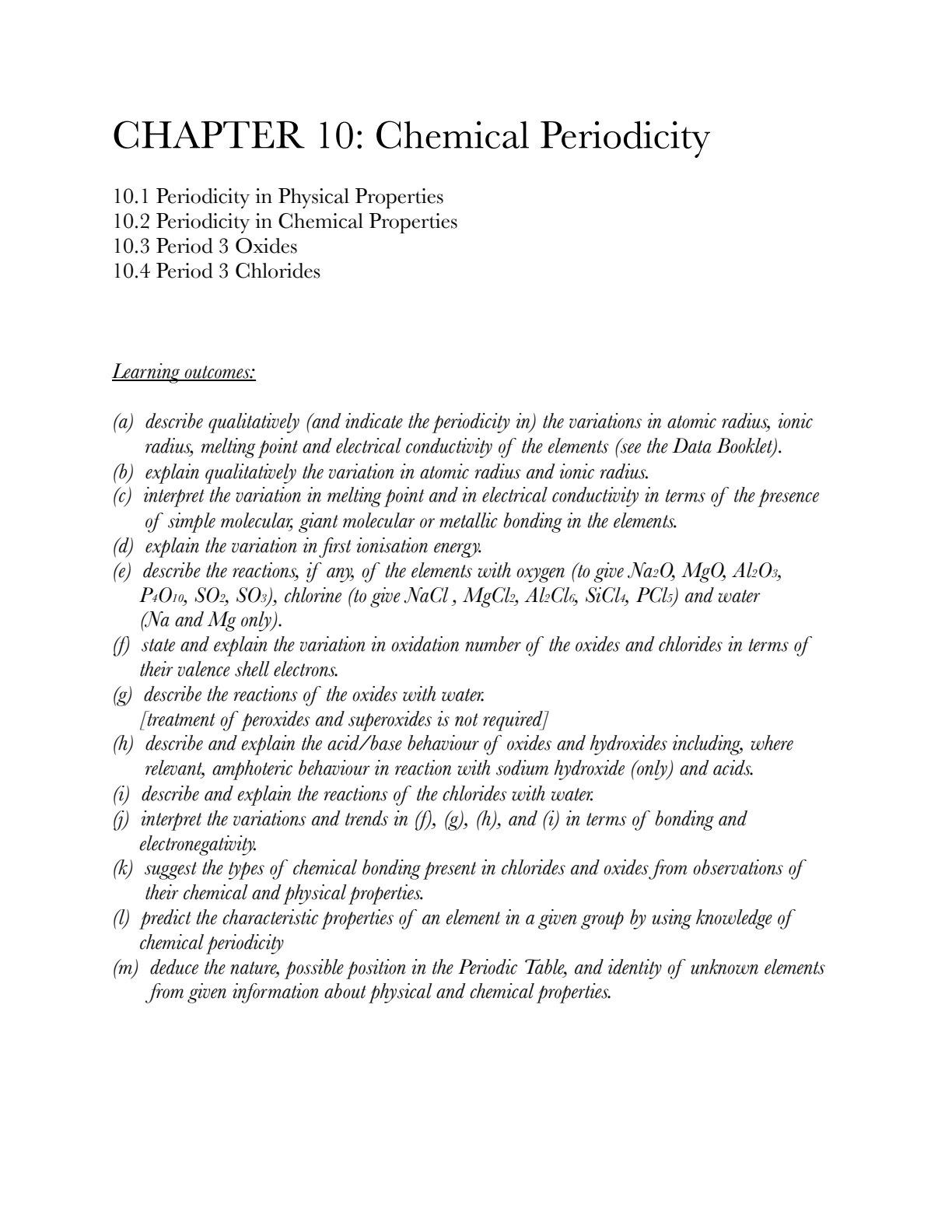
CHAPTER 10: Chemical Periodicity
10.1 Periodicity in Physical Properties
10.2 Periodicity in Chemical Properties
10.3 Period 3 Oxides
10.4 Period 3 Chlorides

Learning outcomes:
(a) describe qualitatively (and indicate the periodicity in) the variations in atomic radius, ionic radius, melting point and electrical conductivity of the elements (see the Data Booklet).
(b) explain qualitatively the variation in atomic radius and ionic radius.
(c) interpret the variation in melting point and in electrical conductivity in terms of the presence of simple molecular, giant molecular or metallic bonding in the elements.
(d) explain the variation in first ionisation energy.
(e) describe the reactions, if any, of the elements with oxygen (to give $\mathrm{Na}_{2} \mathrm{O}, \mathrm{MgO}_{1} \mathrm{Al}_{2} \mathrm{O}_{3}$, $\mathrm{P}_{4} \mathrm{O}_{10}, \mathrm{SO}_{2}, \mathrm{SO}_{3}$ ), chlorine (to give $\mathrm{NaCl}, \mathrm{MgCl}_{2}, \mathrm{Al}_{2} \mathrm{Cl}_{6}, \mathrm{SiCl}_{4}, \mathrm{PCl}_{5}$ ) and water (Na and Mg only).
(f) state and explain the variation in oxidation number of the oxides and chlorides in terms of their valence shell electrons.
(g) describe the reactions of the oxides with water.
[treatment of peroxides and superoxides is not required]
(h) describe and explain the acid/base behaviour of oxides and hydroxides including, where relevant, amphoteric behaviour in reaction with sodium hydroxide (only) and acids.
(i) describe and explain the reactions of the chlorides with water.
(j) interpret the variations and trends in (f), (g), (h), and (i) in terms of bonding and electronegativity.
(k) suggest the types of chemical bonding present in chlorides and oxides from observations of their chemical and physical properties.
(l) predict the characteristic properties of an element in a given group by using knowledge of chemical periodicity
(m) deduce the nature, possible position in the Periodic Table, and identity of unknown elements from given information about physical and chemical properties.