ExamineAI
First page of Secondary Chemistry Acid-Base Neutralisation and Salts Notes Zimbabwe

Secondary Chemistry Acid-Base Neutralisation and Salts Notes Zimbabwe

Study Chemistry notes on Acid-Base Neutralisation and Salts for Secondary. Useful for revision, homework, and exam preparation in Zimbabwe.

A free account is needed to download. Sign in or create one

Subject
Chemistry
Document
Notes
File
PDF, 146 KB

About this notes

This is the Chemistry notes. It is a free notes for revision.

More Chemistry papers

Other years: Chemistry

Text from the first page

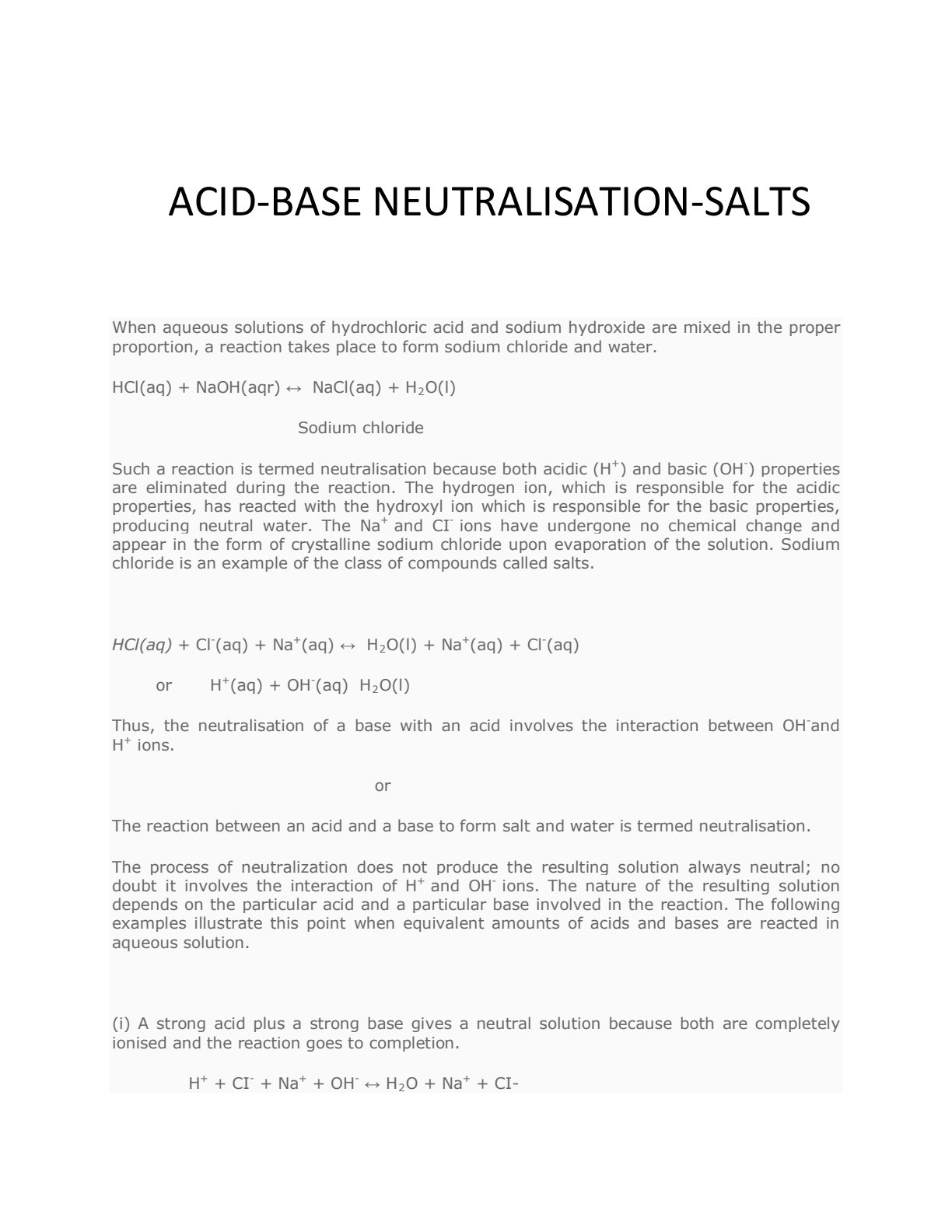
ACID-BASE NEUTRALISATION-SALTS

When aqueous solutions of hydrochloric acid and sodium hydroxide are mixed in the proper proportion, a reaction takes place to form sodium chloride and water.
\[
\mathrm{HCl}(\mathrm{aq})+\mathrm{NaOH}(\mathrm{aqr}) \leftrightarrow \mathrm{NaCl}(\mathrm{aq})+\mathrm{H}_{2} \mathrm{O}(\mathrm{l})
\]

Sodium chloride
Such a reaction is termed neutralisation because both acidic ( $\mathrm{H}^{+}$) and basic ( $\mathrm{OH}^{-}$) properties are eliminated during the reaction. The hydrogen ion, which is responsible for the acidic properties, has reacted with the hydroxyl ion which is responsible for the basic properties, producing neutral water. The $\mathrm{Na}^{+}$and $\mathrm{CI}^{-}$ions have undergone no chemical change and appear in the form of crystalline sodium chloride upon evaporation of the solution. Sodium chloride is an example of the class of compounds called salts.
\[
\begin{array}{l}
\mathrm{HCl}(\mathrm{aq})+\mathrm{Cl}^{-}(\mathrm{aq})+\mathrm{Na}^{+}(\mathrm{aq}) \leftrightarrow \mathrm{H}_{2} \mathrm{O}(\mathrm{I})+\mathrm{Na}^{+}(\mathrm{aq})+\mathrm{Cl}^{-}(\mathrm{aq})
\quad \text { or } \quad \mathrm{H}^{+}(\mathrm{aq})+\mathrm{OH}^{-}(\mathrm{aq}) \quad \mathrm{H}_{2} \mathrm{O}(\mathrm{I})
\end{array}
\]

Thus, the neutralisation of a base with an acid involves the interaction between $\mathrm{OH}^{-}$and $\mathrm{H}^{+}$ions.
or
The reaction between an acid and a base to form salt and water is termed neutralisation.
The process of neutralization does not produce the resulting solution always neutral; no doubt it involves the interaction of $\mathrm{H}^{+}$and $\mathrm{OH}^{-}$ions. The nature of the resulting solution depends on the particular acid and a particular base involved in the reaction. The following examples illustrate this point when equivalent amounts of acids and bases are reacted in aqueous solution.
(i) A strong acid plus a strong base gives a neutral solution because both are completely ionised and the reaction goes to completion.
\[
\mathrm{H}^{+}+\mathrm{Cl}^{-}+\mathrm{Na}^{+}+\mathrm{OH}^{-} \leftrightarrow \mathrm{H}_{2} \mathrm{O}+\mathrm{Na}^{+}+\mathrm{CI}-
\]