ExamineAI
First page of O-Level Principles of Accounts Bank Reconciliation Statement Notes Zimbabwe

O-Level Principles of Accounts Bank Reconciliation Statement Notes Zimbabwe

Study Principles of Accounts notes on Bank Reconciliation Statement for O-Level. Useful for revision, homework, and exam preparation in Zimbabwe.

A free account is needed to download. Sign in or create one

Subject
Principles of Accounts
Level
O-Level
Document
Notes
File
PDF, 310 KB

About this notes

This is the O-Level Principles of Accounts notes. It is a free notes for revision.

More Principles of Accounts O-Level papers

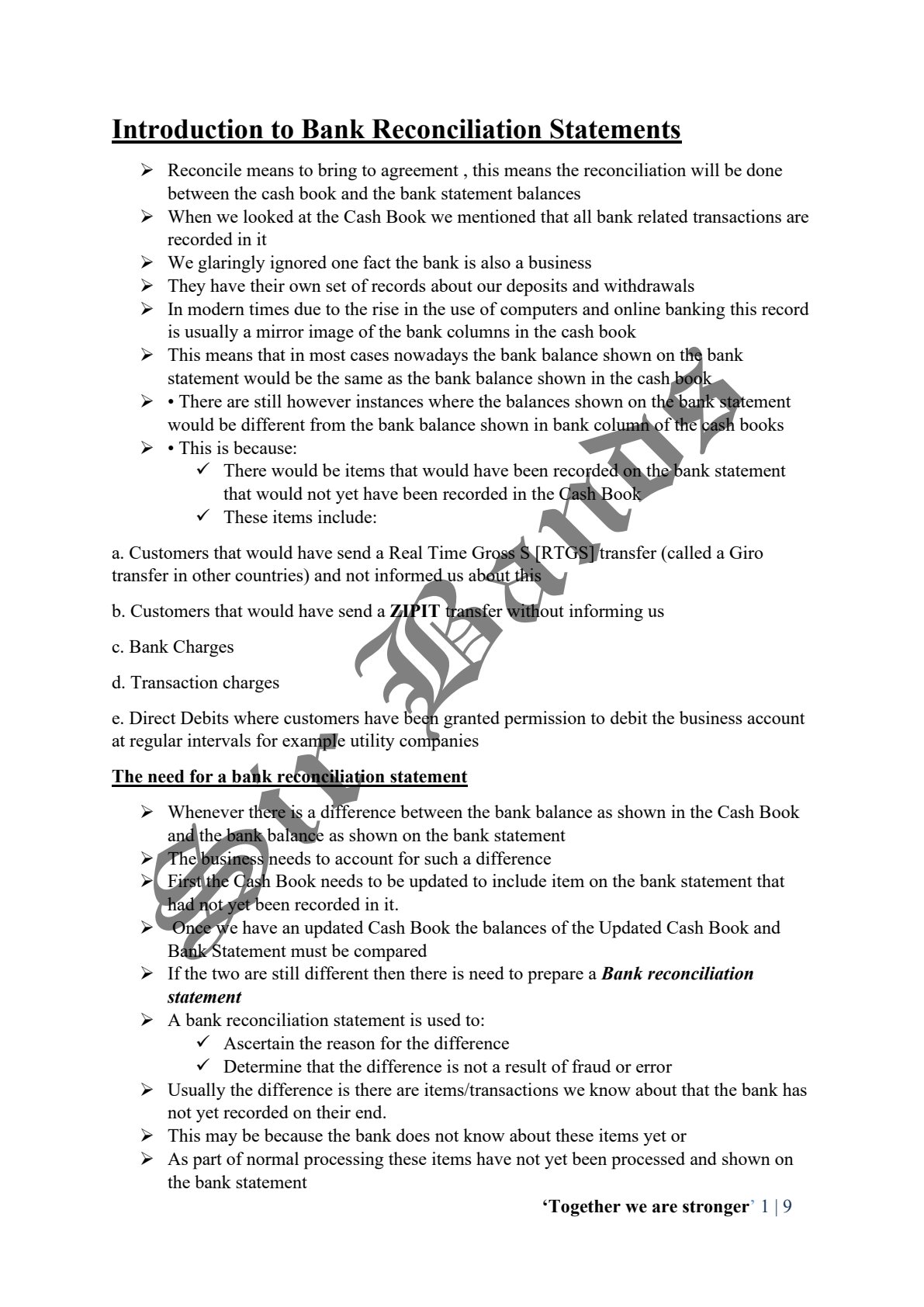
Text from the first page

Introduction to Bank Reconciliation Statements
- Reconcile means to bring to agreement, this means the reconciliation will be done between the cash book and the bank statement balances
- When we looked at the Cash Book we mentioned that all bank related transactions are recorded in it
- We glaringly ignored one fact the bank is also a business
- They have their own set of records about our deposits and withdrawals
- In modern times due to the rise in the use of computers and online banking this record is usually a mirror image of the bank columns in the cash book
- This means that in most cases nowadays the bank balance shown on the bank statement would be the same as the bank balance shown in the cash book
- - There are still however instances where the balances shown on the bank statement would be different from the bank balance shown in bank column of the cash books
- - This is because:
✓ There would be items that would have been recorded on the bank statement that would not yet have been recorded in the Cash Book
✓ These items include:
a. Customers that would have send a Real Time Gross S [RTGS]transfer (called a Giro transfer in other countries) and not informed us about this
b. Customers that would have send a ZIPIT transfer without informing us
c. Bank Charges
d. Transaction charges
e. Direct Debits where customers have been granted permission to debit the business account at regular intervals for example utility companies

The need for a bank reconciliation statement
- Whenever there is a difference between the bank balance as shown in the Cash Book and the bank balance as shown on the bank statement
- The business needs to account for such a difference First the Cash Book needs to be updated to include item on the bank statement that had not yet been recorded in it.
- Once we have an updated Cash Book the balances of the Updated Cash Book and Bank Statement must be compared
- If the two are still different then there is need to prepare a Bank reconciliation statement
- A bank reconciliation statement is used to:
✓ Ascertain the reason for the difference
✓ Determine that the difference is not a result of fraud or error
- Usually the difference is there are items/transactions we know about that the bank has not yet recorded on their end.
- This may be because the bank does not know about these items yet or
- As part of normal processing these items have not yet been processed and shown on the bank statement

'Together we are stronger' 1 | 9