ExamineAI
First page of O-Level Physics Notes Zimbabwe

O-Level Physics Notes Zimbabwe

Study Physics notes for O-Level. Useful for revision, homework, and exam preparation in Zimbabwe.

A free account is needed to download. Sign in or create one

Exam board
ZIMSEC
Subject
Physics
Level
O-Level
Document
Notes
File
PDF, 7.9 MB

About this notes

This is the ZIMSEC O-Level Physics notes. It is a free notes for revision.

More Physics O-Level papers

Other years: Physics O-Level

Text from the first page

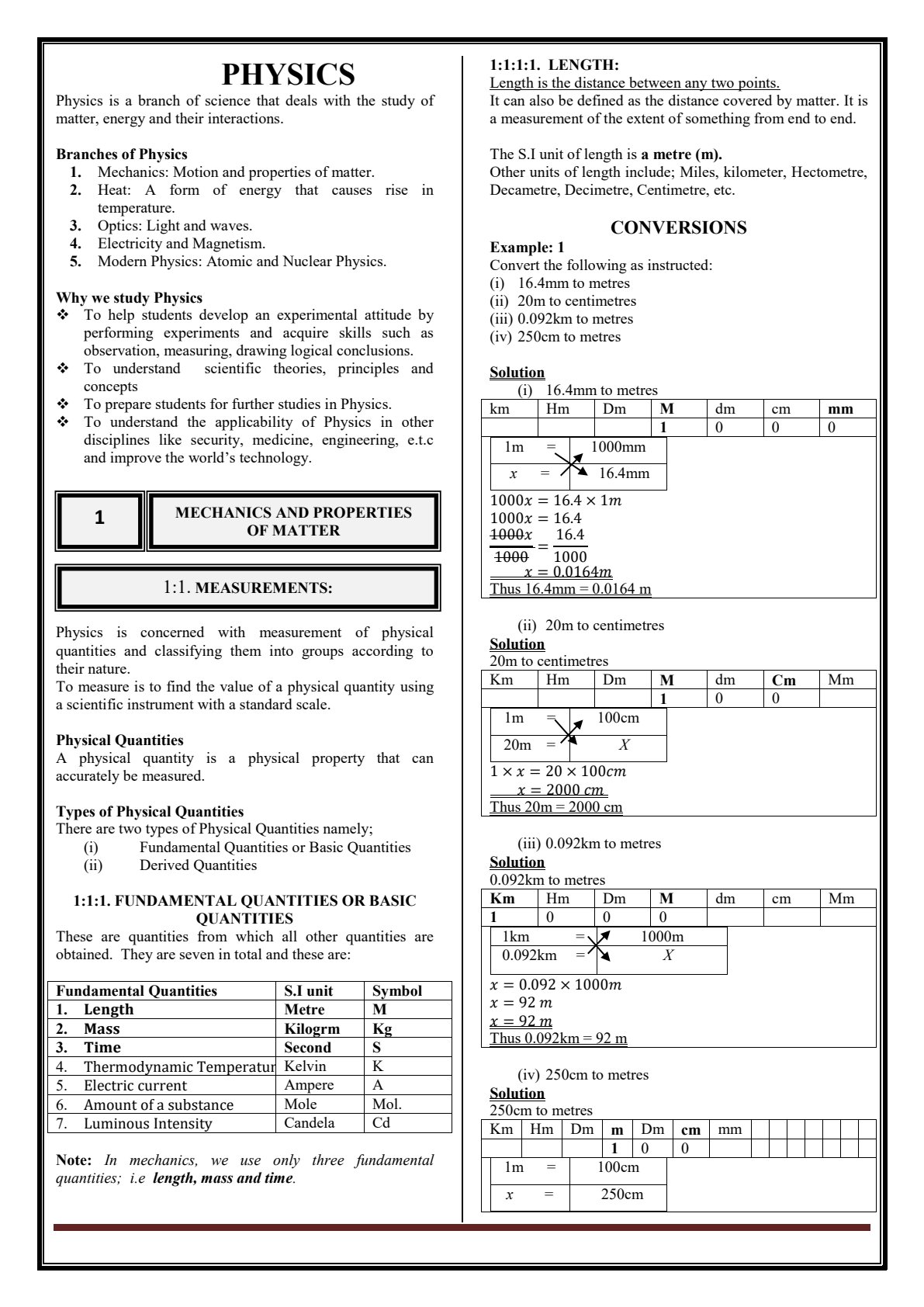
PHYSICS
Physics is a branch of science that deals with the study of matter, energy and their interactions.

Branches of Physics
1. Mechanics: Motion and properties of matter.
2. Heat: A form of energy that causes rise in temperature.
3. Optics: Light and waves.
4. Electricity and Magnetism.
5. Modern Physics: Atomic and Nuclear Physics.

Why we study Physics
- To help students develop an experimental attitude by performing experiments and acquire skills such as observation, measuring, drawing logical conclusions.
- To understand scientific theories, principles and concepts
- To prepare students for further studies in Physics.
- To understand the applicability of Physics in other disciplines like security, medicine, engineering, e.t.c and improve the world's technology.

1
MECHANICS AND PROPERTIES OF MATTER

1:1. MEASUREMENTS:

Physics is concerned with measurement of physical quantities and classifying them into groups according to their nature.
To measure is to find the value of a physical quantity using a scientific instrument with a standard scale.

Physical Quantities
A physical quantity is a physical property that can accurately be measured.

Types of Physical Quantities
There are two types of Physical Quantities namely;
(i) Fundamental Quantities or Basic Quantities
(ii) Derived Quantities

1:1:1. FUNDAMENTAL QUANTITIES OR BASIC QUANTITIES
These are quantities from which all other quantities are obtained. They are seven in total and these are:

 Fundamental Quantities  |  S.I unit  |  Symbol
 1.  |  Length  |  Metre  |  M
 2.  |  Mass  |  Kilogrm  |  Kg
 3.  |  Time  |  Second  |  S
 4.  |  Thermodynamic Temperatur  |  Kelvin  |  K
 5.  |  Electric current  |  Ampere  |  A
 6.  |  Amount of a substance  |  Mole  |  Mol.
 7.  |  Luminous Intensity  |  Candela  |  Cd

Note: In mechanics, we use only three fundamental quantities; i.e length, mass and time.

1:1:1:1. LENGTH:
Length is the distance between any two points.
It can also be defined as the distance covered by matter. It is a measurement of the extent of something from end to end.

The S.I unit of length is a metre (m).
Other units of length include; Miles, kilometer, Hectometre, Decametre, Decimetre, Centimetre, etc.

CONVERSIONS
Example: 1
Convert the following as instructed:
(i) 16.4 mm to metres
(ii) 20 m to centimetres
(iii) 0.092 km to metres
(iv) 250 cm to metres

Solution
(i) 16.4 mm to metres

 km  |  Hm  |  Dm  |  $\mathbf{M}$  |  dm  |  cm  |  $\mathbf{m m}$
  |  &  |  $\mathbf{1}$ …