ExamineAI
First page of Literature in English Literary Devices Notes Zimbabwe

Literature in English Literary Devices Notes Zimbabwe

Study Literature in English notes on Literary Devices. Useful for revision, homework, and exam preparation in Zimbabwe.

A free account is needed to download. Sign in or create one

Subject
Literature in English
Document
Notes
File
PDF, 156 KB

About this notes

This is the Literature in English notes. It is a free notes for revision.

More Literature in English papers

Text from the first page

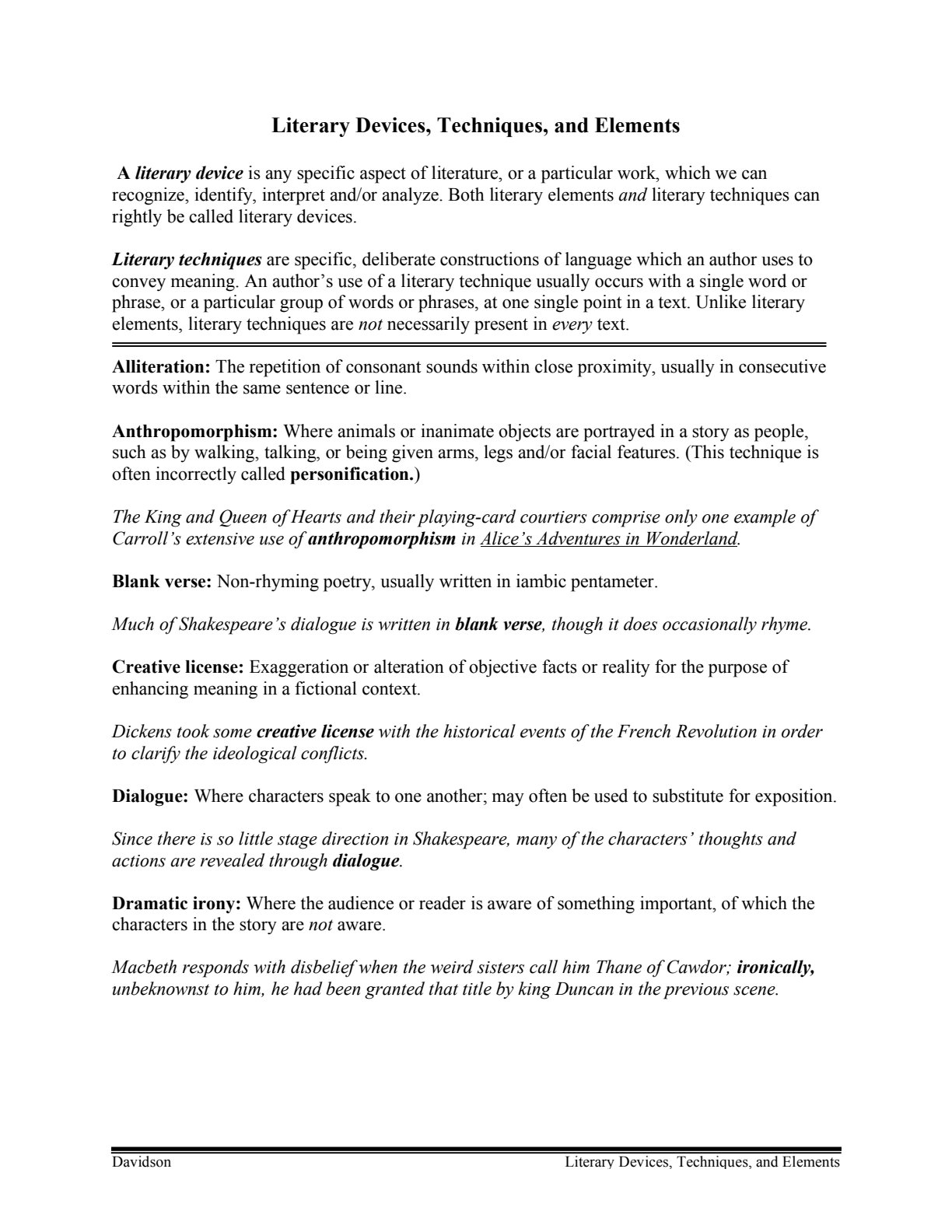
Literary Devices, Techniques, and Elements
A literary device is any specific aspect of literature, or a particular work, which we can recognize, identify, interpret and/or analyze. Both literary elements and literary techniques can rightly be called literary devices.

Literary techniques are specific, deliberate constructions of language which an author uses to convey meaning. An author's use of a literary technique usually occurs with a single word or phrase, or a particular group of words or phrases, at one single point in a text. Unlike literary elements, literary techniques are not necessarily present in every text.

Alliteration: The repetition of consonant sounds within close proximity, usually in consecutive words within the same sentence or line.

Anthropomorphism: Where animals or inanimate objects are portrayed in a story as people, such as by walking, talking, or being given arms, legs and/or facial features. (This technique is often incorrectly called personification.)

The King and Queen of Hearts and their playing-card courtiers comprise only one example of Carroll's extensive use of anthropomorphism in Alice's Adventures in Wonderland.

Blank verse: Non-rhyming poetry, usually written in iambic pentameter.
Much of Shakespeare's dialogue is written in blank verse, though it does occasionally rhyme.
Creative license: Exaggeration or alteration of objective facts or reality for the purpose of enhancing meaning in a fictional context.

Dickens took some creative license with the historical events of the French Revolution in order to clarify the ideological conflicts.

Dialogue: Where characters speak to one another; may often be used to substitute for exposition.
Since there is so little stage direction in Shakespeare, many of the characters' thoughts and actions are revealed through dialogue.

Dramatic irony: Where the audience or reader is aware of something important, of which the characters in the story are not aware.

Macbeth responds with disbelief when the weird sisters call him Thane of Cawdor; ironically, unbeknownst to him, he had been granted that title by king Duncan in the previous scene.

Davidson
Literary Devices, Techniques, and Elements