ExamineAI
First page of Chemistry Period 3 Elements Notes Zimbabwe

Chemistry Period 3 Elements Notes Zimbabwe

Study Chemistry notes on Period 3 Elements. Useful for revision, homework, and exam preparation in Zimbabwe.

A free account is needed to download. Sign in or create one

Subject
Chemistry
Document
Notes
File
PDF, 17 KB

About this notes

This is the Chemistry notes. It is a free notes for revision.

More Chemistry papers

Other years: Chemistry

Text from the first page

Period 3
A5
1

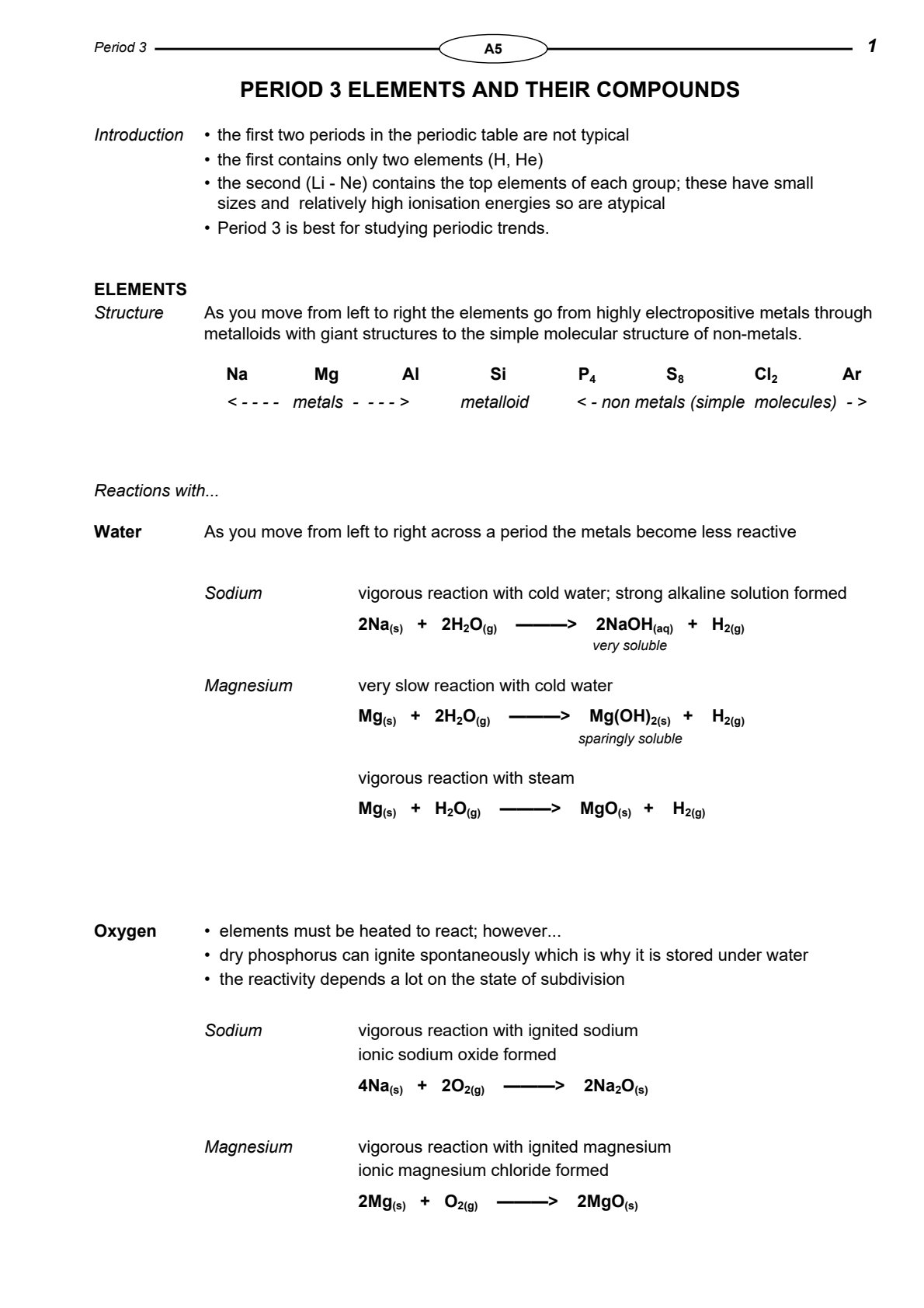
PERIOD 3 ELEMENTS AND THEIR COMPOUNDS

Introduction - the first two periods in the periodic table are not typical
- the first contains only two elements (H, He)
- the second ( $\mathrm{Li}-\mathrm{Ne}$ ) contains the top elements of each group; these have small sizes and relatively high ionisation energies so are atypical
- Period 3 is best for studying periodic trends.

ELEMENTS
Structure As you move from left to right the elements go from highly electropositive metals through metalloids with giant structures to the simple molecular structure of non-metals.

$\left.\begin{array}{lccclcll}\mathrm{Na}  |  \mathrm{Mg}  |  \mathrm{Al}  |  \mathrm{Si}  |  \mathrm{P}_{4}  |  \mathrm{~S}_{8}  |  \mathrm{Cl}_{2}  |  \mathrm{Ar}  <--  |  \text { metals }  |  \ldots->  |  \text { metalloid }  |  & <- \text { non }  |  \text { metals (simple }  |  \text { molecules) }\end{array}\right)=>$

Reactions with...

Water As you move from left to right across a period the metals become less reactive

Sodium vigorous reaction with cold water; strong alkaline solution formed
\[
\mathbf{2 N a}_{(\mathbf{s})}+\mathbf{2 H}_{\mathbf{2}} \mathbf{O}_{(\mathbf{g})} \longrightarrow \underset{\text { very soluble }}{\mathbf{2} \mathbf{N a O H}_{(\mathbf{a q})}}+\mathbf{H}_{\mathbf{2 ( g )}}
\]

Magnesium very slow reaction with cold water
\[
\mathbf{M g}_{(\mathbf{s})}+\mathbf{2 H}_{\mathbf{2}} \mathbf{O}_{(\mathbf{g})} \longrightarrow \underset{\text { sparingly soluble }}{\mathbf{M g}(\mathbf{O H})_{\mathbf{2}(\mathbf{s})}}+\mathbf{H}_{\mathbf{2 ( g )}}
\]
vigorous reaction with steam
\[
\mathrm{Mg}_{(\mathrm{s})}+\mathrm{H}_{2} \mathrm{O}_{(\mathrm{g})} \longrightarrow \mathrm{MgO}_{(\mathrm{s})}+\mathrm{H}_{2(\mathrm{~g})}
\]

Oxygen - elements must be heated to react; however...
- dry phosphorus can ignite spontaneously which is why it is stored under water
- the reactivity depends a lot on the state of subdivision

Sodium vigorous reaction with ignited sodium ionic sodium oxide formed
\[
4 \mathrm{Na}_{(\mathrm{s})}+2 \mathrm{O}_{2(\mathrm{~g})} \longrightarrow 2 \mathrm{Na}_{2} \mathrm{O}_{(\mathrm{s})}
\]

Magnesium vigorous reaction with ignited magnesium ionic magnesium chloride formed
\[
2 \mathbf{M g}_{(\mathbf{s})}+\mathbf{O}_{\mathbf{2 ( g )}} \longrightarrow 2 \mathrm{MgO}_{(\mathbf{s})}
\]