ExamineAI
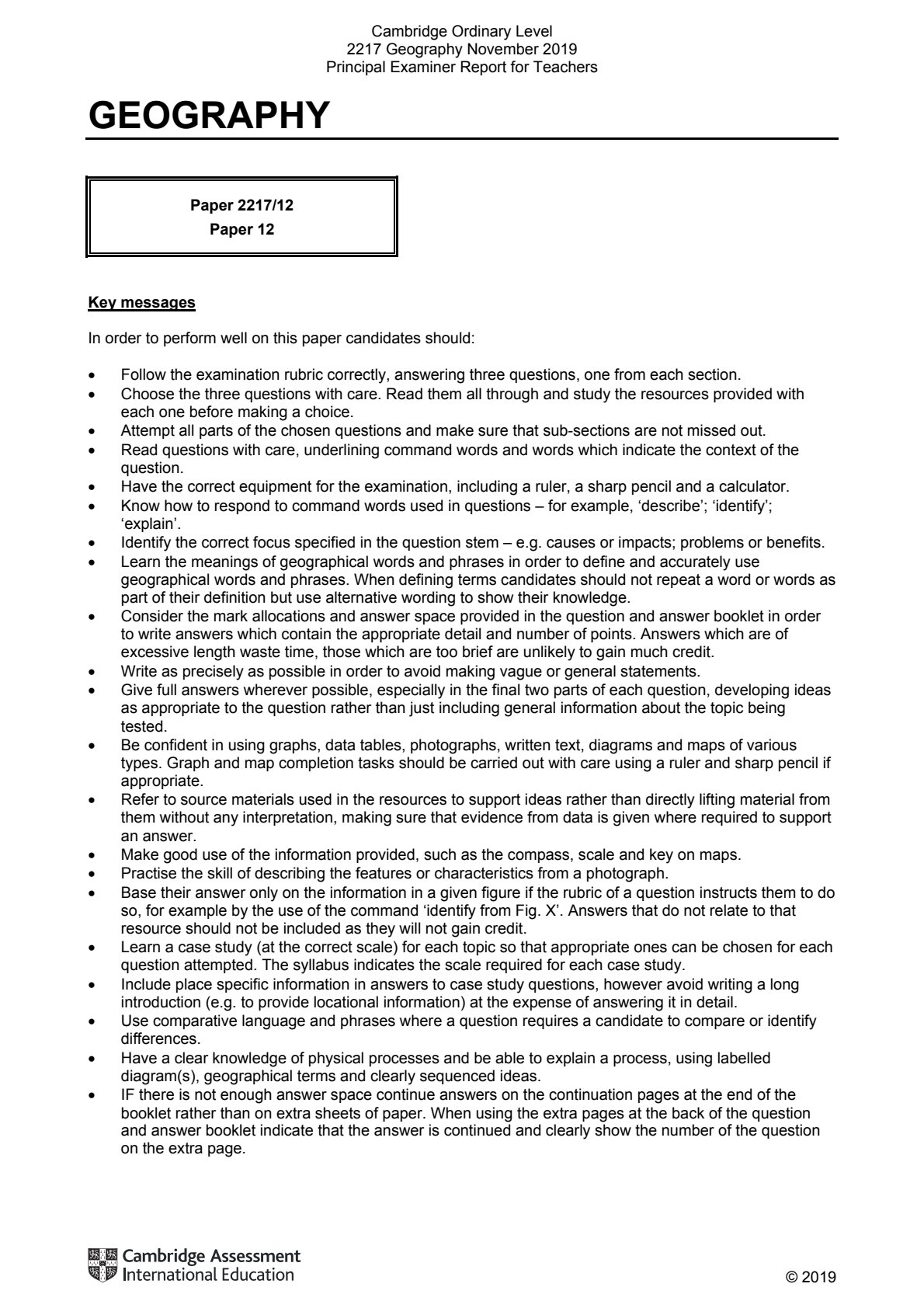
First page of Cambridge O-Level Geography Paper 12 November 2019 Marking Scheme

Cambridge O-Level Geography Paper 12 November 2019 Marking Scheme

Use this Cambridge O-Level Geography Paper 12 November 2019 marking scheme for checking answers, revision, and exam preparation in Zimbabwe.

A free account is needed to download. Sign in or create one

Exam board
Cambridge
Subject
Geography
Level
O-Level
Document
Marking Scheme
Paper
Paper 12
Paper code
2217/12
Session
November
Year
2019
File
PDF, 907 KB

About this marking scheme

This is the Cambridge O-Level Geography marking scheme for Paper 12 from November 2019. It shows how marks are awarded, so you can mark your own answers. The paper code is 2217/12.

More Geography O-Level 2019 papers

Other years: Geography O-Level

Text from the first page

Cambridge Ordinary Level
2217 Geography November 2019
Principal Examiner Report for Teachers
GEOGRAPHY

Paper 2217/12
Paper 12

Key messages
In order to perform well on this paper candidates should:
- Follow the examination rubric correctly, answering three questions, one from each section.
- Choose the three questions with care. Read them all through and study the resources provided with each one before making a choice.
- Attempt all parts of the chosen questions and make sure that sub-sections are not missed out.
- Read questions with care, underlining command words and words which indicate the context of the question.
- Have the correct equipment for the examination, including a ruler, a sharp pencil and a calculator.
- Know how to respond to command words used in questions - for example, 'describe'; 'identify'; 'explain'.
- Identify the correct focus specified in the question stem - e.g. causes or impacts; problems or benefits.
- Learn the meanings of geographical words and phrases in order to define and accurately use geographical words and phrases. When defining terms candidates should not repeat a word or words as part of their definition but use alternative wording to show their knowledge.
- Consider the mark allocations and answer space provided in the question and answer booklet in order to write answers which contain the appropriate detail and number of points. Answers which are of excessive length waste time, those which are too brief are unlikely to gain much credit.
- Write as precisely as possible in order to avoid making vague or general statements.
- Give full answers wherever possible, especially in the final two parts of each question, developing ideas as appropriate to the question rather than just including general information about the topic being tested.
- Be confident in using graphs, data tables, photographs, written text, diagrams and maps of various types. Graph and map completion tasks should be carried out with care using a ruler and sharp pencil if appropriate.
- Refer to source materials used in the resources to support ideas rather than directly lifting material from them without any interpretation, making sure that evidence from data is given where required to support an answer.
- Make good use of the information provided, such as the compass, scale and key on maps.
- Practise the skill of describing the features or characteristics from a photograph.
- Base their answer only on the information in a given figure if the …