ExamineAI
First page of A-Level Biology Osmosis Worksheet Zimbabwe

A-Level Biology Osmosis Worksheet Zimbabwe

Study Biology worksheet on Osmosis for A-Level. Useful for revision, homework, and exam preparation in Zimbabwe.

A free account is needed to download. Sign in or create one

Subject
Biology
Level
A-Level
Document
Worksheet
File
PDF, 6.8 MB

About this worksheet

This is the A-Level Biology worksheet. It is a free worksheet for revision.

More Biology A-Level papers

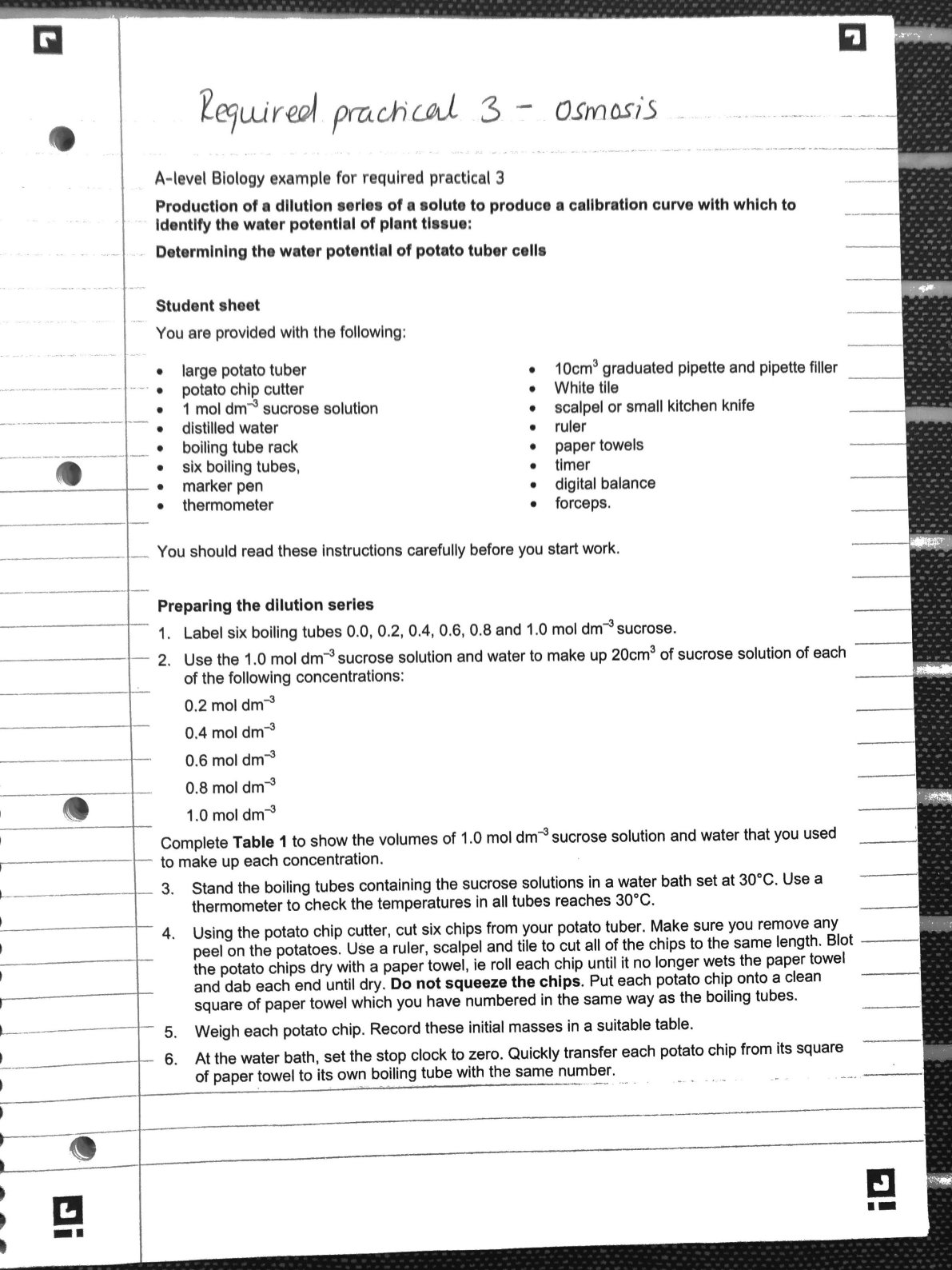
Text from the first page

Required practical 3 -osmosis

A-level Biology example for required practical 3
Production of a dilution series of a solute to produce a calibration curve with which to identify the water potential of plant tissue:
Determining the water potential of potato tuber cells

Student sheet
You are provided with the following:
- large potato tuber
- potato chip cutter
- $1 \mathrm{~mol} \mathrm{dm}^{-3}$ sucrose solution
- distilled water
- boiling tube rack
- six boiling tubes,
- marker pen
- thermometer
- $10 \mathrm{~cm}^{3}$ graduated pipette and pipette filler
- White tile
- scalpel or small kitchen knife
- ruler
- paper towels
- timer
- digital balance
- forceps.

You should read these instructions carefully before you start work.

Preparing the dilution series
1. Label six boiling tubes $0.0,0.2,0.4,0.6,0.8$ and $1.0 \mathrm{~mol} \mathrm{dm}^{-3}$ sucrose.
2. Use the $1.0 \mathrm{~mol} \mathrm{dm}^{-3}$ sucrose solution and water to make up $20 \mathrm{~cm}^{3}$ of sucrose solution of each of the following concentrations:
$0.2 \mathrm{~mol} \mathrm{dm}^{-3}$
$0.4 \mathrm{~mol} \mathrm{dm}^{-3}$
$0.6 \mathrm{~mol} \mathrm{dm}^{-3}$
$0.8 \mathrm{~mol} \mathrm{dm}^{-3}$
$1.0 \mathrm{~mol} \mathrm{dm}^{-3}$
Complete Table 1 to show the volumes of $1.0 \mathrm{~mol} \mathrm{dm}^{-3}$ sucrose solution and water that you used to make up each concentration.
3. Stand the boiling tubes containing the sucrose solutions in a water bath set at $30^{\circ} \mathrm{C}$. Use a thermometer to check the temperatures in all tubes reaches $30^{\circ} \mathrm{C}$.
4. Using the potato chip cutter, cut six chips from your potato tuber. Make sure you remove any peel on the potatoes. Use a ruler, scalpel and tile to cut all of the chips to the same length. Blot the potato chips dry with a paper towel, ie roll each chip until it no longer wets the paper towel and dab each end until dry. Do not squeeze the chips. Put each potato chip onto a clean square of paper towel which you have numbered in the same way as the boiling tubes.
5. Weigh each potato chip. Record these initial masses in a suitable table.
6. At the water bath, set the stop clock to zero. Quickly transfer each potato chip from its square of paper towel to its own boiling tube with the same number.