ExamineAI
First page of A-Level Biology Movement Across Membranes Notes Zimbabwe

A-Level Biology Movement Across Membranes Notes Zimbabwe

Study Biology notes on Movement Across Membranes for A-Level. Useful for revision, homework, and exam preparation in Zimbabwe.

A free account is needed to download. Sign in or create one

Exam board
ZIMSEC
Subject
Biology
Level
A-Level
Document
Notes
File
PDF, 16 MB

About this notes

This is the ZIMSEC A-Level Biology notes. It is a free notes for revision.

More Biology A-Level papers

Text from the first page

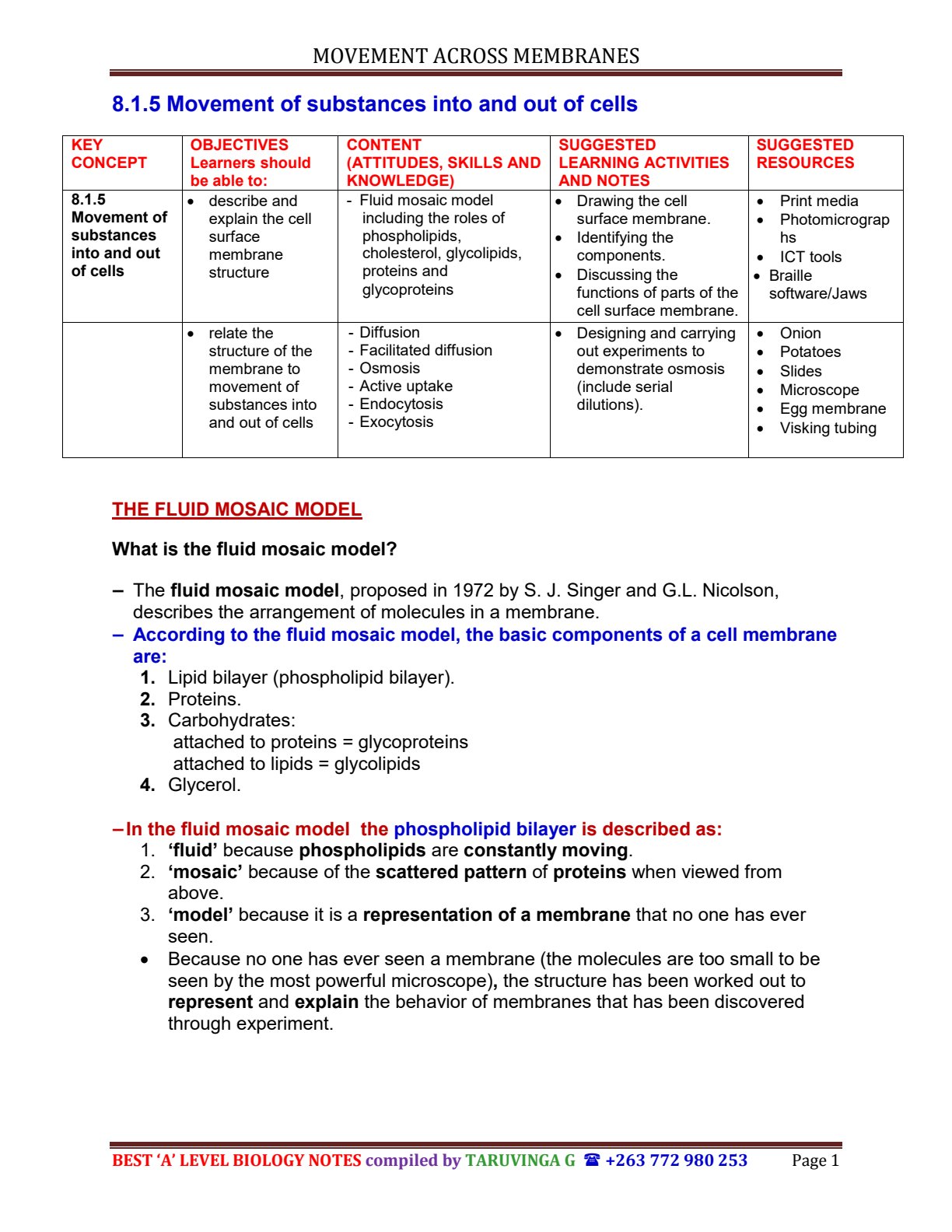
MOVEMENT ACROSS MEMBRANES

\begin{table}
\captionsetup{labelformat=empty}
\caption{8.1.5 Movement of substances into and out of cells}

 KEY CONCEPT  |  OBJECTIVES Learners should be able to:  |  CONTENT (ATTITUDES, SKILLS AND KNOWLEDGE)  |  SUGGESTED LEARNING ACTIVITIES AND NOTES  |  SUGGESTED RESOURCES
 8.1.5 Movement of substances into and out of cells  |  - describe and explain the cell surface membrane structure  |  - Fluid mosaic model including the roles of phospholipids, cholesterol, glycolipids, proteins and glycoproteins  |
- Drawing the cell surface membrane.
- Identifying the components.
- Discussing the functions of parts of the cell surface membrane.
  |
- Print media
- Photomicrograp hs
- ICT tools
- Braille software/Jaws

  |  - relate the structure of the membrane to movement of substances into and out of cells  |
- Diffusion
- Facilitated diffusion
- Osmosis
- Active uptake
- Endocytosis
- Exocytosis
  |  - Designing and carrying out experiments to demonstrate osmosis (include serial dilutions).  |
- Onion
- Potatoes
- Slides
- Microscope
- Egg membrane
- Visking tubing

\end{table}

THE FLUID MOSAIC MODEL
What is the fluid mosaic model?
- The fluid mosaic model, proposed in 1972 by S. J. Singer and G.L. Nicolson, describes the arrangement of molecules in a membrane.
- According to the fluid mosaic model, the basic components of a cell membrane are:
1. Lipid bilayer (phospholipid bilayer).
2. Proteins.
3. Carbohydrates:
attached to proteins = glycoproteins
attached to lipids = glycolipids
4. Glycerol.
-In the fluid mosaic model the phospholipid bilayer is described as:
1. 'fluid' because phospholipids are constantly moving.
2. 'mosaic' because of the scattered pattern of proteins when viewed from above.
3. 'model' because it is a representation of a membrane that no one has ever seen.
- Because no one has ever seen a membrane (the molecules are too small to be seen by the most powerful microscope), the structure has been worked out to represent and explain the behavior of membranes that has been discovered through experiment.

BEST 'A' LEVEL BIOLOGY NOTES compiled by TARUVINGA G P +263772980253
Page 1