ExamineAI
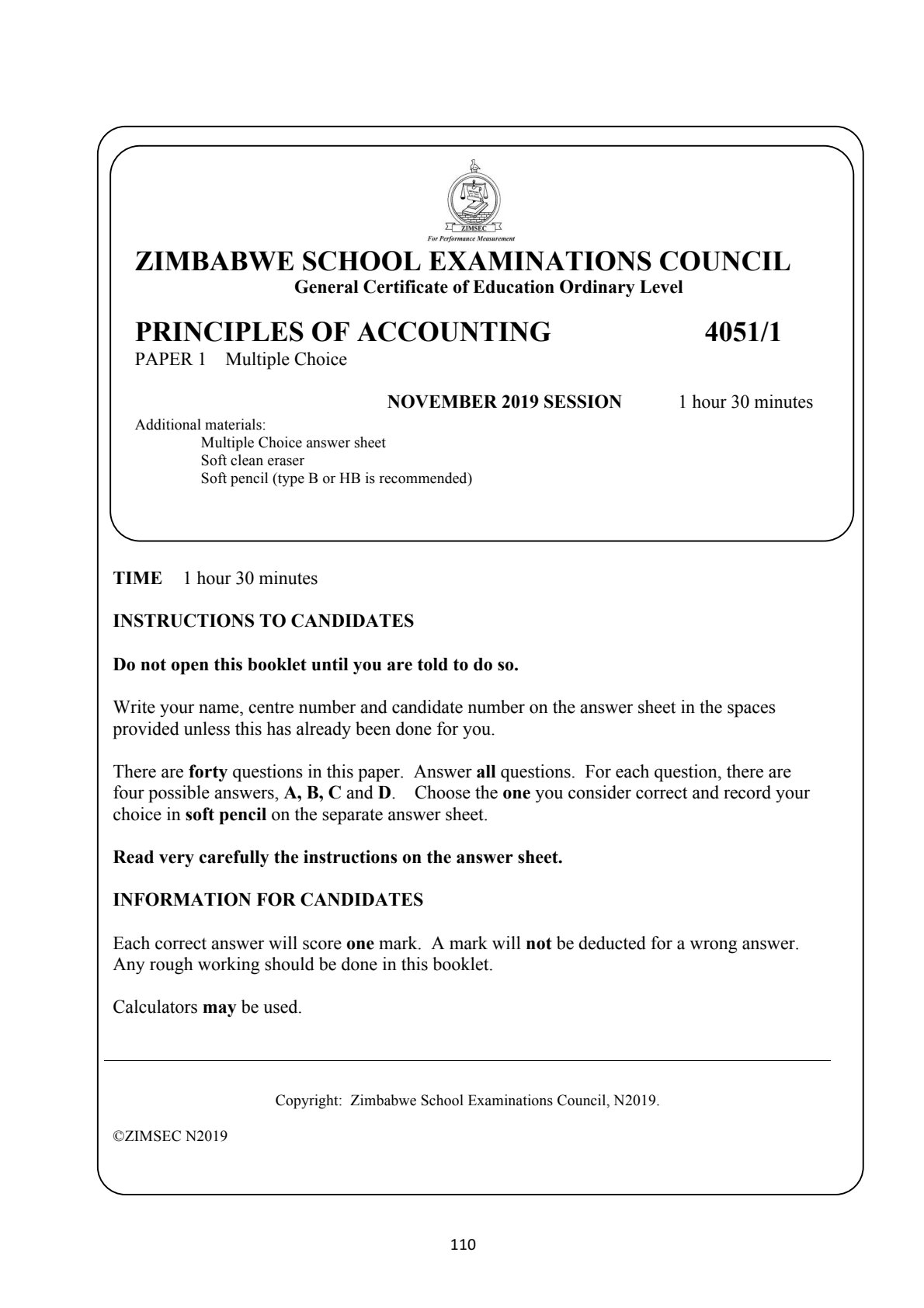
First page of ZIMSEC O-Level Principles of Accounts Paper 1 November 2019 Question Paper

ZIMSEC O-Level Principles of Accounts Paper 1 November 2019 Question Paper

Download and practise with this ZIMSEC O-Level Principles of Accounts Paper 1 November 2019 question paper. Useful for exam revision, past paper practice, and preparation in Zimbabwe.

A free account is needed to download. Sign in or create one

Exam board
ZIMSEC
Subject
Principles of Accounts
Level
O-Level
Document
Question Paper
Paper
Paper 1
Paper code
4051/1
Time allowed
1 hour 30 minutes
Session
November
Year
2019
File
PDF, 179 KB

About this question paper

This is the ZIMSEC O-Level Principles of Accounts question paper for Paper 1 from November 2019. Use it for exam practice under timed conditions. The paper code is 4051/1. Time allowed: 1 hour 30 minutes.

More Principles of Accounts O-Level 2019 papers

Other years: Principles of Accounts O-Level

Extracted text

# ZIMBABWE SCHOOL EXAMINATIONS COUNCIL <br> General Certificate of Education Ordinary Level

**PRINCIPLES OF ACCOUNTING PAPER 1 Multiple Choice**

NOVEMBER 2019 SESSION

1 hour 30 minutes

Additional materials:

Multiple Choice answer sheet

Soft clean eraser

Soft pencil (type B or HB is recommended)

TIME 1 hour 30 minutes

### INSTRUCTIONS TO CANDIDATES

Do not open this booklet until you are told to do so.

Write your name, centre number and candidate number on the answer sheet in the spaces provided unless this has already been done for you.

There are forty questions in this paper. Answer all questions. For each question, there are four possible answers, \(\mathbf{A}, \mathbf{B}, \mathbf{C}\) and \(\mathbf{D}\). Choose the one you consider correct and record your choice in soft pencil on the separate answer sheet.

Read very carefully the instructions on the answer sheet.

### INFORMATION FOR CANDIDATES

Each correct answer will score one mark. A mark will not be deducted for a wrong answer. Any rough working should be done in this booklet.

Calculators may be used.

Copyright: Zimbabwe School Examinations Council, N2019.

©ZIMSEC N2019

## Question 1
A sole proprietorship is a business which is

A managed by a board of directors.

B managed by a selected committee.

C owned and managed by one person.

D owned by two to twenty people.

## Question 2
Which of the following is the correct sequence of the accounting cycle?

A ledger ⟶ subsidiary books ⟶ trial balance ⟶ final accounts

B subsidiary books ⟶ ledger ⟶ trial balance ⟶ final accounts

C subsidiary books ⟶ trial balance ⟶ ledger ⟶ final accounts

D trial balance ⟶ ledger ⟶ subsidiary books ⟶ final accounts

## Question 3
Which document contains details of purchases, returns and payments which occurred in a month?

A credit note

B debit note

C invoice

D statement

## Question 4
The part of the central processing unit that manages data processing in a computer is known as

A hardware.

B keyboard.

C mouse.

D Software

## Question 5
Trade discount is offered in order to

A encourage bulk buying.

B encourage prompt payment.

C increase customer's profit.

D reduce trader's profit.

## Question 6
Which subsidiary book is part of the double entry system?

A general journal

B petty cash book

C purchases returns book

D sales journal

## Question 7
Which item is recorded in the general journal?

A assets brought into the business by the owner

B cash taken by the owner for personal use

C goods returned to supplier

D inventory sold on credit

## Question 8
A business made the following payments.

|  | \($\) |
| :--- | ---: |
| Roof repairs | 2100 |
| Purchase of computers | 5000 |
| Carriage costs on computers | 400 |
| Replacement tyre for van | 100 |
| Installation costs of computers | 300 |

What was the total capital expenditure?

A \($ 2200\)

B \($ 2900\)

C \($ 5700\)

D \($ 7100\)

## Question 9
Which of the following items is revenue expenditure?

A cost of installing a new non-current asset

B cost of maintaining a non-current asset

C legal costs for purchase of non-current asset

D purchase of new non-current asset

## Question 10
Control accounts are found in the

A general ledger.

B private ledger.

C purchases ledger.

D sales ledger.

## Question 11
Which of the following transactions has an effect on capital?

A cash payment of \($ 2500\) to trade payables

B purchase of motor vehicle for \($ 10000\) by cheque

C receipt of \($ 1400\) cheque from trade receivables

D sale of inventory at a profit of \($ 200\)

## Question 12
Which of the following is a desirable quality in a bookkeeper?

A dishonesty

B faithlessness

C integrity

D subjectivity

## Question 13
Control accounts are prepared in order to

A check on the work of accounts clerks.

B correct errors.

C prevent fraud.

D reduce trade receivables and trade payables.

## Question 14
Which is the correct entry for carriage on sales in the final accounts?

A credit profit and loss account

B credit trading account

C debit profit and loss account

D debit trading account

## Question 15
A cash book had a debit balance of \($ 2900\). The bank statement showed the following:

Bank charges 150

Standing order: Zesa 700

Credit transfer: Farai 1400

Dishonoured cheques 350

The updated cash book balance was

A \($ 3100\) credit.

B \($ 3100\) debit.

C \($ 3800\) credit.

D \($ 3800\) debit.

## Question 16
Which is a current asset?

A interest earned accrued

B interest on loan accrued

C rent received in advance

D rent payable due

## Question 17
A business always depreciates its motor vehicles using the reducing balance method.

Which accounting principle is being applied?

A consistency

B double entry

C going concern

D prudence

## Question 18
A sales returns journal has been overcast.

The journal entry needed to correct this error is

|  | debit | credit |
| :--- | :--- | :--- |
| A | returns inwards account | suspense account. |
| B | returns outwards account | suspense account. |
| C | suspense account | returns inwards account. |
| D | suspense account | returns outwards account |

## Question 19
Fadzai owed Chido \($ 700\) on 1 June 2016. The following transactions took place during the month.

- Fadzai bought goods on credit valued at \($ 2600\) from Chido.
- Fadzai paid \($ 1900\) by cheque to Chido.

The balance in Fadzai's account on 30 June 2016 was

A \($ 100\) credit.

B \($ 100\) debit.

C \($ 1400\) credit.

D \($ 1400\) debit.

## Question 20
Which is an error of omission?

A cash account balance omitted from the trial balance

B cash received from the sale of machinery not entered in the books

C cash received from the sale of machinery entered in the cash book only

D cash received from the sale of machinery entered in the machinery disposal account only

## Question 21
A debit balance in a stationery account at the end of a financial period represents

A inventory of unused stationery.

B stationery bought on credit.

C …