ExamineAI
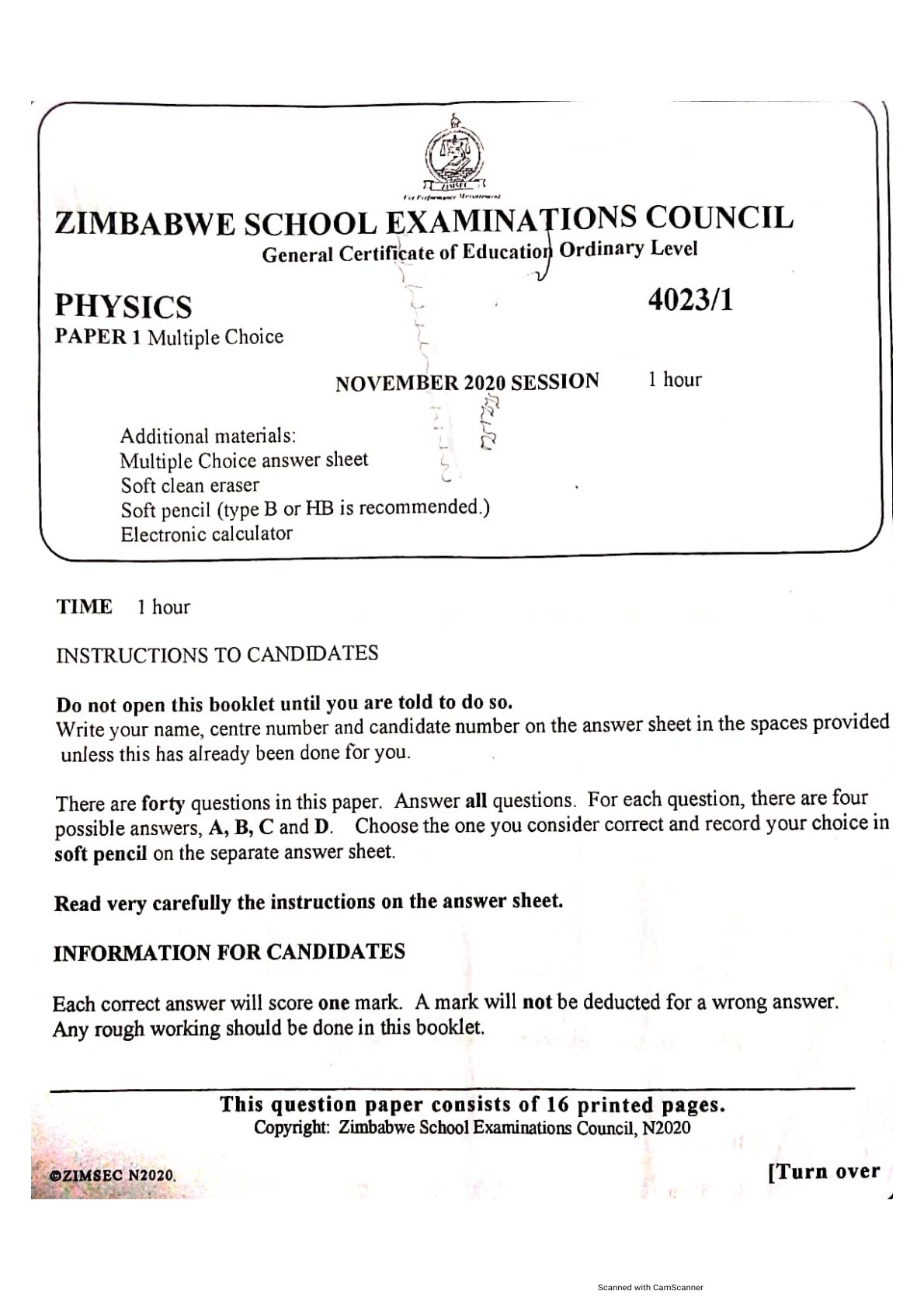
First page of ZIMSEC O-Level Physics Paper 1 November 2020 Question Paper

ZIMSEC O-Level Physics Paper 1 November 2020 Question Paper

Download and practise with this ZIMSEC O-Level Physics Paper 1 November 2020 question paper. Useful for exam revision, past paper practice, and preparation in Zimbabwe.

A free account is needed to download. Sign in or create one

Exam board
ZIMSEC
Subject
Physics
Level
O-Level
Document
Question Paper
Paper
Paper 1
Paper code
4023/1
Time allowed
1 hour
Session
November
Year
2020
File
PDF, 1.7 MB

About this question paper

This is the ZIMSEC O-Level Physics question paper for Paper 1 from November 2020. Use it for exam practice under timed conditions. The paper code is 4023/1. Time allowed: 1 hour.

More Physics O-Level 2020 papers

Other years: Physics O-Level

Extracted text

# ZIMBABWE SCHOOL EXAMINATIONS COUNCIL

**PHYSICS**

TIME 1 hour

### INSTRUCTIONS TO CANDIDATES

Do not open this booklet until you are told to do so.
Write your name, centre number and candidate number on the answer sheet in the spaces provided unless this has already been done for you.

There are forty questions in this paper. Answer all questions. For each question, there are four possible answers, \(\mathbf{A}, \mathbf{B}, \mathbf{C}\) and \(\mathbf{D}\). Choose the one you consider correct and record your choice in soft pencil on the separate answer sheet.

Read very carefully the instructions on the answer sheet.

### INFORMATION FOR CANDIDATES

Each correct answer will score one mark. A mark will not be deducted for a wrong answer. Any rough working should be done in this booklet.

**This question paper consists of 16 printed pages.**
Copyright: Zimbabwe School Examinations Council, N2020

## Question 1
Which is the SI unit of temperature?

A Degrees Fahrenheit

B Degrees Celsius

C Kelvin

D Degrees

## Question 2
The derived unit of force is

A \(\mathrm{kgm}^{-1} \mathrm{~s}^{-1}\).

B \(\mathrm{kgms}^{-1}\).

C \(\mathrm{kgms}^{-2}\).

D \(\mathrm{kgm}^{-1} \mathrm{~s}^{-2}\).

## Question 3
The diagram shows a speed-time graph for a car.

![](https://ocr.unopasa.com/p/ocr_assets/5882b0b019448c19a8110c68344e68f33ac3acd32b6556f8945a4edc8589d351.jpg)

What is the total distance travelled by the car?

A 40 m

B 60 m

C 80 m

## Question 4
Terminal velocity is the velocity of a falling object

A just after it falls.

B just before it comes to rest.

C when the forces acting on it are unbalanced.

D when the forces acting on it are in equilibrium.

## Question 5
Free fall is the falling of an object when

A the only force acting on it is gravitational force.

B the resultant force acting on it is zero.

C the forces acting on it are in opposite directions.

D air resistance acts against its weight.

## Question 6
What is the smallest and largest resultant force that can be produced by forces of 3 N and 4 N acting at the same point?

|  | Smallest | Largest |
| :--- | :--- | :--- |
| A | 1 N | 5 N |
| B | 1 N | 7 N |
| C | 3 N | 5 N |
| D | 3 N | 7 N |

## Question 7
Which one states Newton's second law of motion?

A \(\quad \frac{\text { work done }}{\text { displacement }}\)

B \(\frac{\text { work done }}{\text { time }}\)

C mass \(x\) velocity

D mass × acceleration

## Question 8
Momentum is the product of

A force and velocity.

B force and time.

C mass and speed.

D mass and velocity.

## Question 9
The diagram shows an extension-force graph. Which point \(\mathbf{A}, \mathbf{B}, \mathbf{C}\) or \(\mathbf{D}\) marks the limit of proportionality?

![](https://ocr.unopasa.com/p/ocr_assets/a82017656a445bf0da2527082dc3d14fa21fc2382253342eb1ac193a1afbe71e.jpg)

## Question 10
A force of 20 N on a spring produces an extension of 4 cm. What will be the extension if a force of 50 N is applied to the spring, when the limit of proportionality is not exceeded?

A 1.6 cm

B 2.5 cm

C 10.0 cm

D 12.5 cm

## Question 11
Which statement best describes frictional force?

A Opposes motion and increases effort needed to move the object.

B Opposes motion and decreases effort needed to move the object.

C Opposes motion and increases weight of object.

D Opposes motion and decreases weight of object.

## Question 12
Which statement describes circular motion?

A The object's speed changes.

B The object's velocity does not change.

C The force on the object is towards the centre of the circle.

D The acceleration of the object is directed away from the centre of the circle.

## Question 13
Which statement is NOT correct about pressure?

A A fluid exerts equal pressure in all directions at the same height.

B To withstand liquid pressure, dams are built thicker at the bottom.

C Atmospheric pressure decreases with increase in height.

D Water in a cup does not exert any pressure on the cup.

## Question 14
Increasing the distance of the effort from pivot on a lever increases

A effort.

B velocity ratio.

C mechanical advantage.

D friction on pivot.

## Question 15
The mechanical advantage of a single movable pulley is

A 1.

B 2.

C 3.

D 4.

## Question 16
Which formula is used to calculate efficiency?

A \(\frac{\text { distance moved by effort }}{\text { distance moved by load }} \times 100 \%\)

B \(\frac{\text { velocity ratio }}{\text { mechanical advantage }} \times 100 \%\)

C \(\frac{\text { energy output }}{\text { energy input }} \times 100 \%\)

D \(\frac{\text { work input }}{\text { work output }} \times 100 \%\)

## Question 17
What energy changes take place when a dart player throws a dart to the moment it hits the target?

A elastic ⟶ kinetic ⟶ potential

B kinetic ⟶ elastic ⟶ kinetic

C potential ⟶ chemical ⟶ kinetic

D chemical ⟶ kinetic ⟶ potential

## Question 18
A block of mass 4 kg slides down a frictionless slope as shown in the diagram.

![](https://ocr.unopasa.com/p/ocr_assets/2b7463245972b7d27f113b5656d75775172965469e6abedff6d015054bc29bf3.jpg)

What is the change in gravitational potential energy?

A 80 J

B 200 J

C 400 J

D 800 J

## Question 19
What is the power of an electric motor that lifts a weight of 200 N to a height of 20 m in 10 seconds?

A 20 W

B 100 W

C 400 W

D 40000 W

## Question 20
A rock of mass 3.0 kg falls from a cliff 20 m high. What is its kinetic energy on hitting the ground?

A 30 J

B 60 J

C 200 J

D 600 J

## Question 21
Which thermometer is suitable for measuring temperature at a point?

A thermocouple

B constant-gas volume

C platinum resistance

D liquid in glass

## Question 22
Which graph describes Charles' law for a fixed mass of gas at constant pressure?

A

![](https://ocr.unopasa.com/p/ocr_assets/b8c690cca88d4e767ea9186dbc3bda333d4cbe3ec83268663ff7d9ac00c1a674.jpg)

B

![](https://ocr.unopasa.com/p/ocr_assets/eeeb162888cf9eb50e9e192fec84697fedf07ed2b2f00316544eec35c57b322b.jpg)

C …