ExamineAI
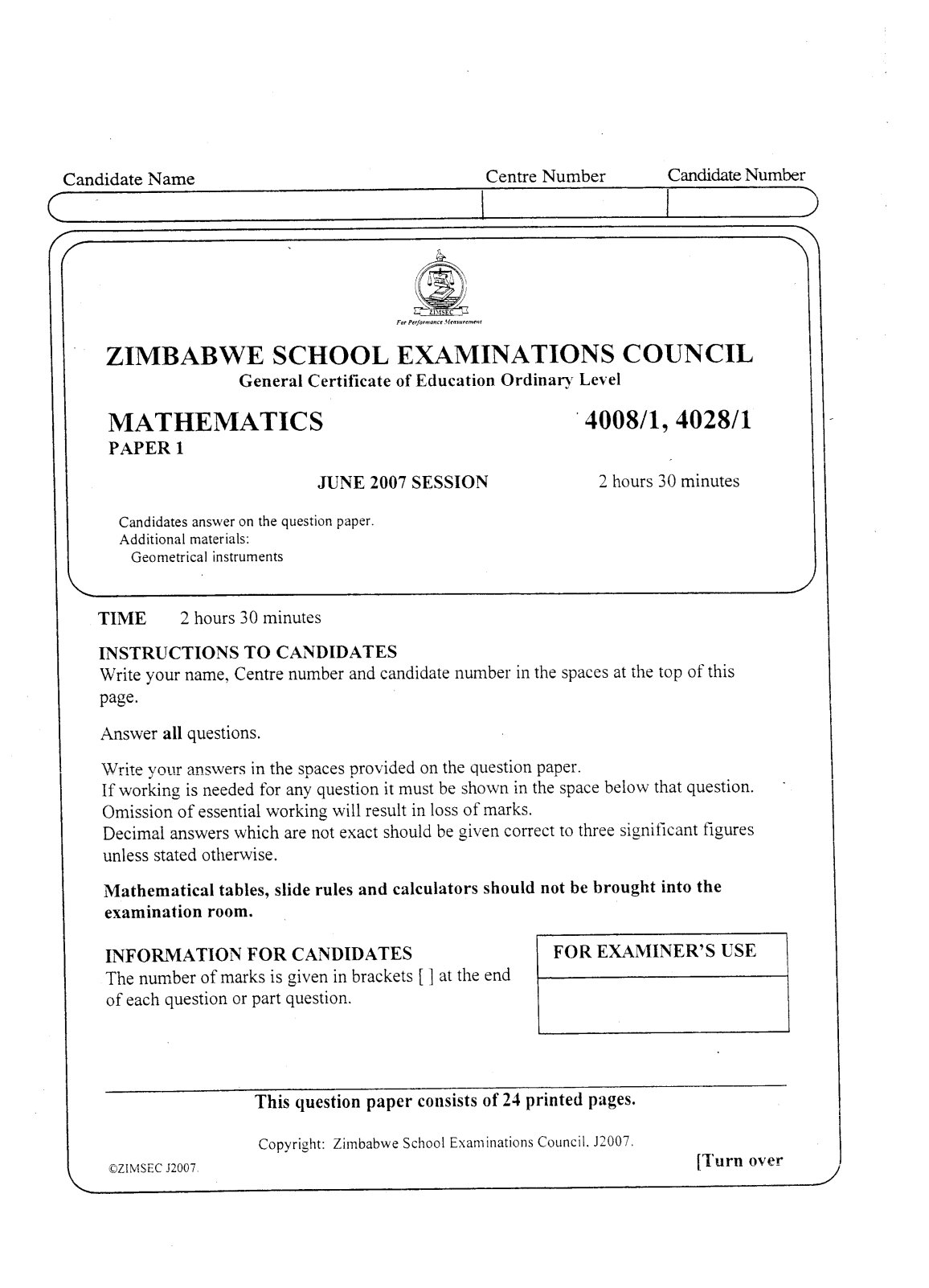
First page of ZIMSEC O-Level Mathematics Paper 1 June 2007 Question Paper

ZIMSEC O-Level Mathematics Paper 1 June 2007 Question Paper

Download and practise with this ZIMSEC O-Level Mathematics Paper 1 June 2007 question paper. Useful for exam revision, past paper practice, and preparation in Zimbabwe.

A free account is needed to download. Sign in or create one

Exam board
ZIMSEC
Subject
Mathematics
Level
O-Level
Document
Question Paper
Paper
Paper 1
Paper code
4008/1
Time allowed
2 hours 30 minutes
Session
June
Year
2007
File
PDF, 290 KB

About this question paper

This is the ZIMSEC O-Level Mathematics question paper for Paper 1 from June 2007. Use it for exam practice under timed conditions. The paper code is 4008/1. Time allowed: 2 hours 30 minutes.

More Mathematics O-Level 2007 papers

Other years: Mathematics O-Level

Extracted text

# ZIMBABWE SCHOOL EXAMINATIONS COUNCIL <br> General Certificate of Education Ordinary Level

**MATHEMATICS <br> PAPER 1**

4008/1, 4028/1

2 hours 30 minutes

JUNE 2007 SESSION

Candidates answer on the question paper.

Additional materials:

Geometrical instruments

TIME 2 hours 30 minutes

### INSTRUCTIONS TO CANDIDATES

Write your name, Centre number and candidate number in the spaces at the top of this page.

Answer all questions.

Write your answers in the spaces provided on the question paper.

If working is needed for any question it must be shown in the space below that question.

Omission of essential working will result in loss of marks.

Decimal answers which are not exact should be given correct to three significant figures unless stated otherwise.

Mathematical tables, slide rules and calculators should not be brought into the examination room.

### INFORMATION FOR CANDIDATES

The number of marks is given in brackets [ ] at the end of each question or part question.

### FOR EXAMINER'S USE

□

**This question paper consists of 24 printed pages.**

**NEITHER MATHEMATICAL TABLES NOR SLIDE RULES NOR CALCULATORS MAY BE USED IN THIS PAPER**

## Question 1
Giving each answer as a common fraction in its lowest terms, find the value of

### (a)

\(\frac{5}{8}-\frac{3}{5}\),

### (b)

\(\frac{6}{7} \div 2 \frac{1}{7}\),

### (c)

\(\frac{3}{4}+\frac{1}{4} \times \frac{2}{3}\).

(a) \_\_\_\_

(b) \_\_\_\_

(c) \_\_\_\_

## Question 2
Express 0,016

### (a)

as a common fraction in its lowest terms,

### (b)

correct to 1 significant figure,

### (c)

in standard form.

Answer

(a) \_\_\_\_

(b) \_\_\_\_

(c) \_\_\_\_

## Question 3
Evaluate

### (a)

\(0,05^{2}\),

### (b)

\(\sqrt[3]{0,027}\),

### (c)

\(4^{-1}\).

Answer

(a)

[1]

(b)

[1]

(c)

[1]

## Question 4
A window is in the shape of a semi-circle of radius 70 cm.

### (a)

Write down the length of the diameter.

### (b)

Calculate the perimeter of the window.

Use \(\pi=\frac{22}{7}\).

Answer

(a) \_\_\_\_ cm [1]

(b) \_\_\_\_ cm [2]

## Question 5
### (a)

Express \(4 \times 8^{3}+3 \times 8^{2}+5 \times 8\) as a number in base 8.

### (b)

Evaluate \(431_{5}-244_{5}\), giving your answer in base 10.

Answer

(a) \_\_\_\_ [1]

(b) \_\_\_\_ [2]

## Question 6
### (a)

Factorize completely \(2 \pi r h+2 \pi r^{2}\).

### (b)

Express \(\frac{4}{x+5}-\frac{3}{x}\) as a single fraction in its simplest form.

Answer

(a) \_\_\_\_ [1]

(b) \_\_\_\_ [2]

## Question 7
Solve the simultaneous equations

$$
\begin{aligned}  |  2 x+3 y=13   |  x+2 y=8
\end{aligned}
$$

Answer

\(x=\) \_\_\_\_

\(y=\) \_\_\_\_

## Question 8
\(M\) varies directly as the square of \(d\) and inversely as \(q\).

### (a)

Write down an expression for \(M\) in terms of \(d\), \(q\) and a constant \(k\).

### (b)

Find \(k\), given that \(M=6\) when \(d=4\) and \(q=8\).

(a) \(M=\) \_\_\_\_

(b) \(k=\) \_\_\_\_

## Question 9
Given that \(n(\xi)=20, n(\mathrm{X})=15\) and \(n(\mathrm{Y})=8\), find

### (a)

\(n\left(\mathrm{Y}^{\prime}\right)\),

### (b)

the largest possible value of \(n(X \cap Y)\),

### (c)

the smallest possible value of \(n(X \cup Y)\).

Answer

(a) \_\_\_\_ [1]

(b) \_\_\_\_ [1]

(c) \_\_\_\_ [1]

## Question 10
![](https://ocr.unopasa.com/p/ocr_assets/3ddcb8315b25966b56855c3fccf61d5b4803c37dc7502d9204a53d6018cefd50.jpg)

The diagram shows the straight line \(l\) which cuts the \(x\)-axis at \((6 ; 0)\) and the \(y\)-axis at \((0 ;-4)\).

Find

### (a)

the equation of the line \(l\),

### (b)

the equation of the line \(m\), parallel to line \(l\) and passing through the origin.

Answer

(a) \_\_\_\_ [2]

(b) \_\_\_\_ [1]

## Question 11
![](https://ocr.unopasa.com/p/ocr_assets/e8097a487018707dd49b491599e7386ff1b45762417e06a49444656aca4b4329.jpg)

In the diagram the straight line \(l\) cuts across two parallel lines AB and CD.

### (a)

Write down the special name given to line \(l\) with respect to the parallel lines.

### (b)

Write down an equation in its simplest form, connecting

#### (i)

\(m\) and \(p\),

#### (ii)

\(n\) and \(p\),

#### (iii)

\(n\) and \(q\).

Answer (a) \_\_\_\_

(b)

(i) \_\_\_\_ [1]

(ii) \_\_\_\_ [1]

(iii) \_\_\_\_ [1]

## Question 12
The table shows some scores and their corresponding frequencies.

Find

### (a)

the mode,

### (b)

the median,

### (c)

the mean.

Answer (a) \_\_\_\_

(b) \_\_\_\_ [1]

(c) \_\_\_\_

## Question 13
![](https://ocr.unopasa.com/p/ocr_assets/4c8192c95a7f6e1ead7fe1247187c0670c41833873dbacc3e6067aabdf44f29b.jpg)

Study the diagram above and use it to answer the following questions.

### (a)

Write down the column vector which translates triangle \(\mathbf{T}\) onto triangle \(\mathbf{T}_{1}\).

### (b)

Describe fully the single transformation which maps triangle \(\mathbf{T}\) onto triangle \(\mathrm{T}_{2}\).

Answer

(a) \_\_\_\_ [1]

(b) \_\_\_\_

\_\_\_\_

\_\_\_\_ [3]

## Question 14
Given that \(f(x)=x^{2}-9\), find

### (a)

\(f(7)\),

### (b)

the values of \(x\) for which \(f(x)=16\).

Answer

(a) \_\_\_\_

(b) \(x=\) \_\_\_\_ or \_\_\_\_

## Question 15
\(\mathbf{M}=\left(\begin{array}{cc}1  |  -1  -1  |  3\end{array}\right)\) and \(\quad \mathbf{N}=\left(\begin{array}{cc}1  |  -2  x  |  6\end{array}\right)\).

Find

### (a)

\(\mathrm{M}^{2}\),

### (b)

\(x\), given that \(\mathbf{N}\) has no inverse.

Answer

(a) \(\mathbf{M}^{2}=\) \_\_\_\_

(b) \(x=\) \_\_\_\_

## Question 16
The formula connecting \(v, u, a\) and \(t\) is \(v=u+a t\).

### (a)

Find \(v\) when \(u=50, a=-9,8\) and \(t=3\).

### (b)

Make \(t\) the subject of the formula.

Answer

(a) \(v=\) \_\_\_\_ [2]

(b) \(t=\) \_\_\_\_ [2]

## Question 17
ABCDE is a regular pentagon. The sides AE and CD are produced to meet at X. Calculate the size of

### (a)

each interior angle of the pentagon,

### (b)

\(E \hat{X} D\).

Answer

(a) \_\_\_\_

(b) \_\_\_\_

## Question 18
The price of petrol was increased from \($ 2700\) per litre by \(20 \%\). The following year the new price was increased by …