ExamineAI
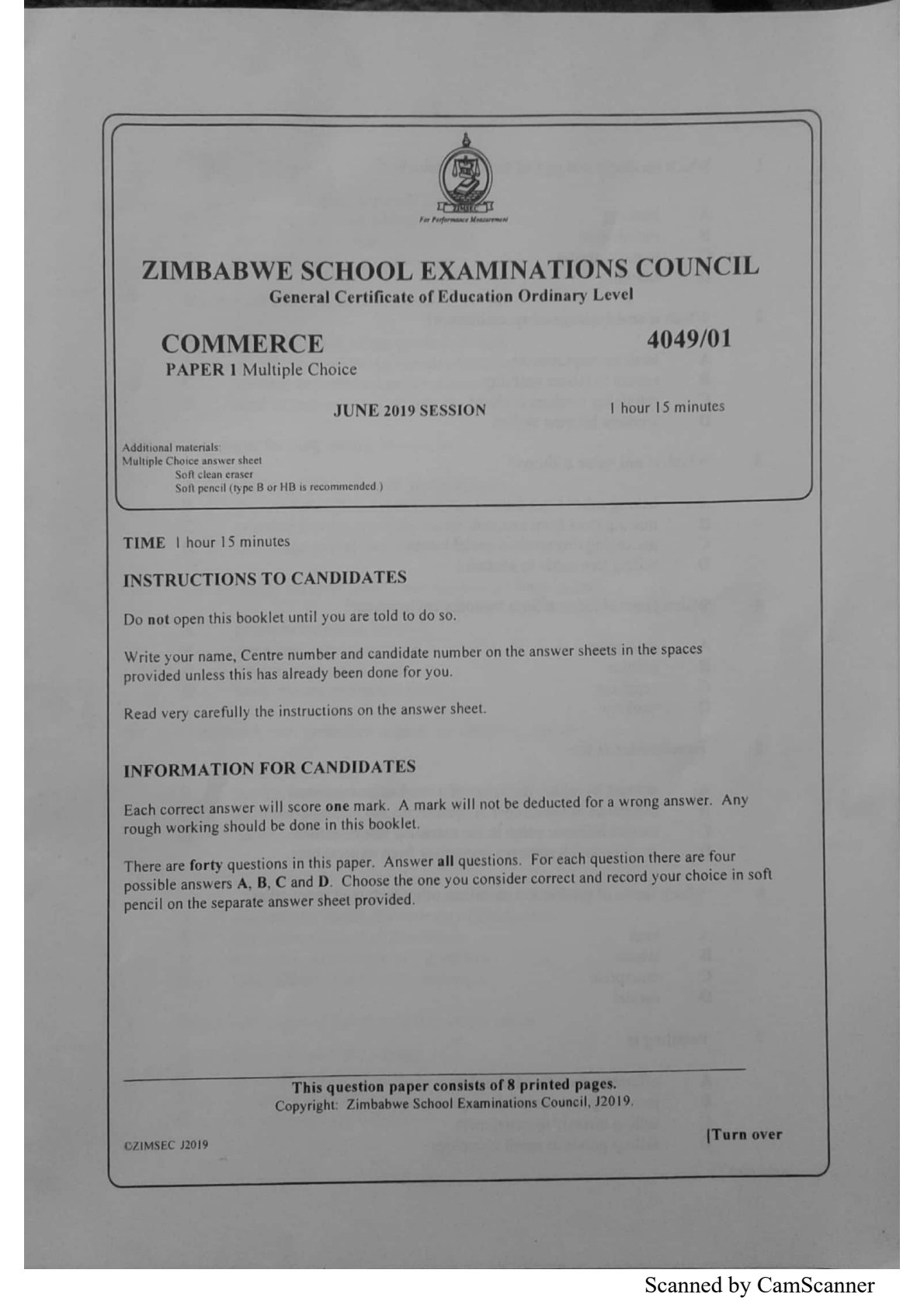
First page of ZIMSEC O-Level Commerce Paper 1 June 2019 Question Paper

ZIMSEC O-Level Commerce Paper 1 June 2019 Question Paper

Download and practise with this ZIMSEC O-Level Commerce Paper 1 June 2019 question paper. Useful for exam revision, past paper practice, and preparation in Zimbabwe.

A free account is needed to download. Sign in or create one

Exam board
ZIMSEC
Subject
Commerce
Level
O-Level
Document
Question Paper
Paper
Paper 1
Paper code
4049/01
Time allowed
1 hour 15 minutes
Session
June
Year
2019
File
PDF, 642 KB

About this question paper

This is the ZIMSEC O-Level Commerce question paper for Paper 1 from June 2019. Use it for exam practice under timed conditions. The paper code is 4049/01. Time allowed: 1 hour 15 minutes.

More Commerce O-Level 2019 papers

Other years: Commerce O-Level

Extracted text

# ZIMBABWE SCHOOL EXAMINATIONS COUNCIL <br> General Certificate of Education Ordinary Level

**COMMERCE**

PAPER 1 Multiple Choice

4049/01

JUNE 2019 SESSION

1 hour 15 minutes

Additional materials:

Multiple Choice answer sheet

Soft clean eraser

Soft pencil (type B or HB is recommended.)

TIME 1 hour 15 minutes

### INSTRUCTIONS TO CANDIDATES

Do not open this booklet until you are told to do so.

Write your name, Centre number and candidate number on the answer sheets in the spaces provided unless this has already been done for you.

Read very carefully the instructions on the answer sheet.

### INFORMATION FOR CANDIDATES

Each correct answer will score one mark. A mark will not be deducted for a wrong answer. Any rough working should be done in this booklet.

There are forty questions in this paper. Answer all questions. For each question there are four possible answers A, B, C and D. Choose the one you consider correct and record your choice in soft pencil on the separate answer sheet provided.

## Question 1
Which service is not part of tertiary production?

A banking

B distribution

C manufacturing

D teaching

## Question 2
Which is an advantage of specialisation?

A leads to employment

B results in labour mobility

C retraining workers is cheap

D workers become skilled

## Question 3
Which is not value addition?

A baking cakes from flour

B making steel from iron ore

C packaging diamonds in metal boxes

D selling live cattle to abattoirs

## Question 4
Which external factor affects business environment?

A customers

B politics

C suppliers

D workers

## Question 5
Beneficiation is the

A amount by which the value of a product is increased.

B difference between cost of production and selling price.

C natural intrinsic value in the extracted raw materials.

D process which removes impurities from mineral ores.

## Question 6
Which factor of production mobilises other factors of production?

A land

B labour

C enterprise

D capital

## Question 7
Retailing is

A offering goods to wholesalers.

B providing raw materials to producers.

C selling directly to consumers.

D selling goods in small quantities.

## Question 8
Quotas

A discourage domestic consumption.

B increase inflow of foreign currency.

C limit quantities of goods imported.

D make imports more expensive.

## Question 9
Balance of trade is equal to

A goods exported minus goods imported.

B goods exported minus services exported.

C services exported minus services imported.

D total exports minus total imports.

## Question 10
The aim of forming trading blocs is to

A challenge integration of global economy.

B discriminate against non-member countries.

C promote free trade among member states.

D encourage global free trade by nations.

## Question 11
The similarity between home trade and foreign trade is that

A goods in transit are insured.

B same language is involved.

C foreign currency is used.

D same measurements are used.

## Question 12
Consumers need protection against the following except

A false price cutting.

B buying tested products.

C incorrect labelling of goods.

D unfair repossession of goods.

## Question 13
Which board tests products for quality?

A Advertising Media Association of Zimbabwe.

B Consumer Council of Zimbabwe.

C Standards Association of Zimbabwe.

D Small Claims Court of Zimbabwe.

## Question 14
Which is a feature of business in the private sector?

A clearly identifiable owners

B no profit making motive

C owned by the government

D set-up to provide a service

## Question 15
A partnership is formed by

A at least one person.

B two and no maximum shareholders.

C two to fifty shareholders.

D two to twenty individuals.

## Question 16
Which characteristic applies to both private limited company and public limited company?

A owners are called shareholders

B share transfer is unrestricted

C shares sold on Stock Exchange

D start trading after incorporation

## Question 17
What is privatisation?

A converting a partnership into a public corporation

B converting a private limited company into a public limited company

C selling a business to government by an individual

D converting public sector business to private sector business

## Question 18
An entrepreneur is

A a book-keeper who maintains accounts.

B a salesperson who markets goods.

C one who takes financial risks.

D someone who calculates premiums.

## Question 19
Planning as management function deals with

A bringing workers together.

B ensuring that workers do different jobs.

C finding out whether aims are met.

D setting goals for the business.

## Question 20
Which function of money is used to compare goods?

A measure of value

B medium of exchange

C standard for future payment

D store of value

## Question 21
Return on capital employed is given by the formula

A \(\quad \frac{\text { Gross Profit }}{\text { Capital owned }} \times 100\).

B \(\quad \frac{\text { Gross Profit }}{\text { Cost of sales }} \times 100\)

C \(\frac{\text { Net Profit }}{\text { Capital invested }} \times 100\)

D \(\frac{\text { Net Profit }}{\text { Turnover }} \times 100\)

Use the information below to answer questions 22 and 23.

A trader bought 200 crates of mineral water at \($ 10\) a crate from a wholesaler under the following terms:

- Trade discount 25\%
- Cash discount \(5 \% 15\) days

## Question 22
How much trade discount was offered to the trader?

A \($ 100\)

B \($ 400\)

C \($ 500\)

D \($ 2000\)

## Question 23
How much did the trader pay if the account was settled within 10 days?

A \($ 1900\)

B \($ 1600\)

C \($ 1500\)

D \($ 1425\)

## Question 24
Which statement is true about the principle of utmost good faith?

A the insured must not make profit

B all relevant information must be disclosed

C the insured must suffer loss

D the risk must be insurable

## Question 25
The calculation of insurance premiums is done by the

A actuaries.

B assessors.

C brokers.

D underwriters.

## Question …