ExamineAI
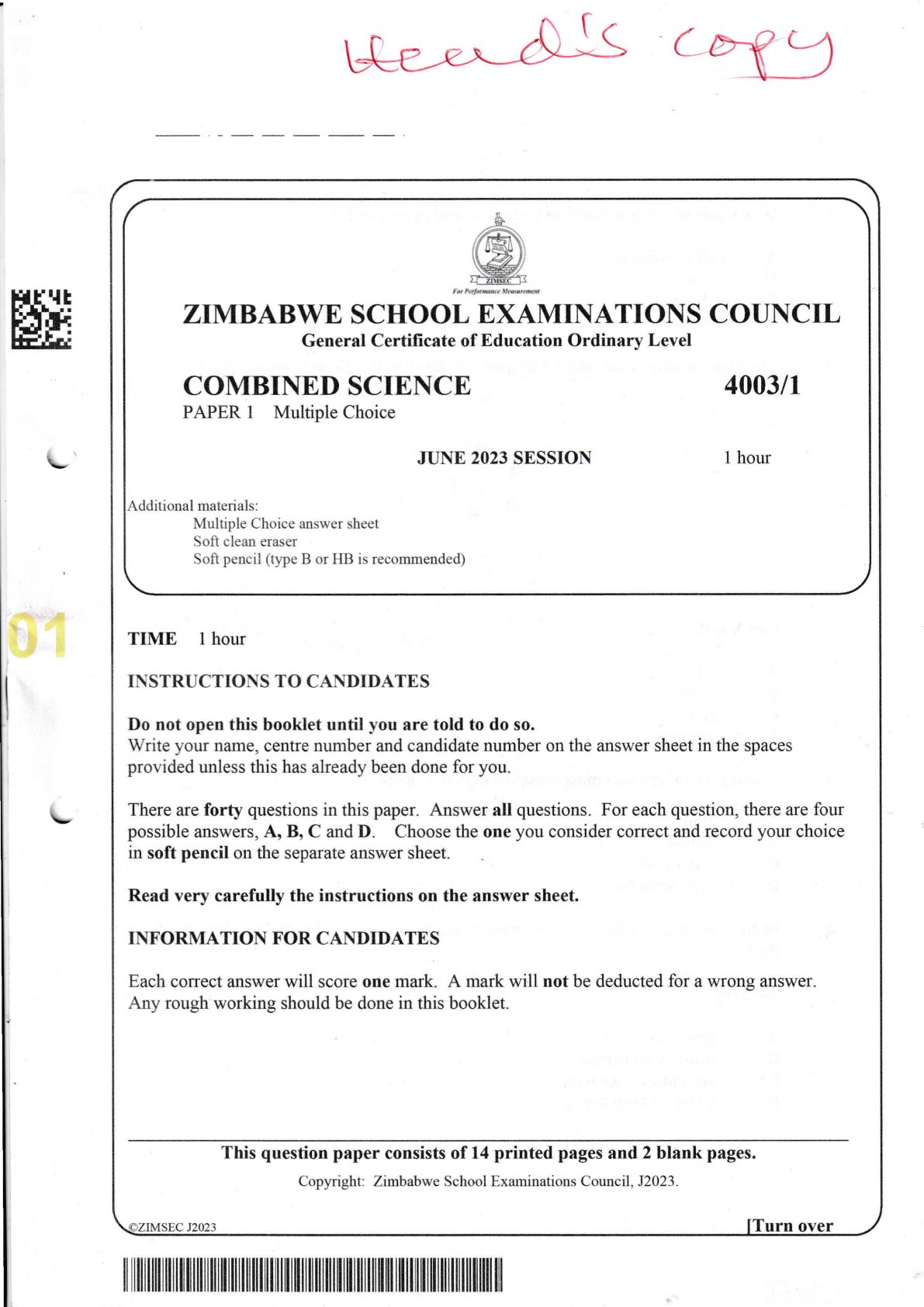
First page of ZIMSEC O-Level Combined Science Paper 1 June 2023 Question Paper

ZIMSEC O-Level Combined Science Paper 1 June 2023 Question Paper

Download and practise with this ZIMSEC O-Level Combined Science Paper 1 June 2023 question paper. Useful for exam revision, past paper practice, and preparation in Zimbabwe.

A free account is needed to download. Sign in or create one

Exam board
ZIMSEC
Subject
Combined Science
Level
O-Level
Document
Question Paper
Paper
Paper 1
Paper code
4003/1
Time allowed
1 hour
Session
June
Year
2023
File
PDF, 3.0 MB

About this question paper

This is the ZIMSEC O-Level Combined Science question paper for Paper 1 from June 2023. Use it for exam practice under timed conditions. The paper code is 4003/1. Time allowed: 1 hour.

More Combined Science O-Level 2023 papers

Other years: Combined Science O-Level

Extracted text

# ZIMBABWE SCHOOL EXAMINATIONS COUNCIL <br> General Certificate of Education Ordinary Level

**COMBINED SCIENCE**
**PAPER 1 Multiple Choice**

**JUNE 2023 SESSION**
**1 hour**

Additional materials:
Multiple Choice answer sheet
Soft clean eraser
Soft pencil (type B or HB is recommended)

**TIME 1 hour**

### INSTRUCTIONS TO CANDIDATES

Do not open this booklet until you are told to do so.
Write your name, centre number and candidate number on the answer sheet in the spaces provided unless this has already been done for you.

There are forty questions in this paper. Answer all questions. For each question, there are four possible answers, A, B, C and D. Choose the one you consider correct and record your choice in soft pencil on the separate answer sheet.

Read very carefully the instructions on the answer sheet.

### INFORMATION FOR CANDIDATES

Each correct answer will score one mark. A mark will not be deducted for a wrong answer. Any rough working should be done in this booklet.

## Question 1
Which part of a cell is found in both plant and animal cells?

A cell membrane

B vacuole

C cell sap

D cell wall

## Question 2
The diagram shows the internal structure of the root of a dicotyledonous plant.

![](https://ocr.unopasa.com/p/ocr_assets/7851746d6f572adaaef3a7b353ccdb8b12d750a87a1197da452847a54043a341.jpg)

Part \(\mathbf{X}\) is the

A cortex.

B xylem.

C phloem.

D epidermis.

## Question 3
A manual worker's diet must contain a higher proportion of

A fibre.

B iodine.

C vitamin D.

D carbohydrates.

## Question 4
In an ecosystem, a zebra feeds on grass, a lion feeds on the zebra and a vulture feeds on the lion.

The lion is a

A producer.

B primary consumer.

C secondary consumer.

D tertiary consumer.

## Question 5
The diagram shows part of the human digestive system.

![](https://ocr.unopasa.com/p/ocr_assets/12a4d03d535e7291f1b0d9c09d7f981b173452d2488b995fb9c3b1aed912f58c.jpg)

What is labelled \(\mathbf{A}\) ?

A the stomach

B the pancreas

C the large intestine

D the small intestine

## Question 6
The rate of transpiration is measured by a

A barometer.

B manometer.

C micrometer.

D potometer.

## Question 7
The diagram shows a flower.

Which part, \(\mathbf{A}, \mathbf{B}, \mathbf{C}\) or \(\mathbf{D}\), develops into a fruit after fertilisation?

![](https://ocr.unopasa.com/p/ocr_assets/af9943c6a889890fcc1137b557d6f4af5bff0b65c418687d80e0d35de62572f2.jpg)

## Question 8
A farmer planted 30 bean seeds and 12 seeds did not germinate.

What was the percentage germination?

A 18\%

B 40\%

C 42\%

D 60\%

## Question 9
Which characteristic, in humans, shows continuous variation?

A sex

B height

C tongue rolling

D left or right handedness

## Question 10
Which part of the male reproductive system carries urine and semen out of the body through the penis?

A scrotum.

B urethra.

C sperm duct.

D epididymis.

## Question 11
Which organism causes genital herpes?

A fungi

B virus

C bacterium

D protozoan

## Question 12
Which blood vessel transports deoxygenated blood to the lungs?

A vena cava

B pulmonary artery

C pulmonary vein

D aorta

## Question 13
Aerobic respiration takes place in the

A nucleus.

B vacuole.

C chloroplast.

D mitochondria.

## Question 14
A food sample was mixed with Benedict's solution in a test tube. The test tube was placed into a hot water bath. The solution changed from blue to brick-red.

The food sample contained

A starch.

B glucose.

C protein.

D maltose.

## Question 15
Which method is used to separate an insoluble solid from a liquid?

A filtration

B magnetism

C distillation

D evaporation

## Question 16
The mass number and the proton number of an element X is shown below.

\({ }_{35}^{81} X\)

How many neutrons are there in an atom of element X ?

A 35

B 46

C 81

D 116

## Question 17
The diagram shows bonding in a compound formed between elements M and N .

![](https://ocr.unopasa.com/p/ocr_assets/28339f6cabbe06b8abb8dbc350e1f3bd0ec3fc53a028d57e63bdc8870b00a481.jpg)

In which Group of the Periodic Table is element N found?

A I

B II

C VI

D VIII

## Question 18
How many moles are present in 6 grams of carbon?

[mass number of carbon \(=12\); atomic number of carbon \(=6\) ]

A \(\quad 0.5\)

B 1.0

C 12.0

D \(\quad 6.0 \times 10^{23}\)

## Question 19
A metal reacts with steam to produce hydrogen and a

A metal oxide.

B metal salt.

C metal chloride.

D metal hydroxide.

## Question 20
A stage in the manufacture of sulphuric acid is shown by the equation:

$$
2 \mathrm{SO}_{2}(\mathrm{~g})+\mathrm{O}_{2}(\mathrm{~g}) \leftrightharpoons 2 \mathrm{SO}_{3}(\mathrm{~g}) \quad \Delta \mathrm{H}=-94 \mathrm{~kJ} / \mathrm{mol}
$$

The sign ⇋ shows that the reaction is

A an endothermic reaction.

B a reversible reaction.

C an exothermic reaction.

D an oxidation reaction.

## Question 21
Oxygen is separated from nitrogen by fractional distillation because

A nitrogen makes \(78 \%\) of the air.

B oxygen is denser than nitrogen.

C nitrogen is an inert element.

D of their different boiling points.

## Question 22
The diagram shows a method used to decorate a ring.

![](https://ocr.unopasa.com/p/ocr_assets/f1e362f3fa510d33fc6b07c23b738ccf8af85bba55f64ff543ace4f09e061223.jpg)

The method used is

A alloying.

B painting.

C galvanising.

D electroplating.

## Question 23
A salt can be prepared by adding an acid slowly using a burette to a conical flask which contains an indicator and sodium hydroxide.

![](https://ocr.unopasa.com/p/ocr_assets/61752c052abd632beeed597052ee50e80af75c24ef9a933f2b6857c0bec432c6.jpg)

The method used is

A titration.

B filtration.

C distillation.

D fractional distillation.

## Question 24
Which reaction, in the blast furnace, shows the formation of slag?

A \(\quad \mathrm{CaCO}_{3} \longrightarrow \mathrm{CaO}+\mathrm{CO}_{2}\)

B \(\mathrm{CO}_{2}+\mathrm{C} \longrightarrow 2 \mathrm{CO}\)

C \(\quad \mathrm{Fe}_{2} \mathrm{O}_{3}+3 \mathrm{C} \longrightarrow 2 \mathrm{Fe}+3 \mathrm{CO}\) …