ExamineAI
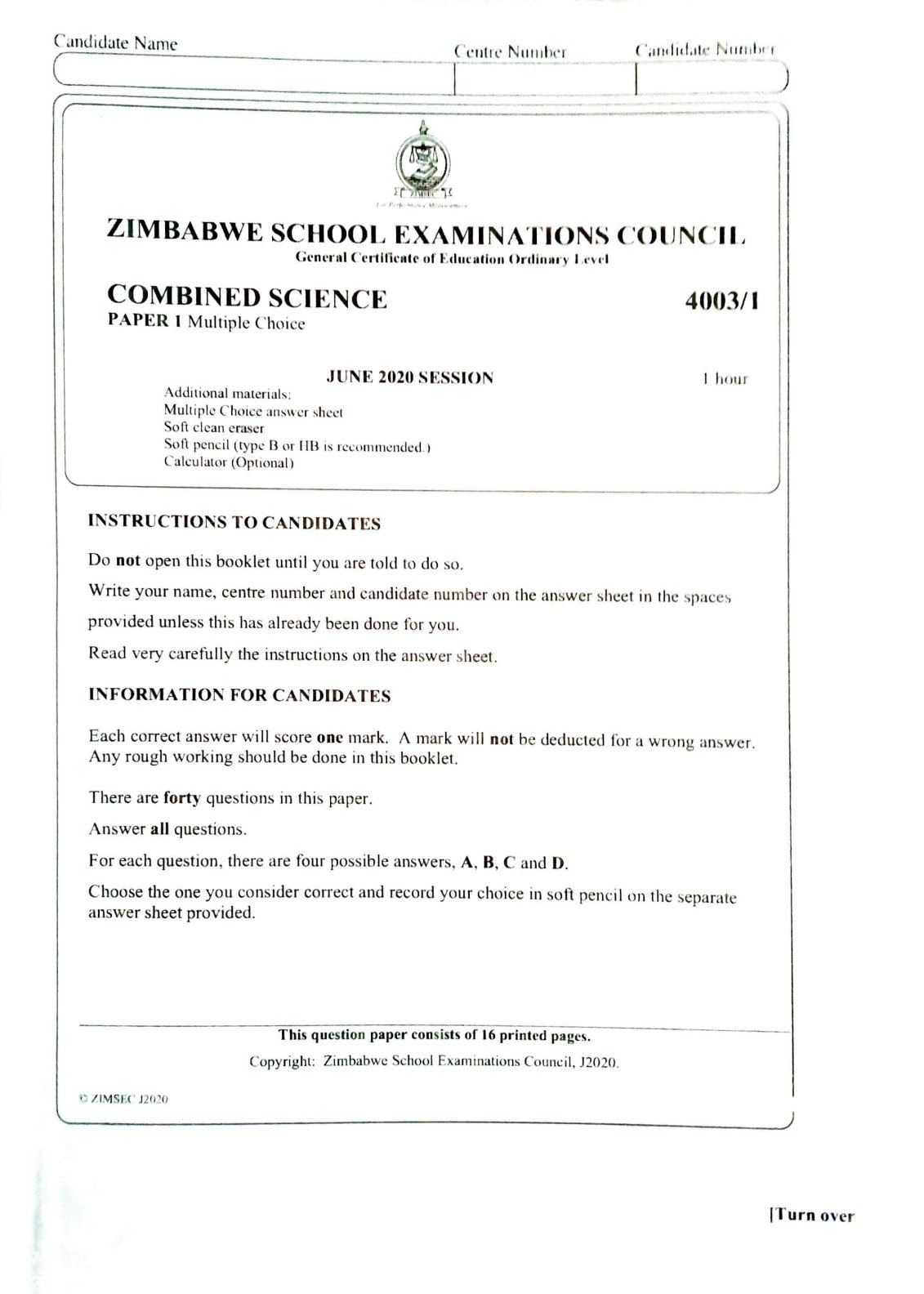
First page of ZIMSEC O-Level Combined Science Paper 1 June 2020 Question Paper

ZIMSEC O-Level Combined Science Paper 1 June 2020 Question Paper

Download and practise with this ZIMSEC O-Level Combined Science Paper 1 June 2020 question paper. Useful for exam revision, past paper practice, and preparation in Zimbabwe.

A free account is needed to download. Sign in or create one

Exam board
ZIMSEC
Subject
Combined Science
Level
O-Level
Document
Question Paper
Paper
Paper 1
Paper code
4003/1
Time allowed
1 hour
Session
June
Year
2020
File
PDF, 1.9 MB

About this question paper

This is the ZIMSEC O-Level Combined Science question paper for Paper 1 from June 2020. Use it for exam practice under timed conditions. The paper code is 4003/1. Time allowed: 1 hour.

More Combined Science O-Level 2020 papers

Other years: Combined Science O-Level

Extracted text

# ZIMBABWE SCHOOL EXAMINATIONS COUNCIL <br> General Certificate of Education Ordinary Level

**COMBINED SCIENCE**

**PAPER 1 Multiple Choice**

**JUNE 2020 SESSION**

1 hour

Additional materials:

Multiple Choice answer sheet

Soft clean eraser

Soft pencil (type B or HB is recommended.)

Calculator (Optional)

### INSTRUCTIONS TO CANDIDATES

Do not open this booklet until you are told to do so.

Write your name, centre number and candidate number on the answer sheet in the spaces provided unless this has already been done for you.

Read very carefully the instructions on the answer sheet.

### INFORMATION FOR CANDIDATES

Each correct answer will score one mark. A mark will not be deducted for a wrong answer. Any rough working should be done in this booklet.

There are forty questions in this paper.

Answer all questions.

For each question, there are four possible answers, \(\mathbf{A}, \mathbf{B}, \mathbf{C}\) and \(\mathbf{D}\).

Choose the one you consider correct and record your choice in soft pencil on the separate answer sheet provided.

**This question paper consists of 16 printed pages.**

Copyright: Zimbabwe School Examinations Council, J2020.

## Question 1
Which one is a physical component of an ecosystem?

A air

B fungi

C humus

D bacteria

## Question 2
What is the function of the vacuole in a plant cell?

A stores salts and sugars

B controls the activities of the cell

C produces food by photosynthesis

D controls movement of substances in and out of the cell

## Question 3
The equation for anaerobic respiration in muscle cells is given below:

$$
\text { glucose } \longrightarrow \text { energy }+ \text { Q }
$$

What is \(\mathbf{Q}\) ?

A carbon dioxide

B lactic acid

C alcohol

D water

## Question 4
The diagram shows part of teeth on the upper jaw of a human being.

![](https://ocr.unopasa.com/p/ocr_assets/3301d333c9274971efbf6c87b92ec38a6c85bd8d8bd132280b4c5d8f7c400d47.jpg)

The tooth labelled \(\mathbf{X}\) is

A a molar.

B a canine.

C an incisor.

D a premolar.

## Question 5
The diagram shows a stage in the process of testing a leaf for starch.

![](https://ocr.unopasa.com/p/ocr_assets/28fb7743770afeffa65e87eb4d26488389f302a3eec902b1d45910c543c633a0.jpg)

Why is the stage shown important?

A to soften the leaf

B to make the leaf brittle

C to kill and open up the leaf cells

D to remove chlorophyll from the leaf

## Question 6
An experiment on germination was carried out by planting 80 seeds and 50 seeds germinated.

What was the percentage germination?

A \(\frac{30}{80} \times \frac{100}{1}\)

B \(\frac{50}{80} \times \frac{100}{1}\)

C \(\frac{30}{100} \times \frac{80}{1}\)

D \(\frac{50}{100} \times \frac{80}{1}\)

## Question 7
Where does gaseous exchange occur?

A in the bronchiole

B in the bronchus

C in the trachea

D in the alveoli

## Question 8
Which one is not a function carried out by the blood?

A defence

B excretion

C transport

D homeostasis

## Question 9
Why is transpiration good for a plant?

A It helps the plant to take up water and mineral salts.

B It helps to transport sugars around the plant.

C It maintains a balance of starch.

D It keeps the plant cells turgid.

## Question 10
The diagram shows the double blood circulation system in humans.

![](https://ocr.unopasa.com/p/ocr_assets/c246d518b85096b659ae9da08c4e95c23d1f33b6ba1092bc0ab09fcb3fb50a1c.jpg)

Which blood vessels are thick walled?

A 1 and 2

B 1 and 3

C 2 and 4

D 3 and 4

## Question 11
The diagram shows the structure of a wind pollinated flower.

Which part produces pollen grains?

![](https://ocr.unopasa.com/p/ocr_assets/85fc9a5ade8cf119233c2098fd2c52b8b910b902de6171b5f1f96d6418b846e7.jpg)

## Question 12
The diagram shows the transfer of a substance between the placenta and the uterine wall in a pregnant woman.

![](https://ocr.unopasa.com/p/ocr_assets/230fdaf34c550327db6ec21b2e7573e8c3cac688100a59f49cedc962d01348da.jpg)

The substance carried in the direction of the arrows is

A urea.

B oxygen.

C glucose.

D an antibody.

## Question 13
![](https://ocr.unopasa.com/p/ocr_assets/ad6adc8d67a2093d9980f36de7b274c9e226026805b29aed6ecede31f9462da7.jpg)

Which method can effectively control the mosquito at stage \(\mathbf{J}\) ?

A spraying with insecticide

B using mosquito repellents

C covering water ponds with oil

D cutting grass around the home

## Question 14
Active immunity may be developed by

A suffering and recovering from a disease.

B breast feeding for at least six months.

C avoiding contact with sick people.

D being injected with antibodies.

## Question 15
The Avogadro's number is the number of

A particles in one mole of a substance.

B protons in one mole of a substance.

C electrons in one mole of a substance.

D neutrons in one mole of a substance.

## Question 16
The two types of sub-atomic particles found in the nucleus are the

A electron and proton.

B electron and neutron.

C proton and neutron.

D nucleon and electron.

## Question 17
The symbol \(^{18}\text{O}\) represents an atom of oxygen.

How many neutrons does the atom have?

A 8

B 10

C 18

D 26

## Question 18
What is the relative molecular mass of water \(\text{H}_2\text{O}\)? [Ar of H is 1, Ar of O is 16]

A 14

B 17

C 18

D 32

## Question 19
The diagram shows the type of bonding in a compound XY.

![](https://ocr.unopasa.com/p/ocr_assets/2a34cbf47d0d096590211c45d009352c1c1a2de258489c63e68bbb6b56428fd4.jpg)

XY has

A hydrogen bonding.

B metallic bonding.

C covalent bonding.

D ionic bonding.

## Question 20
Which product is formed when a metal reacts with air?

A a salt

B an oxide

C a carbonate

D a hydroxide

## Question 21
The best method of separating a mixture of liquids of different boiling points is

A filtration.

B evaporation.

C simple distillation.

D fractional distillation.

## Question 22
A solution has a pH of 6. The solution is a

A strong acid.

B weak acid.

C strong base.

D weak base.

## Question 23
A neutralisation reaction occurs when

A a salt only …