ExamineAI
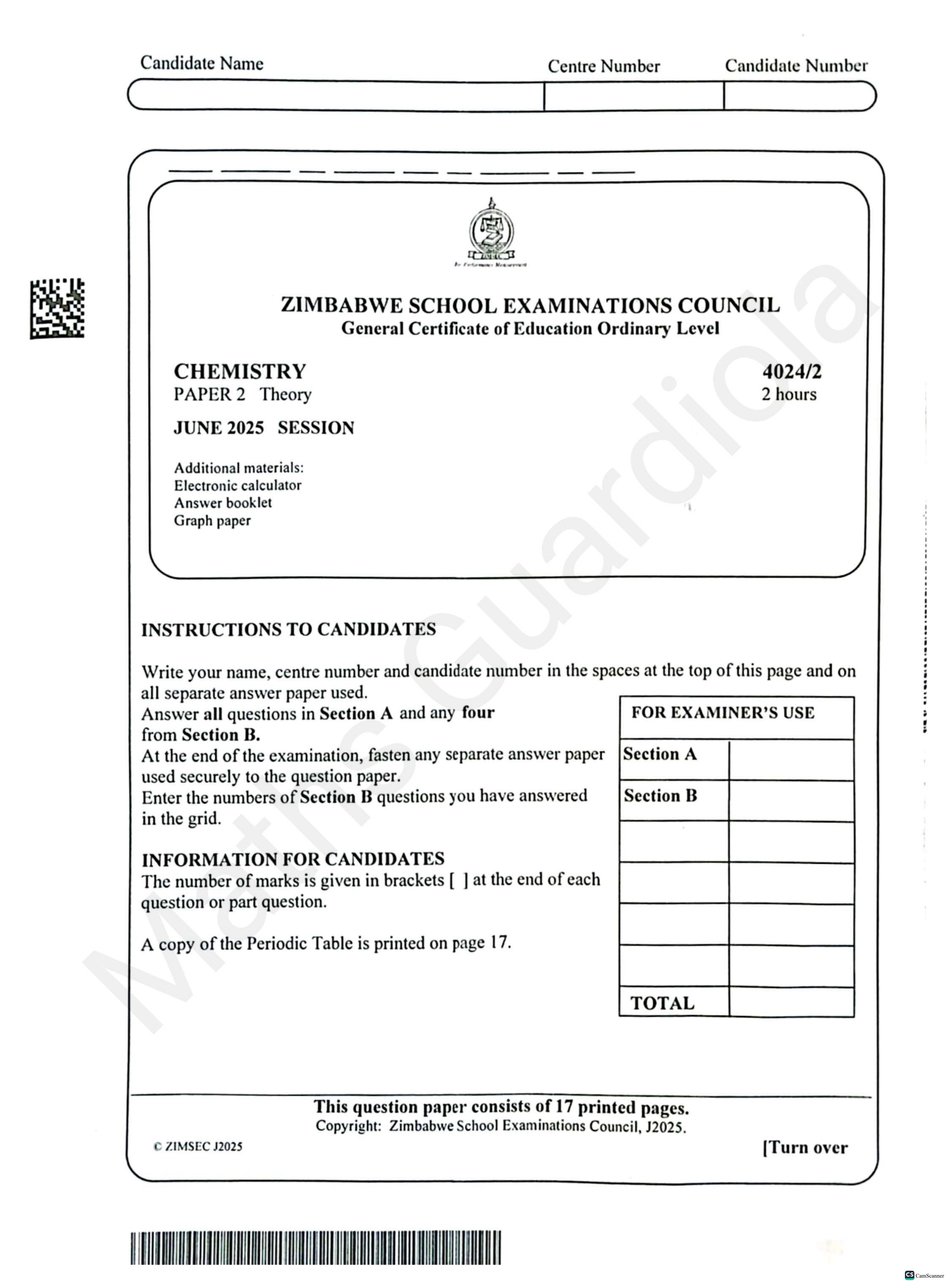
First page of ZIMSEC O-Level Chemistry Paper 2 June 2025 Question Paper

ZIMSEC O-Level Chemistry Paper 2 June 2025 Question Paper

Download and practise with this ZIMSEC O-Level Chemistry Paper 2 June 2025 question paper. Useful for exam revision, past paper practice, and preparation in Zimbabwe.

A free account is needed to download. Sign in or create one

Exam board
ZIMSEC
Subject
Chemistry
Level
O-Level
Document
Question Paper
Paper
Paper 2
Time allowed
2 hours
Session
June
Year
2025
File
PDF, 4.1 MB

About this question paper

This is the ZIMSEC O-Level Chemistry question paper for Paper 2 from June 2025. Use it for exam practice under timed conditions. Time allowed: 2 hours.

More Chemistry O-Level 2025 papers

Other years: Chemistry O-Level

Extracted text

# ZIMBABWE SCHOOL EXAMINATIONS COUNCIL General Certificate of Education Ordinary Level

**CHEMISTRY**

**PAPER 2 Theory**

**JUNE 2025 SESSION**

Additional materials:
Electronic calculator
Answer booklet
Graph paper

### INSTRUCTIONS TO CANDIDATES

Write your name, centre number and candidate number in the spaces at the top of this page and on all separate answer paper used.
Answer all questions in Section A and any four from Section B.
At the end of the examination, fasten any separate answer paper used securely to the question paper.
Enter the numbers of Section B questions you have answered in the grid.

### INFORMATION FOR CANDIDATES

The number of marks is given in brackets [ ] at the end of each question or part question.

A copy of the Periodic Table is printed on page 17.

| FOR EXAMINER'S USE |  |
| :--- | :--- |
| Section A |  |
| Section B |  |
|  |  |
|  |  |
|  |  |
|  |  |
| TOTAL |  |

![](https://ocr.unopasa.com/p/ocr_assets/68c43b9b8a4bda5a9b4ac1cf720611454ff163cd08181293aa30471cf66b8f00.jpg)

**Section A**

Answer all questions from this section.
Write your answers on the spaces provided in the question paper.

## Question 1
### (a)

Name the method used to separate a mixture of

1. sand and salt solution,

2. ethanol solution and water.

### (b)

Table 1.1 is an incomplete table showing two ions and their subatomic particles.

**Table 1.1**

| ion | number of protons | number of electrons |
| :---: | :---: | :---: |
| \(N^{3-}\) |  |  |
| \(H^{+}\) |  |  |

Complete Table 1.1 by stating the number of protons and electrons in each ion.

### (c)

Draw a dot and cross diagram to show the bonding in ammonia.

## Question 2
### (a)

Fig 2.1 shows a zinc plate placed in copper sulphate solution.

![](https://ocr.unopasa.com/p/ocr_assets/7886e31e5dd3b2c10cf79c9446cff73e3e8692e2f10e002cb02c72595efb4000.jpg)
Fig 2.1

#### (i)

Identify the brown solid deposited on the zinc plate.

#### (ii)

Write a balanced chemical equation for the chemical changes taking place.

#### (iii)

State the type of reaction which occurs when zinc is converted to the \(Zn^{2+}\) ions.

\_\_\_\_

\_\_\_\_

![](https://ocr.unopasa.com/p/ocr_assets/00ca43a411255d296281f43397dd29e8d7017ae53dd8c3b9d1b372dc043d9714.jpg)

### (b)

Fig 2.2 represents a method used to test for a gas produced when calcium carbonate is heated.

![](https://ocr.unopasa.com/p/ocr_assets/38b2eeb8437c2ce53ee23c88498f81e7d59573684b6dff92324dd92c957a0387.jpg)
Fig 2.2

#### (i)

Describe what happens when the calcium carbonate is heated.

\_\_\_\_

\_\_\_\_

\_\_\_\_

\_\_\_\_

#### (ii)

State the acid base/base nature of the product that remains in the hard glass test tube.

## Question 3
### (a)

Define reduction in terms of

1. electron transfer,

\_\_\_\_

\_\_\_\_

2. oxidation number.

\_\_\_\_

\_\_\_\_

### (b)

#### (i)

Fig 3.1 shows an energy profile for the conversion of **A** to **B**.

![](https://ocr.unopasa.com/p/ocr_assets/fefd5ec24b8aa123009128600d3740c7e6daf619c53d4b6047e08468529a3826.jpg)
Fig 3.1

Name the type of energy represented by

1. \(x\),

\_\_\_\_

2. \(y\).

\_\_\_\_

\_\_\_\_

![](https://ocr.unopasa.com/p/ocr_assets/96159235935f7d1032a06e5ff10a9ff9da1c213d03c487f316787e14f7ad340d.jpg)

#### (ii)

State, with a reason, whether the reaction is endothermic or exothermic.

### (c)

Compare the reactivities of calcium and magnesium with water.

## Question 4
### (a)

Fig 4.1 shows how coal can be converted to other products during dry distillation.

![](https://ocr.unopasa.com/p/ocr_assets/1cc9f1ad39a247a9045c4c27e84f7626cf739b1945b35d52d1f830524e1ce6ce.jpg)
Fig 4.1

#### (i)

Name substance X.

#### (ii)

State the role of the cold water.

#### (iii)

Explain the industrial importance of the process in value addition and beneficiation of coal.

\_\_\_\_

\_\_\_\_

\_\_\_\_

\_\_\_\_

\_\_\_\_

\_\_\_\_

\_\_\_\_

\_\_\_\_

### (b)

#### (i)

Fig 4.2 shows the structural formulae of compounds **A** and **B**.

![](https://ocr.unopasa.com/p/ocr_assets/bc571ddf3468967fbcd547836a344fcc9d831a16b0c7a0413596d97198bb9476.jpg)
Fig 4.2

Name compound

1. A,

\_\_\_\_

2. B.

\_\_\_\_

![](https://ocr.unopasa.com/p/ocr_assets/a747bfad1d35d8ccc1ab57c3e194c541bae7f0d2a694b943d64421b30fa38b25.jpg)

<img class="imgSvg" id = "mqpk0eie5ahytufein" src="https://ocr.unopasa.com/p/ocr_assets/46f9bd965d861a2557c0f73352bd3cc184f9dddcb2951848a6dda46e3c56b1c2.svg"/>

Fig 4.3

Describe a chemical test that can be used to distinguish between B and C.

## Question 5
### (a)

#### (i)

Define the term amphoteric.

#### (ii)

Two oxides \(XO_{3}\) and \(MO\) react with water according to the following equations:

$$
\begin{aligned}  |  MO_{(s)} + H_2O_{(l)} \rightarrow M^{2+}_{(aq)} + 2OH^{-}_{(aq)}   |  XO_{3(g)} + H_2O_{(l)} \rightarrow 2H^{+}_{(aq)} + XO_4^{2-}_{(aq)}
\end{aligned}
$$

Identify the acid base/nature of

1. \(MO_{(s)}\),

2. \(XO_{3(g)}\).

### (b)

Fig 5.1 shows a section of terylene.

![](https://ocr.unopasa.com/p/ocr_assets/e211cff18f659ea4a54ee0fd6315b934dcd41fee10d5280d2b5a5e81d5654248.jpg)
Fig 5.1

#### (i)

State the type of polymerisation that formed terylene.

#### (ii)

Name the linkage in terylene.

![](https://ocr.unopasa.com/p/ocr_assets/617090d1f55db0ca6d3bf4cfef9e2c8c78f24510cbe702c2b108260480bcd919.jpg)

#### (iii)

Draw the structures of the monomers of terylene.

#### (iv)

State any one use of terylene.

**Section B**

Answer any four questions from this section.
Write your answer on the separate paper provided.

## Question 6
### (a)

In the electrolysis of acidified water, oxygen and hydrogen are produced.

#### (i)

Calculate the volume of hydrogen produced if \(50 cm^3\) of oxygen is produced at room temperature and pressure.

#### (ii)

Explain why the method of electrolysis is an expensive method of producing oxygen.

### (b)

Hydrogen is used in the production of copper from copper (II) oxide according to the chemical equation shown.

$$
CuO_{(s)} + H_{2(g)} \rightarrow Cu_{(s)} + …