ExamineAI
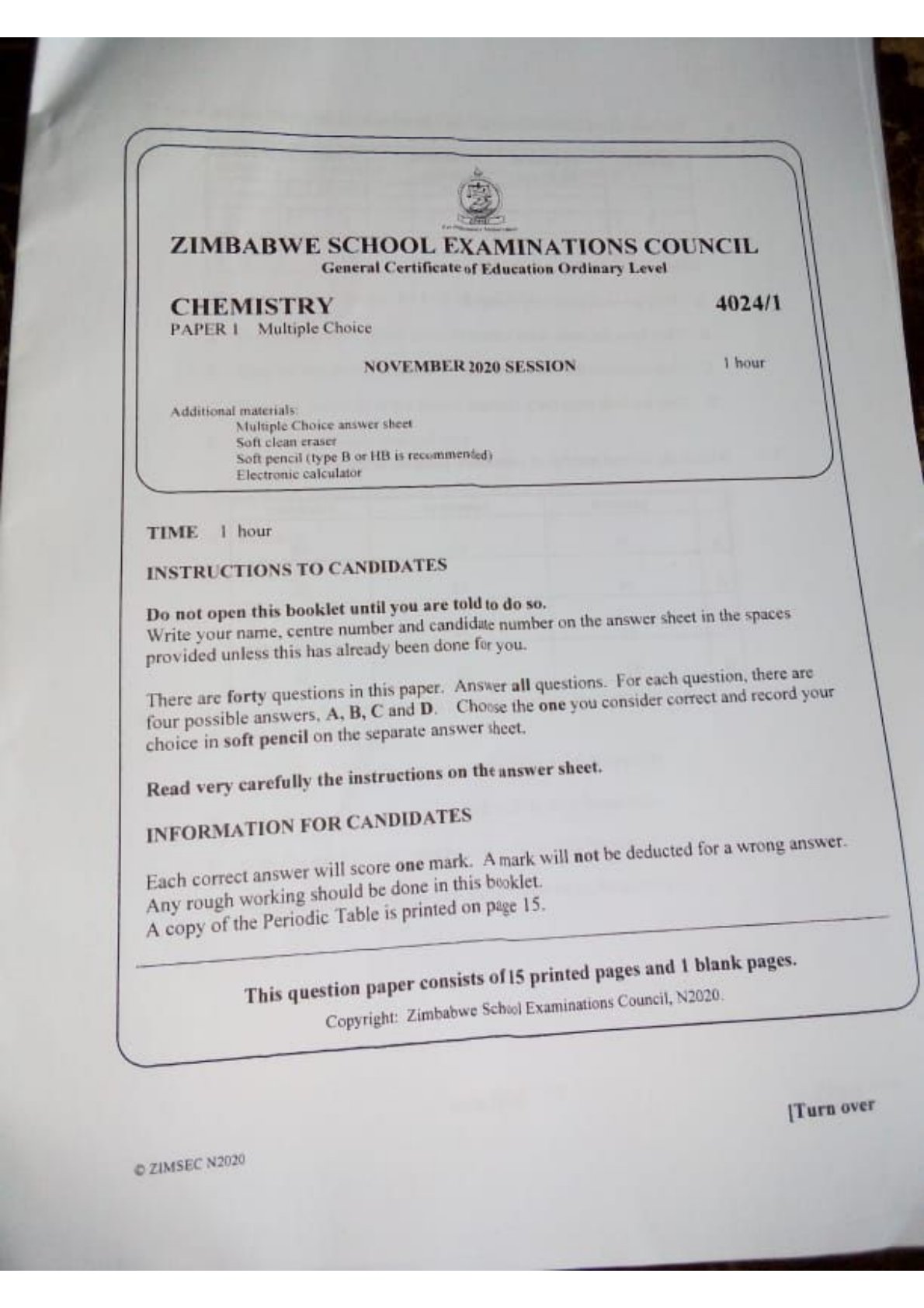
First page of ZIMSEC O-Level Chemistry Paper 1 November 2020 Question Paper

ZIMSEC O-Level Chemistry Paper 1 November 2020 Question Paper

Download and practise with this ZIMSEC O-Level Chemistry Paper 1 November 2020 question paper. Useful for exam revision, past paper practice, and preparation in Zimbabwe.

A free account is needed to download. Sign in or create one

Exam board
ZIMSEC
Subject
Chemistry
Level
O-Level
Document
Question Paper
Paper
Paper 1
Paper code
4024/1
Time allowed
1 hour
Session
November
Year
2020
File
PDF, 511 KB

About this question paper

This is the ZIMSEC O-Level Chemistry question paper for Paper 1 from November 2020. Use it for exam practice under timed conditions. The paper code is 4024/1. Time allowed: 1 hour.

More Chemistry O-Level 2020 papers

Other years: Chemistry O-Level

Extracted text

# ZIMBABWE SCHOOL EXAMINATIONS COUNCIL <br> General Certificate of Education Ordinary Level

**CHEMISTRY**<br>**PAPER 1 Multiple Choice**

**NOVEMBER 2020 SESSION**

1 hour

Additional materials:

Multiple Choice answer sheet

Soft clean eraser

Soft pencil (type B or HB is recommended)

Electronic calculator

TIME 1 hour

### INSTRUCTIONS TO CANDIDATES

Do not open this booklet until you are told to do so.

Write your name, centre number and candidate number on the answer sheet in the spaces provided unless this has already been done for you.

There are forty questions in this paper. Answer all questions. For each question, there are four possible answers, A, B, C and D. Choose the one you consider correct and record your choice in soft pencil on the separate answer sheet.

Read very carefully the instructions on the answer sheet.

### INFORMATION FOR CANDIDATES

Each correct answer will score one mark. A mark will not be deducted for a wrong answer. Any rough working should be done in this booklet.

A copy of the Periodic Table is printed on page 15.

This question paper consists of 15 printed pages and 1 blank page.

Copyright: Zimbabwe School Examinations Council, N2020.

## Question 1
The table shows information about the subatomic particles of two species, \(X\) and \(Y\).

| element | number of <br> electrons | number of <br> neutrons | number of <br> protons |
| :---: | :---: | :---: | :---: |
| \(X\) | 4 | 6 | 5 |
| \(Y\) | 6 | 4 | 5 |

Which statement about \(X\) and \(Y\) is correct?

A They are both positively charged.

B They have the same mass number.

C They represent the same element.

D They are both negatively charged.

## Question 2
What is the correct number of subatomic particles in the ion \({ }_{38}^{90} \mathrm{Z}^{2+}\)?

|  | protons | neutrons | electrons |
| :---: | :---: | :---: | :---: |
| A | 38 | 52 | 40 |
| B | 38 | 52 | 36 |
| C | 52 | 38 | 40 |
| D | 52 | 38 | 36 |

## Question 3
The table shows information about particles of two elements, M and N.

| element | number of <br> protons | number of <br> neutrons | electronic structure |
| :---: | :---: | :---: | :---: |
| M | 9 | 10 | 2.8 |
| N | 17 | 20 | 2.8.8 |

Which statement is correct for both M and N?

A They are isotopes of the same element.

B They are negatively charged ions.

C They are atoms of noble gases.

D They are positively charged ions.

## Question 4
Which factor affects the rate of diffusion of a gas?

A inertness

B solubility

C colour

D molecular mass

## Question 5
Increasing the temperature of a reaction mixture increases the rate of reaction because

A particles gain kinetic energy and collide more frequently.

B particles lose kinetic energy and collide less frequently.

C particles gain kinetic energy and collide less frequently.

D particles lose kinetic energy and collide more frequently.

## Question 6
Which statement is not true about the properties of particles of matter?

A particles in a liquid have less energy than particles in a gas

B particles in a solid have less energy than particles in a liquid

C particles in a gas have less energy than particles in a solid

D particles in a liquid have more energy than particles in a solid

## Question 7
An element, X, in its ground state, is a diatomic gas and has seven valence electrons.

Element X is

A helium.

B oxygen.

C chlorine.

D nitrogen.

## Question 8
A volume of \(20.00 \mathrm{~cm}^{3}\) of \(0.20 \mathrm{moldm}^{-3}\) hydrochloric acid were reacted with potassium hydroxide solution.

What was the concentration of the hydroxide if \(15.00 \mathrm{~cm}^{3}\) were needed for complete neutralisation?

A \(0.27 \mathrm{moldm}^{-3}\)

B \(1.33 \mathrm{moldm}^{-3}\)

C \(4.00 \mathrm{moldm}^{-3}\)

D \(0.03 \mathrm{moldm}^{-3}\)

## Question 9
Which statement is not correct about the reaction between calcium carbonate and excess hydrochloric acid?

A The reaction can be speeded up by using powdered calcium carbonate.

B The reaction can be slowed down by using cold acid.

C The reaction can be speeded up by using dilute acid.

D Half the volume of gas is produced if half the mass of calcium carbonate is used.

## Question 10
Which set of elements exist as diatomic molecules?

|  |  |  |  |
| :--- | :--- | :--- | :--- |
| A | nitrogen | fluorine | neon |
| B | hydrogen | chlorine | neon |
| C | oxygen | chlorine | helium |
| D | oxygen | hydrogen | nitrogen |

## Question 11
An endothermic reaction occurs when

A the products are more stable than the reactants.

B the reactants have more energy than the products.

C bonds are formed.

D bonds are broken.

## Question 12
An ionic compound has the formula \(\mathrm{MX}_{2}\).

Which row correctly shows the Groups of the Periodic Table to which the elements represented by M and X belong?

|  | M | X |
| :---: | :---: | :---: |
| A | VII | II |
| B | II | VII |
| C | I | III |
| D | VI | III |

## Question 13
Which statement is not true about eutrophication?

A It is caused by washing of excess fertilizers into water bodies.

B It results in increased growth of algae and other aquatic plants.

C It reduces the amount of oxygen available to fish and other aquatic animals.

D It can be reversed by reducing the number of organisms that need oxygen.

## Question 14
Extraction of copper consists of four main stages.

What is the correct sequence of these stages?

A crushing, flotation, smelting, electrolysis

B smelting, crushing, flotation, electrolysis

C electrolysis, smelting, crushing, flotation

D flotation, crushing, smelting, electrolysis

## Question 15
Hydrogen gas is becoming very popular as a fuel mainly because hydrogen

A is very flammable.

B is more efficient.

C is cheaper to produce.

D produces less pollutants.

## Question 16
The gas produced at the anode, during the electrolysis of dilute sulphuric acid, can be identified by

A dipping a burning wooden splint into the gas.

B dipping damp blue litmus paper into the gas.

C bubbling the gas through …