ExamineAI
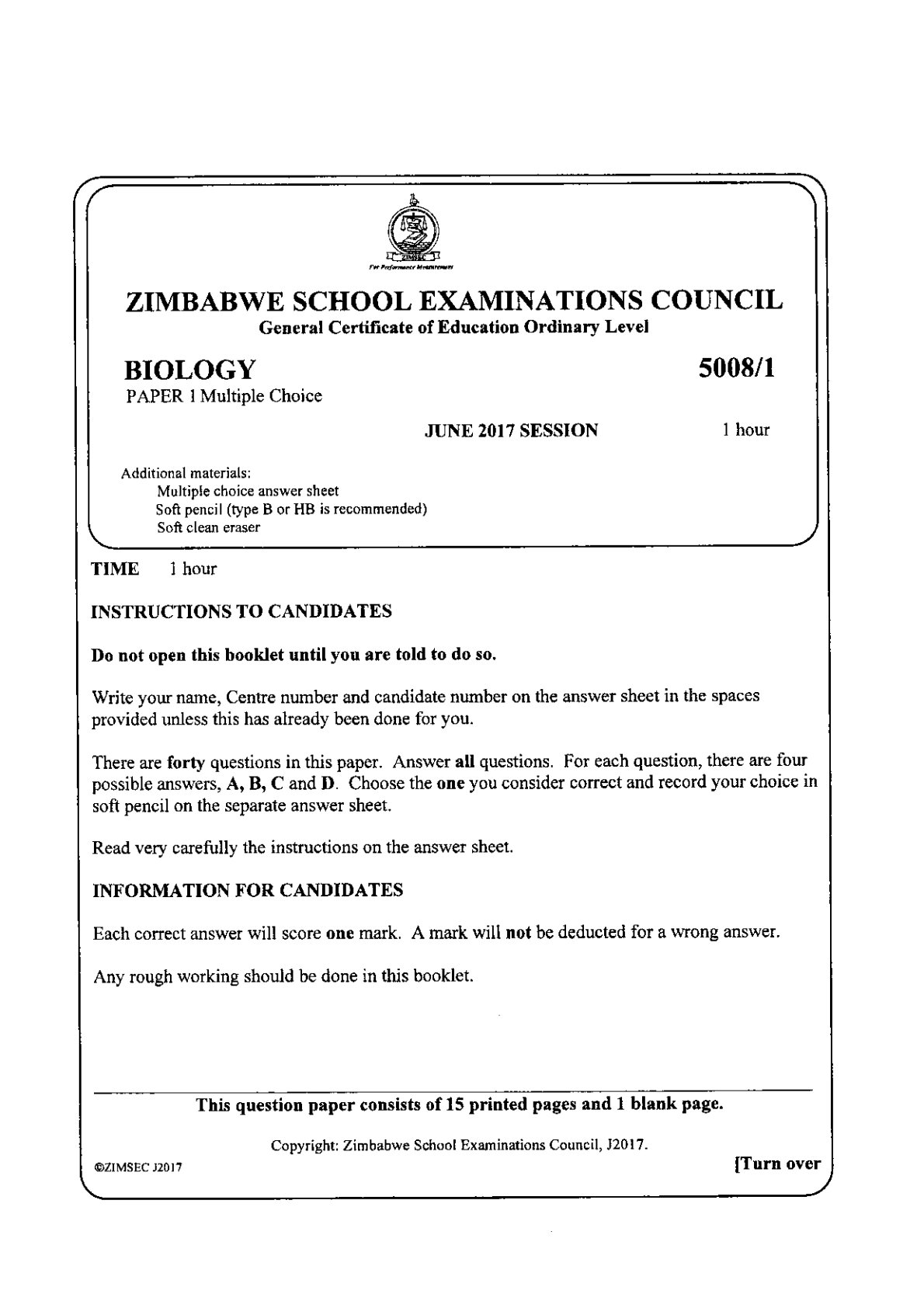
First page of ZIMSEC O-Level Biology Paper 1 June 2017 Question Paper

ZIMSEC O-Level Biology Paper 1 June 2017 Question Paper

Download and practise with this ZIMSEC O-Level Biology Paper 1 June 2017 question paper. Useful for exam revision, past paper practice, and preparation in Zimbabwe.

A free account is needed to download. Sign in or create one

Exam board
ZIMSEC
Subject
Biology
Level
O-Level
Document
Question Paper
Paper
Paper 1
Paper code
5008/1
Time allowed
1 hour
Session
June
Year
2017
File
PDF, 177 KB

About this question paper

This is the ZIMSEC O-Level Biology question paper for Paper 1 from June 2017. Use it for exam practice under timed conditions. The paper code is 5008/1. Time allowed: 1 hour.

Other years: Biology O-Level

Extracted text

# ZIMBABWE SCHOOL EXAMINATIONS COUNCIL <br> General Certificate of Education Ordinary Level

**BIOLOGY**<br>**PAPER 1 Multiple Choice**

**JUNE 2017 SESSION**
1 hour

Additional materials:
Multiple choice answer sheet
Soft pencil (type B or HB is recommended)
Soft clean eraser

TIME 1 hour

### INSTRUCTIONS TO CANDIDATES

Do not open this booklet until you are told to do so.
Write your name, Centre number and candidate number on the answer sheet in the spaces provided unless this has already been done for you.

There are forty questions in this paper. Answer all questions. For each question, there are four possible answers, A, B, C and D. Choose the one you consider correct and record your choice in soft pencil on the separate answer sheet.

Read very carefully the instructions on the answer sheet.

### INFORMATION FOR CANDIDATES

Each correct answer will score one mark. A mark will not be deducted for a wrong answer.
Any rough working should be done in this booklet.

This question paper consists of 15 printed pages and 1 blank page.
Copyright: Zimbabwe School Examinations Council, J2017.

## Question 1
Which structure, in a plant cell is selectively permeable?

A cell membrane

B cell wall

C sap vacuole

D cytoplasm

## Question 2
The diagram shows a specialised animal cell.

![](https://ocr.unopasa.com/p/ocr_assets/61f72a81d7219b89c1bc7873570588e5b66a703436d574dc12dc087670f34c74.jpg)

The cell is adapted for

A transport

B photosynthesis

C contraction

D absorption

## Question 3
The diagram shows a plant cell, a few minutes after being placed in a concentrated salt solution.

![](https://ocr.unopasa.com/p/ocr_assets/8c4e05b846fc6a9e6619c6d36b9975bca50f0a2a5d463c0bc96b37ff6c608f31.jpg)

Which substance will be found in the space marked E ?

A salt solution

B cytoplasm

C water

D cell sap

## Question 4
Phosphorus is needed by plants for the

A development of roots.

B formation of flowers.

C growth of leaves.

D production of chlorophyll.

## Question 5
Which energy change is correct for green plants?

A chemical energy to light energy

B light energy to heat energy

C light energy to chemical energy

D heat energy to chemical energy

## Question 6
The diagram shows a cross section of a leaf.

![](https://ocr.unopasa.com/p/ocr_assets/a2a50236bf2b95fe395104f55db69627dfb7b6aa9a3103074e68415409c88668.jpg)

In which parts does photosynthesis take place?

A 1, 2 and 3

B 1,2 and 4

C 1,3 and 4

D 2, 3 and 4

## Question 7
The diagram shows part of the human alimentary canal.

Which structure produces digestive juice at the lowest pH ?

![](https://ocr.unopasa.com/p/ocr_assets/5b1e2349ea6607ebc294dc882a3c56faeca34eaea5a3a032dff788ed7d3f3245.jpg)

## Question 8
Why is iron needed in the human diet?

A It builds and hardens bones.

B It prevents blood from clotting.

C It is used to make haemoglobin.

D It helps to prevent tooth decay.

## Question 9
The function of the colon is to

A remove undigested food material.

B produce enzymes.

C absorb digested molecules.

D absorb water into the blood stream.

## Question 10
Four equal masses of different foods were each burnt as shown in the diagram. The temperature of water was measured at the beginning and at the end of each experiment, and the results recorded in a table.

![](https://ocr.unopasa.com/p/ocr_assets/b2535ea4a403f146a94d56c1edd79b255381b8f39e7377a7775a1dabb80cafe1.jpg)

Which food sample could be fat?

|  | water temperature at <br> the start/ \(^{\circ}\mathrm{C}\) | water temperature at <br> the end/ \(^{\circ}\mathrm{C}\) |
| :---: | :---: | :---: |
| A | 17 | 37 |
| B | 17 | 90 |
| C | 18 | 87 |
| D | 19 | 50 |

## Question 11
What are the products of aerobic respiration of glucose?

A carbon dioxide and lactic acid

B lactic acid, energy and carbon dioxide

C energy, water and oxygen

D carbon dioxide, water and energy

## Question 12
The function of alveoli in the lungs is to

A prevent the lungs from collapsing.

B provide an adequate supply of mucus.

C provide a large surface area.

D make the lungs elastic.

## Question 13
What are the end products of anaerobic respiration in yeast?

A carbon dioxide and ethanol

B carbon dioxide and lactic acid

C carbon dioxide and water

D ethanol and lactic acid

## Question 14
Two leaves were taken from the same plant. One had vaseline smeared on the upper surface while the other had no vaseline. Both were hung in open air for five hours.

If the decrease in mass was the same in both leaves, it can be concluded that the leaves had

A more stomata on the upper surface.

B no stomata on the upper surface.

C no stomata on the lower surface.

D equal numbers of stomata on both sides.

## Question 15
The diagram shows part of the trunk of a tree with a ring of bark removed.

![](https://ocr.unopasa.com/p/ocr_assets/3a8ab9764e139cab98df07fb180e04f66c4c4ba9ff6315bd5d85df1da0efde0b.jpg)

Which row correctly describes the effect of removing the bark on the growth rate of the two branches?

|  | lower branch | upper branch |
| :---: | :---: | :---: |
| A | reduced | normal |
| B | normal | reduced |
| C | normal | normal |
| D | reduced | reduced |

## Question 16
Under which set of conditions would the rate of transpiration in a plant be fastest?

A a cool, dry and calm day.

B a cool, rainy and windy day.

C a hot, dry and calm day.

D a hot, rainy and windy day.

## Question 17
When the left ventricle contracts,

A the bicuspid valve closes.

B the tricuspid valve closes.

C blood flows into the pulmonary artery.

D blood flows into the pulmonary vein.

## Question 18
The diagram shows the heart of a mammal.

![](https://ocr.unopasa.com/p/ocr_assets/425ebf527e6642c4ab93e0d9f5ca534566e3032092ab5a4787f8b9db1c7fa763.jpg)

Which blood vessels carry oxygenated blood?

A 1 and 2

B 2 and 4

C 1 and 3

D 3 and 4

## Question 19
Which process provides a child with active immunity?

A receiving a \(BCG\) vaccine

B receiving antibodies from mother's milk

C receiving anti-venom serum

D …