ExamineAI
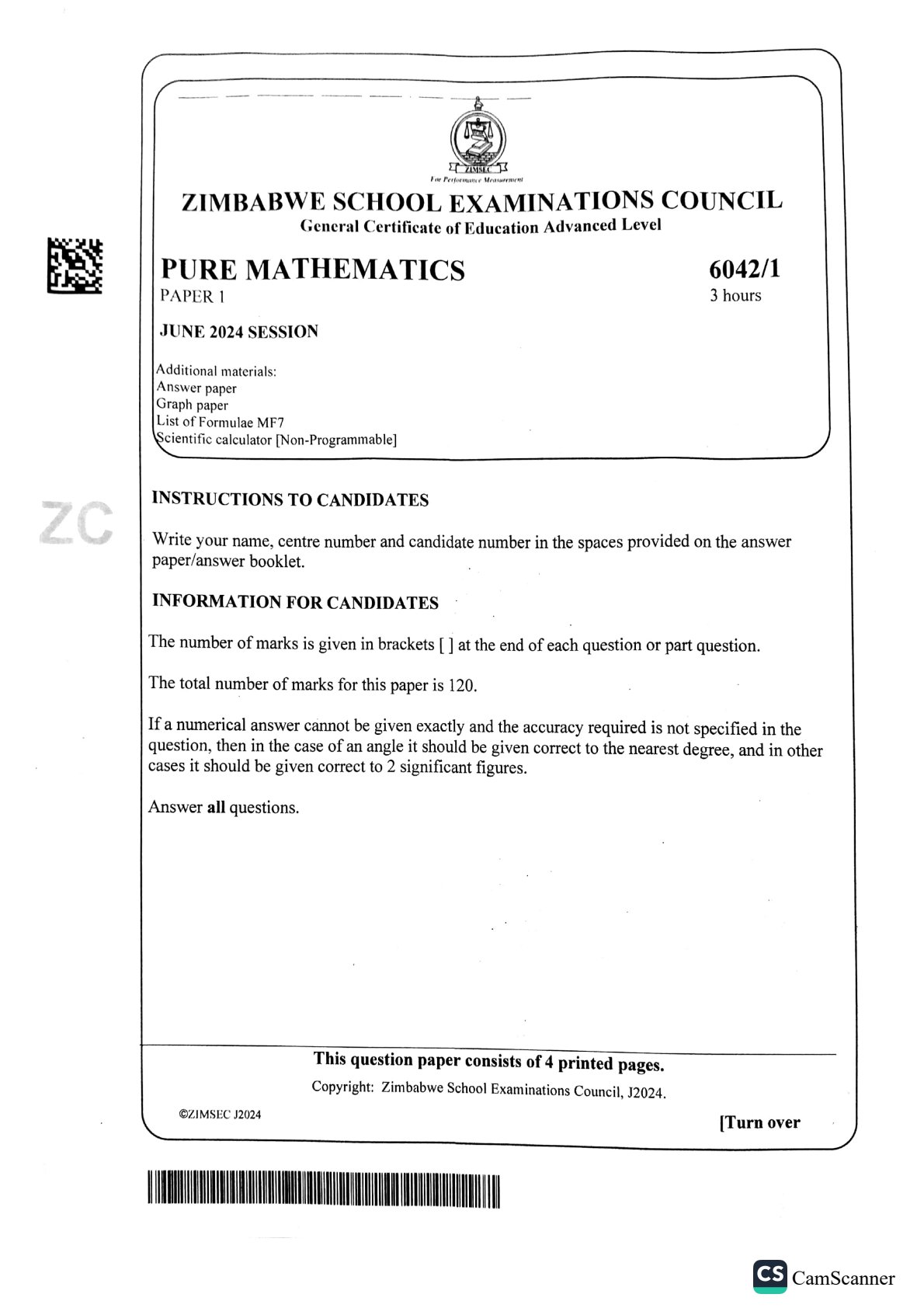
First page of ZIMSEC A-Level Pure Mathematics Paper 1 June 2024 Question Paper

ZIMSEC A-Level Pure Mathematics Paper 1 June 2024 Question Paper

Download and practise with this ZIMSEC A-Level Pure Mathematics Paper 1 June 2024 question paper. Useful for exam revision, past paper practice, and preparation in Zimbabwe.

A free account is needed to download. Sign in or create one

Answers: ZIMSEC A-Level Pure Mathematics Paper 1 June 2024 Marking Scheme

Exam board
ZIMSEC
Subject
Pure Mathematics
Level
A-Level
Document
Question Paper
Paper
Paper 1
Paper code
6042/1
Time allowed
3 hours
Session
June
Year
2024
File
PDF, 917 KB

About this question paper

This is the ZIMSEC A-Level Pure Mathematics question paper for Paper 1 from June 2024. Use it for exam practice under timed conditions, then check your work against the marking scheme. The paper code is 6042/1. Time allowed: 3 hours. See the marking scheme.

More Pure Mathematics A-Level 2024 papers

Other years: Pure Mathematics A-Level

Extracted text

# ZIMBABWE SCHOOL EXAMINATIONS COUNCIL <br> General Certificate of Education Advanced Level

**PURE MATHEMATICS**

**PAPER 1**

**JUNE 2024 SESSION**

Additional materials:
Answer paper
Graph paper
List of Formulae MF7
Scientific calculator [Non-Programmable]

### INSTRUCTIONS TO CANDIDATES

Write your name, centre number and candidate number in the spaces provided on the answer paper/answer booklet.

### INFORMATION FOR CANDIDATES

The number of marks is given in brackets [ ] at the end of each question or part question.
The total number of marks for this paper is 120 .
If a numerical answer cannot be given exactly and the accuracy required is not specified in the question, then in the case of an angle it should be given correct to the nearest degree, and in other cases it should be given correct to 2 significant figures.

Answer all questions.

**This question paper consists of \(\mathbf{4}\) printed pages.** <br> Copyright: Zimbabwe School Examinations Council, J2024.

## Question 1
A sequence is defined by \(U_{n+1}=3 U_{n}+1\)

### (i)

Write down the first four terms of the sequence, given that \(U_{1}=0\).

### (ii)

Hence describe the behaviour of the sequence.

### (iii)

Express \(U_{3}\) in terms of \(U_{1}\).

## Question 2
The variables \(x\) and \(y\) are connected by the equation \(y=a e^{b x}\), where \(a\) and \(b\) are constants. When the values of \(\ln y\) are plotted against values of \(x\), a straight line is obtained passing through the points \((0 ; \ln 2)\) and \((3 ; \ln 5)\).

Calculate the values of \(a\) and \(b\) in exact form.

## Question 3
Express \(\frac{2 x-3}{x^{2}\left(x^{2}-4\right)}\) in partial fractions.

## Question 4
Solve the equation \(\frac{e^{2 x}+e^{-2 x}}{5}=1\), giving the answer in exact form.

## Question 5
Find the set of values of \(x\) for which \((x-3)^{2}>2 x+1\), giving answers in exact form.

## Question 6
Chord \(X Y\) subtends an angle of \(2 \theta\) radians at the centre of a circle radius \(r\) and centre \(O\). Given that the area of the minor segment is \(\frac{1}{6}\) of the area of the major segment, show that \(\operatorname{Sin} 2 \theta=\frac{2}{7}(7 \theta-\pi)\).

## Question 7
### (a)

Expand \((1-2 x)^{\frac{1}{2}}\) up to and including the term in \(x^{2}\), simplifying coefficients.

### (b)

State the values of \(x\) for which the expansion is valid.

### (c)

By putting \(x=\frac{1}{9}\) in the expansion in part (a), show that \(\sqrt{7} \simeq \frac{143}{54}\).

## Question 8
The equation of line \(l\) is \(y+3 x-9=0\).

Find the

### (a)

equation of the line \(m\), that is perpendicular to line \(l\) and passes through the point \(\mathrm{A}(1: 6)\) in the form \(a x+b y+c=0\).

### (b)

equation of the line parallel to \(l\) passing through the point \(\mathrm{B}(5 ; 6)\).

### (c)

perpendicular distance of the point \(B(5 ; 6)\) from the line \(m\).

## Question 9
### (a)

Express \(x^{2}+6 x+5\) in the form \((a x+b)^{2}+c\), where \(a, b\) and \(c\) are constants.

### (b)

Hence or otherwise state the turning point of the graph of \(y=x^{2}+6 x+5\).

### (c)

Find the set of values taken by \(y=\frac{1}{x^{2}+6 x+5}\) for real values of \(x\).

## Question 10
Given that \(f(x)=x^{4}+x^{3}+23 x^{2}+25 x-50\),

### (a)

show that \(-5 i\) is a root of \(f(x)=0\),

### (b)

hence solve the equation \(f(x)=0\).

## Question 11
The functions \(f, g\) and \(h\) are defined as:
\(f: x \rightarrow x^{2}+2 x \quad x \in \mathrm{R}, x \geq-1\)
\(g: x \rightarrow 4 x+1 \quad x \in \mathrm{R},-2 \leq x \leq 3\)
\(h: x \rightarrow \frac{1}{x-3} \quad x \in \mathrm{R} \quad x \neq 3\)

### (a)

Find

#### (i)

\(\quad g h(x)\), stating clearly its domain,

#### (ii)

\(\quad f^{-1}(x)\).

### (b)

#### (i)

Sketch the graph of \(y=|g(x)|\), showing clearly the intercepts and end points.

#### (ii)

Hence state the range of \(|g(x)|\).

## Question 12
### (i)

Prove the identity

$$
\frac{\operatorname{Cos} \theta}{1-\operatorname{Cos} \theta}-\frac{\operatorname{Cos} \theta}{1+\operatorname{Cos} \theta} \equiv 2 \operatorname{Cot}^{2} \theta
$$

### (ii)

Hence or otherwise solve the equation
\(\frac{\operatorname{Cos} \theta}{1-\operatorname{Cos} \theta}-\frac{\operatorname{Cos} \theta}{1+\operatorname{Cos} \theta}=1\) for \(0^{\circ} \leq \theta \leq 360^{\circ}\) giving answer to the nearest degree.

## Question 13
### (a)

#### (i)

By sketching two appropriate graphs, show that \(x^{3}+x-4=0\) has one real root.

#### (ii)

Show that there is a root between 1 and 1.5.

### (b)

By using the formula \(x=\sqrt{\frac{4}{x_{n}}-1}\) and taking \(x_{1}\) as 1.37, approximate the root of \(x^{3}+x-4=0\) correct to 2 decimal places.

## Question 14
The equation of a curve is \(y^{2}-3 x y+2 x^{2}=6\).

### (a)

Show that \(\frac{d y}{d x}=\frac{3 y-4 x}{2 y-3 x}\).

### (b)

Find the equation of the tangent to the curve at \(x=1\) and \(y>0\).