ExamineAI
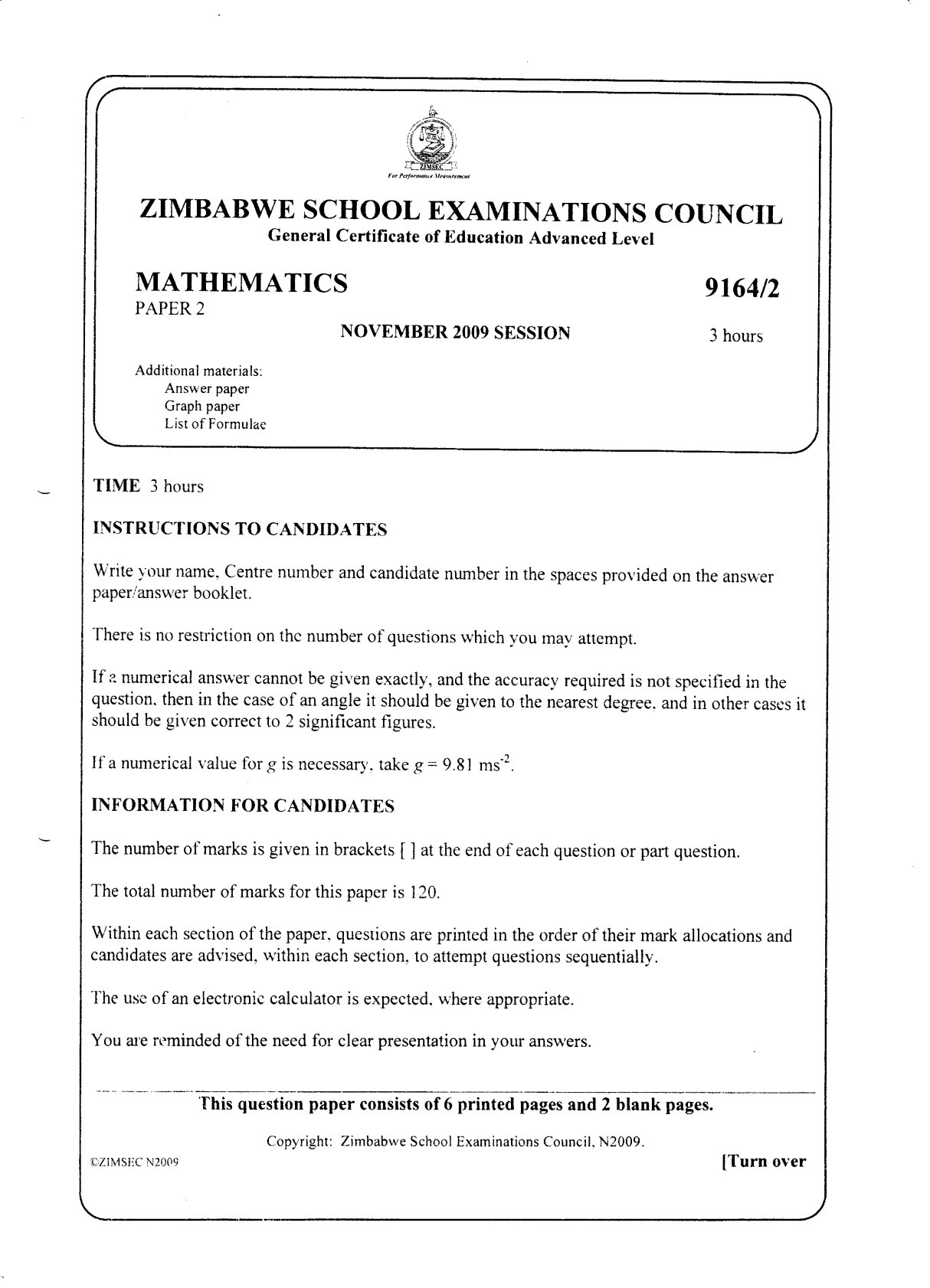
First page of ZIMSEC A-Level Mathematics Paper 2 November 2009 Question Paper

ZIMSEC A-Level Mathematics Paper 2 November 2009 Question Paper

Download and practise with this ZIMSEC A-Level Mathematics Paper 2 November 2009 question paper. Useful for exam revision, past paper practice, and preparation in Zimbabwe.

A free account is needed to download. Sign in or create one

Answers: ZIMSEC A-Level Mathematics Paper 2 November 2009 Marking Scheme

Exam board
ZIMSEC
Subject
Mathematics
Level
A-Level
Document
Question Paper
Paper
Paper 2
Paper code
9164/2
Time allowed
3 hours
Session
November
Year
2009
File
PDF, 164 KB

About this question paper

This is the ZIMSEC A-Level Mathematics question paper for Paper 2 from November 2009. Use it for exam practice under timed conditions, then check your work against the marking scheme. The paper code is 9164/2. Time allowed: 3 hours. See the marking scheme.

More Mathematics A-Level 2009 papers

Other years: Mathematics A-Level

Extracted text

# ZIMBABWE SCHOOL EXAMINATIONS COUNCIL <br> General Certificate of Education Advanced Level

**MATHEMATICS**
**9164/2**
**PAPER 2**
**NOVEMBER 2009 SESSION**
**3 hours**

Additional materials:
Answer paper
Graph paper
List of Formulae

**TIME 3 hours**

### INSTRUCTIONS TO CANDIDATES

Write your name, Centre number and candidate number in the spaces provided on the answer paper/answer booklet.

There is no restriction on the number of questions which you may attempt.
If a numerical answer cannot be given exactly, and the accuracy required is not specified in the question, then in the case of an angle it should be given to the nearest degree, and in other cases it should be given correct to 2 significant figures.

If a numerical value for \(g\) is necessary, take \(g=9.81 \mathrm{~ms}^{-2}\).

### INFORMATION FOR CANDIDATES

The number of marks is given in brackets [] at the end of each question or part question.
The total number of marks for this paper is 120 .
Within each section of the paper, questions are printed in the order of their mark allocations and candidates are advised, within each section, to attempt questions sequentially.

The use of an electronic calculator is expected, where appropriate.
You are reminded of the need for clear presentation in your answers.

This question paper consists of 6 printed pages and 2 blank pages.
Copyright: Zimbabwe School Examinations Council, N2009.
CZIMSEC N2009

**Section (a): Pure Mathematics**

## Question 1
Prove by induction that \(5^{2 n}-3^{2 n}\) is a multiple of 8 for \(n \in \mathrm{Z}^{+}\).

## Question 2
Given that \(z=\cos \theta+i \sin \theta\). Show that \(z-\frac{1}{z}=2 i \sin \theta\).

Hence express \(\sin ^{4} \theta\) in terms of \(\cos ^{4} \theta\) and \(\cos 2 \theta\) using De Moivre's theorem.

## Question 3
### (a)

Expand \(\left(1-\frac{x}{n}\right)^{n}\) up to and including the term in \(x^{3}\) simplifying the coefficients.

### (b)

If the term in \(x^{3}\) is \(\frac{7}{8}\) when \(x=-2\) and \(n\) is a positive integer, find the value of \(n\).

## Question 4
In 2005 a community of 10000 people planned an extension to its water facilities. Assume that the birth rate and death rate are 55 persons per 1000 and 14 persons per 1000 respectively, and that there are no other changes in population. The population is \(P\) persons at time \(t\) years after 2005.

The rate of increase of the population is given by the product of the net-rate of increase and the population at any time.

Show that the differential equation which models this situation can be written as

$$
\frac{\mathrm{d} P}{\mathrm{~d} t}=\frac{41}{1000} P
$$

Solve this equation and determine the predicted population for the year 2020.

## Question 5
Given that \(\mathrm{A}=\left(\begin{array}{lll}1  |  0  |  2  2  |  1  |  0  3  |  1  |  1\end{array}\right)\) and \(\mathrm{B}=\left(\begin{array}{ccc}1  |  -1  |  1  0  |  2  |  1  1  |  3  |  0\end{array}\right)\)

### (i)

Find AB.

### (ii)

Given that \(\mathrm{AB}\left(\begin{array}{ccc}-6  |  -18  |  15  4  |  8  |  -7  4  |  14  |  -10\end{array}\right)\) can be expressed in the form \(\left(\begin{array}{lll}a  |  0  |  0  0  |  a  |  0  0  |  0  |  a\end{array}\right)\). Find the value of the constant \(a\).

### (iii)

It is also given that \(\mathrm{AB}\left(\begin{array}{l}x  y  z\end{array}\right)=\left(\begin{array}{l}3  1  2\end{array}\right)\), find \(x, y, z\).

## Question 6
### (a)

The line \(l\) passes through the points \(\mathrm{Q}(3,1,-2)\) and \(\mathrm{R}(2,7,-4)\). Find

#### (i)

the cartesian equation of the line \(l\),

#### (ii)

the point at which \(l\) intersects the plane \(x=y\).

### (b)

The planes \(\mathrm{P}_{1}, \mathrm{P}_{2}\) and \(\mathrm{P}_{3}\) have the equations

$$
\begin{aligned}  |  2 x-3 y-z-5=0, \quad-6 x+9 y+3 z+2=0 \text { and }   |  3 x+2 y-6 z+10=0 \text { respectively }
\end{aligned}
$$

#### (i)

Show that planes \(P_{1}\) and \(P_{2}\) are parallel to each other.

#### (ii)

The plane \(\mathrm{P}_{4}\) passes through \(\mathrm{P}(5,-2,4)\) and is parallel to \(\mathrm{P}_{3}\). Find its equation.

#### (iii)

Find the perpendicular distance of \(\mathrm{P}(5,-2,4)\) from the plane \(\mathrm{P}_{1}\).

## Question 7
### (a)

Express \(4(\sqrt{3}-i)\) in the form \(r \mathrm{e}^{\mathrm{i} \theta}\) where \(r>0\) and \(-\pi<\theta \leq \pi\).

### (b)

Given that \(x_{1}=1+2 i\) is a root of the equation \(x^{4}-4 x^{3}-6 x^{2}+20 x-75=0\), find the other three roots.

### (c)

Express \(\sin 5 \theta\) in terms of powers of \(\sin \theta\) and hence show that \(\sin 5 \theta-5 \sin \theta=16 \sin ^{5} \theta-20 \sin ^{3} \theta\).

Find \(\int_{\frac{\pi}{6}}^{\frac{7}{2}}\left(16 \sin ^{5} \theta-20 \sin ^{3} \theta\right) d \theta\), giving your answer in exact form.

**Section (b): Mechanics**

## Question 8
A block of mass 3.5 kg is released from rest at point A on a plane inclined at angle \(\alpha\) to the horizontal, where \(\tan \alpha=\frac{3}{4}\). The block slides down until it reaches point B at the base of the plane (see diagram).

Given that the coefficient of friction between the block and the plane is \(\frac{1}{4}\), calculate

### (i)

the velocity of the block at the instant it reaches point B,

### (ii)

the time it takes the block to slide from point A to point B.

## Question 9
![](https://ocr.unopasa.com/p/ocr_assets/9c1815c7b522380d998b4d3323d1db58c7de261caa4b8834ade574b1438db833.jpg)

The diagram above shows a ring of mass \(m \mathrm{~kg}\) accelerating at \(1 \mathrm{~ms}^{-2}\) along a rough horizontal wire. The accelerating force of 6 N is at an angle of \(60^{\circ}\) in the same vertical plane with the wire.

The coefficient of friction between the ring and the wire is \(\frac{1}{4}\). Find in terms of \(m\) and, or \(g\), the exact value of

### (i)

the normal reaction between the ring and the wire,

### (ii)

the friction force.

Hence find the value of \(m\), giving your answer to 3 decimal places.

## …