ExamineAI
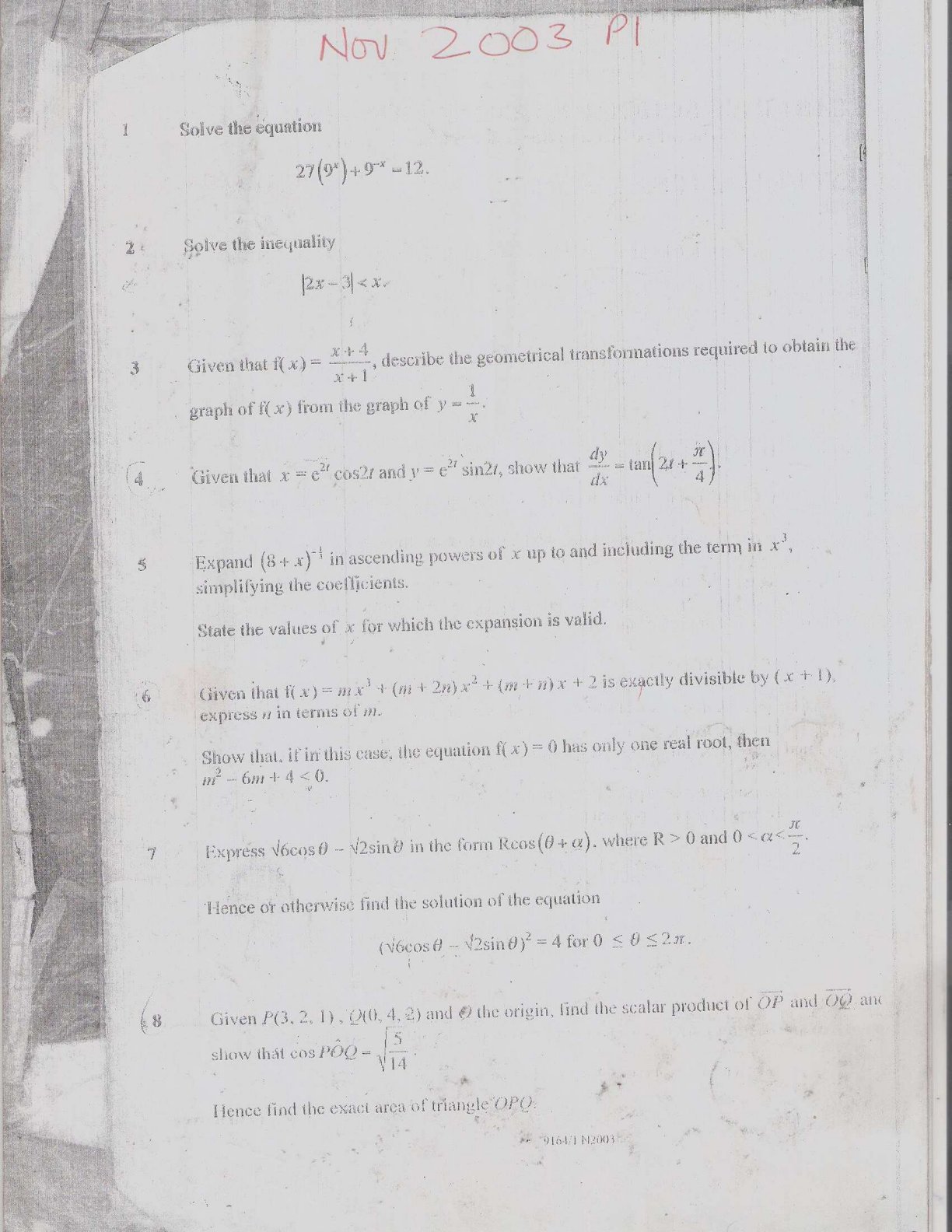
First page of ZIMSEC A-Level Mathematics Paper 1 November 2003 Question Paper

ZIMSEC A-Level Mathematics Paper 1 November 2003 Question Paper

Download and practise with this ZIMSEC A-Level Mathematics Paper 1 November 2003 question paper. Useful for exam revision, past paper practice, and preparation in Zimbabwe.

A free account is needed to download. Sign in or create one

Answers: Mathematics 9164/1 Specimen Marking Scheme 2003

Exam board
ZIMSEC
Subject
Mathematics
Level
A-Level
Document
Question Paper
Paper
Paper 1
Session
November
Year
2003
File
PDF, 1010 KB

About this question paper

This is the ZIMSEC A-Level Mathematics question paper for Paper 1 from November 2003. Use it for exam practice under timed conditions, then check your work against the marking scheme. See the marking scheme.

More Mathematics A-Level 2003 papers

Other years: Mathematics A-Level

Text from the first page

Nov 2003 PI

1 Solve the equation
\[
27\left(9^{x}\right)+9^{-x}-12
\]
2. Solve the inequality
\[
|2 x-3|<x
\]

3 Given that $\mathrm{f}(x)=\frac{x+4}{x+1}$, describe the geometrical transformations required to obtain the graph of $f(x)$ from the graph of $y=\frac{1}{x}$.
4. Given that $x=\mathrm{e}^{2 t} \cos 2 t$ and $y=\mathrm{e}^{2 t} \sin 2 t$, show that $\frac{d y}{d x}=\tan \left(2 t+\frac{\pi}{4}\right)$.

5 Expand $(8+x)^{-\frac{1}{1}}$ in ascending powers of $x$ up to and including the term in $x^{3}$, simplifying the coefficients.
State the values of $x$ for which the expansion is valid.
Given that $\mathrm{f}(x)=m x^{3}+(m+2 n) x^{2}+(m+n) x+2$ is exactly divisible by $(x+1)$, express $n$ in terms of $m$.
Show that if in this case, the equation $\mathrm{f}(x)=0$ has only one real root, then $m^{2}-6 m+4<0$.

7 Express $\sqrt{6} \cos \theta-\sqrt{2} \sin \theta$ in the form $\mathrm{R} \cos (\theta+\alpha)$. where $\mathrm{R}>0$ and $0<\alpha<\frac{\pi}{2}$.
Hence or otherwise find the solution of the equation
\[
(\sqrt{6} \cos \theta-\sqrt{2} \sin \theta)^{2}=4 \text { for } 0 \leq \theta \leq 2 \pi \text {. }
\]
(8) Given $P(3,2,1), Q(0,4,2)$ and ⊗ the origin, lind the scalar product of $\overrightarrow{O P}$ and $\overrightarrow{O Q}$ ane show that $\cos P \hat{O Q}=\sqrt{\frac{5}{14}}$.

Hence find the exact area of triangle $O P Q$.