ExamineAI
First page of Tertiary Islamic Studies Islam and Politics Relations Notes Zimbabwe

Tertiary Islamic Studies Islam and Politics Relations Notes Zimbabwe

Study Islamic Studies notes on Islam and Politics Relations for Tertiary. Useful for revision, homework, and exam preparation in Zimbabwe.

A free account is needed to download. Sign in or create one

Subject
Islamic Studies
Document
Notes
Session
March
Year
2004
File
PDF, 43 KB

About this notes

This is the Islamic Studies notes from March 2004. It is a free notes for revision.

Other years: Islamic Studies

Text from the first page

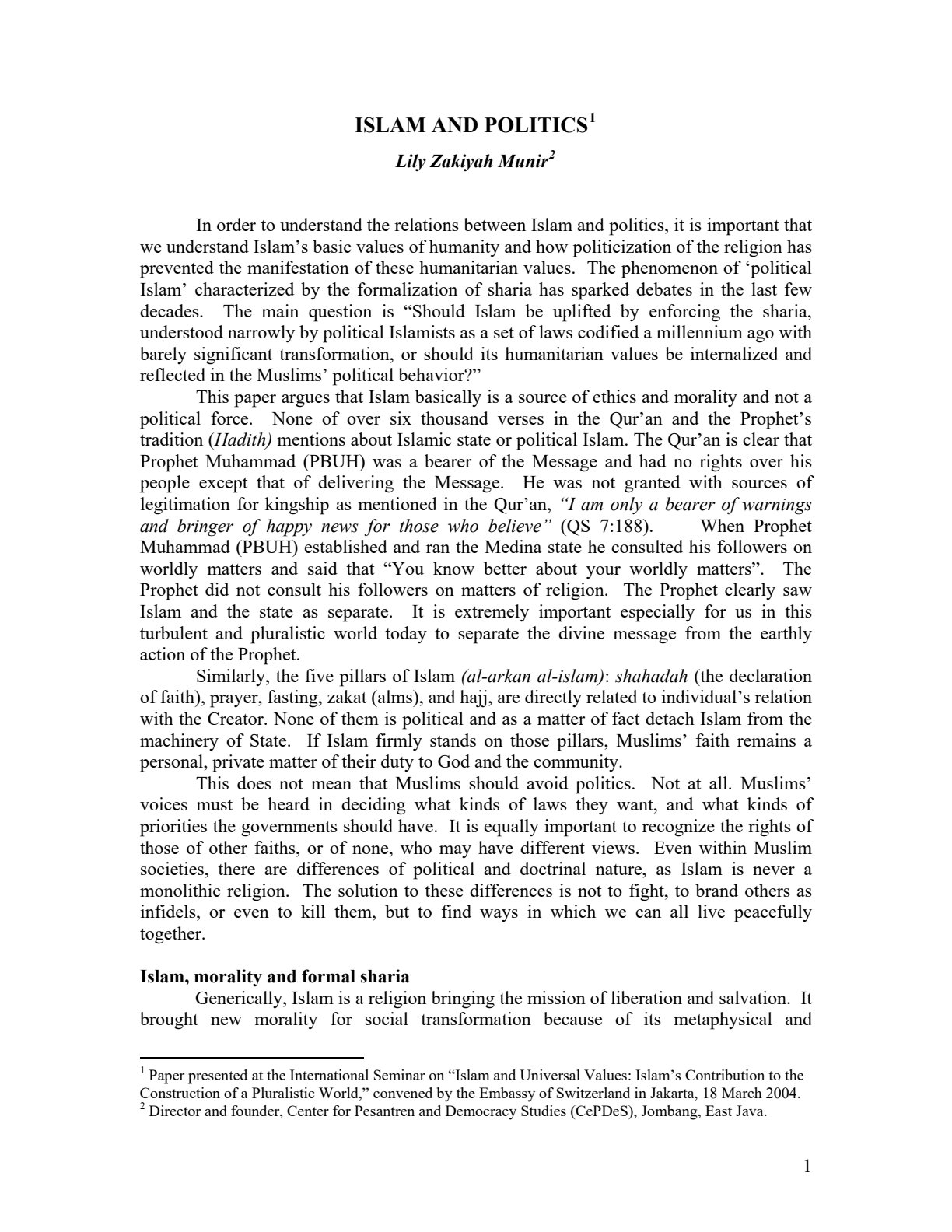
ISLAM AND POLITICS ${ }^{\mathbf{1}}$
Lily Zakiyah Munir ${ }^{2}$

In order to understand the relations between Islam and politics, it is important that we understand Islam's basic values of humanity and how politicization of the religion has prevented the manifestation of these humanitarian values. The phenomenon of 'political Islam' characterized by the formalization of sharia has sparked debates in the last few decades. The main question is "Should Islam be uplifted by enforcing the sharia, understood narrowly by political Islamists as a set of laws codified a millennium ago with barely significant transformation, or should its humanitarian values be internalized and reflected in the Muslims' political behavior?"

This paper argues that Islam basically is a source of ethics and morality and not a political force. None of over six thousand verses in the Qur'an and the Prophet's tradition (Hadith) mentions about Islamic state or political Islam. The Qur'an is clear that Prophet Muhammad (PBUH) was a bearer of the Message and had no rights over his people except that of delivering the Message. He was not granted with sources of legitimation for kingship as mentioned in the Qur'an, "I am only a bearer of warnings and bringer of happy news for those who believe" (QS 7:188). When Prophet Muhammad (PBUH) established and ran the Medina state he consulted his followers on worldly matters and said that "You know better about your worldly matters". The Prophet did not consult his followers on matters of religion. The Prophet clearly saw Islam and the state as separate. It is extremely important especially for us in this turbulent and pluralistic world today to separate the divine message from the earthly action of the Prophet.

Similarly, the five pillars of Islam (al-arkan al-islam): shahadah (the declaration of faith), prayer, fasting, zakat (alms), and hajj, are directly related to individual's relation with the Creator. None of them is political and as a matter of fact detach Islam from the machinery of State. If Islam firmly stands on those pillars, Muslims' faith remains a personal, private matter of their duty to God and the community.

This does not mean that Muslims should avoid politics. Not at all. Muslims' voices must be heard in deciding what kinds of laws they want, and what kinds of priorities the governments should have. It is equally important to recognize the rights of those of other faiths, or of none, who may have different views. Even within …